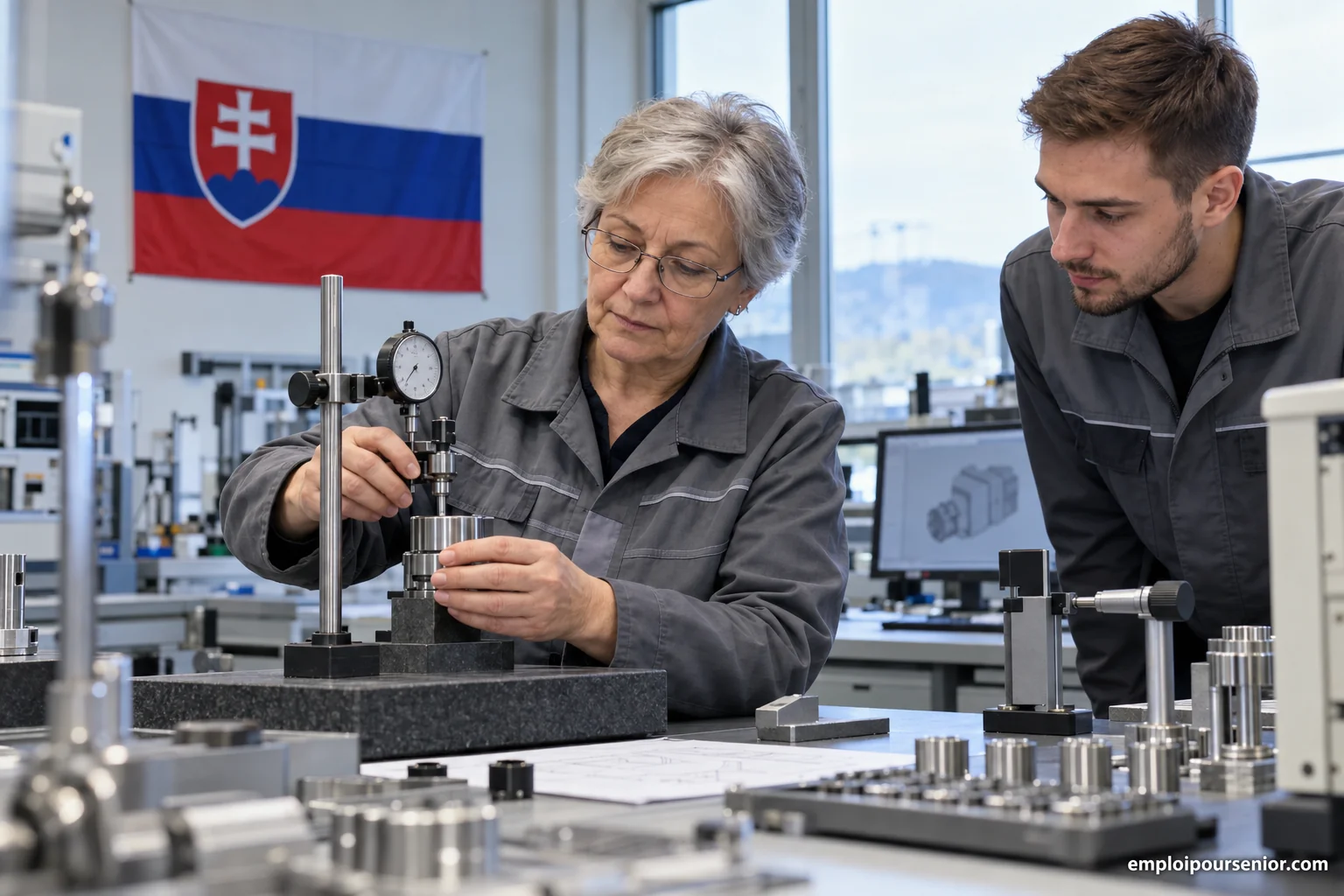
A job market built on industry and services
Slovakia is a fairly small country in central Europe, and its economy leans heavily on industry. Carmaking and its suppliers are very visible, alongside engineering, electronics, logistics and, more recently, shared-service centres set up in the larger cities. Bratislava and Košice hold a good share of the administrative, sales and IT functions.
For someone over 50 this structure has a practical consequence: most vacancies call for technical skills, accuracy and reliability. A quality inspector, a maintenance technician or a stock controller will often find the vocabulary familiar. Office jobs, on the other hand, almost always require a clearly defined working language, usually Slovak or English.
What EU membership changes
Slovakia belongs to the European Union and to the euro area. Citizens of other member states, including the French, Belgians and Luxembourgers, can in principle look for work and take a job without a specific work permit. For nationals of countries outside the EU, other rules apply and each case has to be checked separately.
For a stay of more than three months, a residence registration with the foreign police is generally expected, together with proof of income or employment and health cover. The exact procedure changes from time to time, so it is wise to read the official pages or contact the IOM information centre before you leave.
Pension and work: what to check
The question of combining a pension with earnings arises first of all for people who already draw a French, Belgian or Swiss pension. In the Slovak system the retirement age is tied to life expectancy and capped, and it has been reformed several times, so no precise age should be relied on without a recent check.
- A pension paid by a foreign scheme stays under that scheme's rules: you may have to declare work, there may be an earnings ceiling, and deductions can apply.
- The country where contributions are due depends on where you work and your status, under the EU coordination rules.
- Tax can be shared between two countries, and a tax treaty usually says which one taxes what.
These points are settled with the pension funds concerned and with the tax authorities, not from a general guide.
Language: a deciding factor for many jobs
Slovak is the everyday working language. In workshops, warehouses and public services, safety instructions, job descriptions and exchanges with managers are written in Slovak. A candidate who does not speak it is more naturally steered towards jobs where English, German or French is wanted.
International companies sometimes look for French speakers for customer support, document translation, training or contact with subsidiaries. Such roles exist, but they are occasional and depend a great deal on the city. Even basic Slovak, combined with solid professional skills, makes an application more credible and everyday life easier.
Jobs and assignments where experience counts
Several families of activity suit an experienced profile, provided the candidate can describe exactly what he or she masters.
- Production and inspection: checking dimensions, reading drawings, inspecting a batch before dispatch.
- Maintenance: preventive servicing, fault diagnosis, keeping an intervention log.
- Logistics: order picking, goods-in handling, stock counts.
- Customer service and support: handling cases in French, following up complaints.
- In-house training: passing a skill or a method on to younger colleagues.
A job title alone does not tell you the pace of the work. Two adverts for a production operator can differ in shift patterns (two or three shifts), long periods standing, or heavy handling.
The most common contracts and statuses
The standard employment contract, the pracovná zmluva, covers permanent and fixed-term jobs. Alongside it, Slovak law has occasional work agreements for limited tasks, known as dohody, whose contribution and protection rules differ from those of an ordinary contract.
Some retired people prefer to work for themselves, for instance on a consultancy or training assignment. That requires registration, bookkeeping and specific social contributions. Before signing anything, it is useful to have the duration, weekly hours, probation period, holiday entitlement and sickness cover spelled out. A contract written in Slovak deserves a faithful translation.
Where to look and how to apply
Vacancies appear on Slovak job portals, on the websites of larger employers and through temporary-work and recruitment agencies. The local offices of the public employment service explain vacancies, registration and support measures, as far as these apply to the applicant's situation.
A short, dated, factual CV with concrete achievements is more useful than a long career story. It helps to name the tools, standards or software you have used, to attach translated certificates if the job requires them, and to prepare a version in English or Slovak. A simple cover letter centred on the company's need works better than a generic text.
An example of a realistic project
As an illustration, a 58-year-old former French maintenance technician considers a quality-control post in a factory near Trnava. He finds three vacancies and notes the shift patterns, the language of the instructions and the training offered. He asks in writing whether the company will hold an interview in English and whether an induction period is available.
At the same time he looks into his residence registration, his health cover and the possible effect of Slovak earnings on a future pension. He plans a trial stay of a few weeks before deciding. The example shows a method, not a promise: no vacancy is guaranteed, and every situation is different.
Precautions before committing
A few habits limit unpleasant surprises. No serious recruiter asks for money to offer a job, and an offer that is very generous but vague should raise suspicion. Check too that the employer legally exists, where the workplace really is, and what kind of contract is on offer.
On the health side, shift work, noise or repetitive movements call for an honest assessment of your capacity. Health cover, recognition of qualifications for regulated professions and the cost of housing should all be examined before any move. Finally, a short trial, without giving up your home base, lets you test the pace, the climate and the social life with caution.
Frequently asked questions
Do you need a work permit to work in Slovakia as a French citizen?
In principle no: Slovakia is an EU member and EU citizens can work there without a specific permit. A residence registration is generally required after three months. Because rules can change, confirm them with the Slovak authorities or an official information centre before you leave.
Can you work in Slovakia while receiving a French pension?
Combining the two depends above all on the rules of the scheme that pays the pension, so on the French, Belgian or Swiss fund concerned. Some pensions set no limit, others require a declaration. It is prudent to ask the fund before signing a contract, then to check how both incomes are taxed.
Do you have to speak Slovak to find a job?
Not always, but it is a clear advantage. In industry and public services, instructions are in Slovak. Jobs open without it generally ask for English, German or French, for example in customer support or training. Basic lessons also make daily administration much easier.
Which sectors recruit experienced people?
The car industry and its suppliers, engineering, logistics, service centres and retail employ varied profiles. The need often concerns quality, maintenance, team supervision or training. Vacancies change with the region and the economic climate, and no recruitment is ever assured.
Which contract is the most common?
The ordinary employment contract, fixed-term or permanent, remains the reference. The occasional agreements called dohody are used for limited tasks, with different social protection. Before accepting, ask for working hours, duration, holidays and the contributions deducted to be set out clearly.
How can you tell whether a job offer is genuine?
Check that the company exists, its address and contact details, and that the job described makes sense. A request for payment, hiring without an interview or a very high salary with no detail are warning signs. Authorised agencies and public employment services help you cross-check the information.