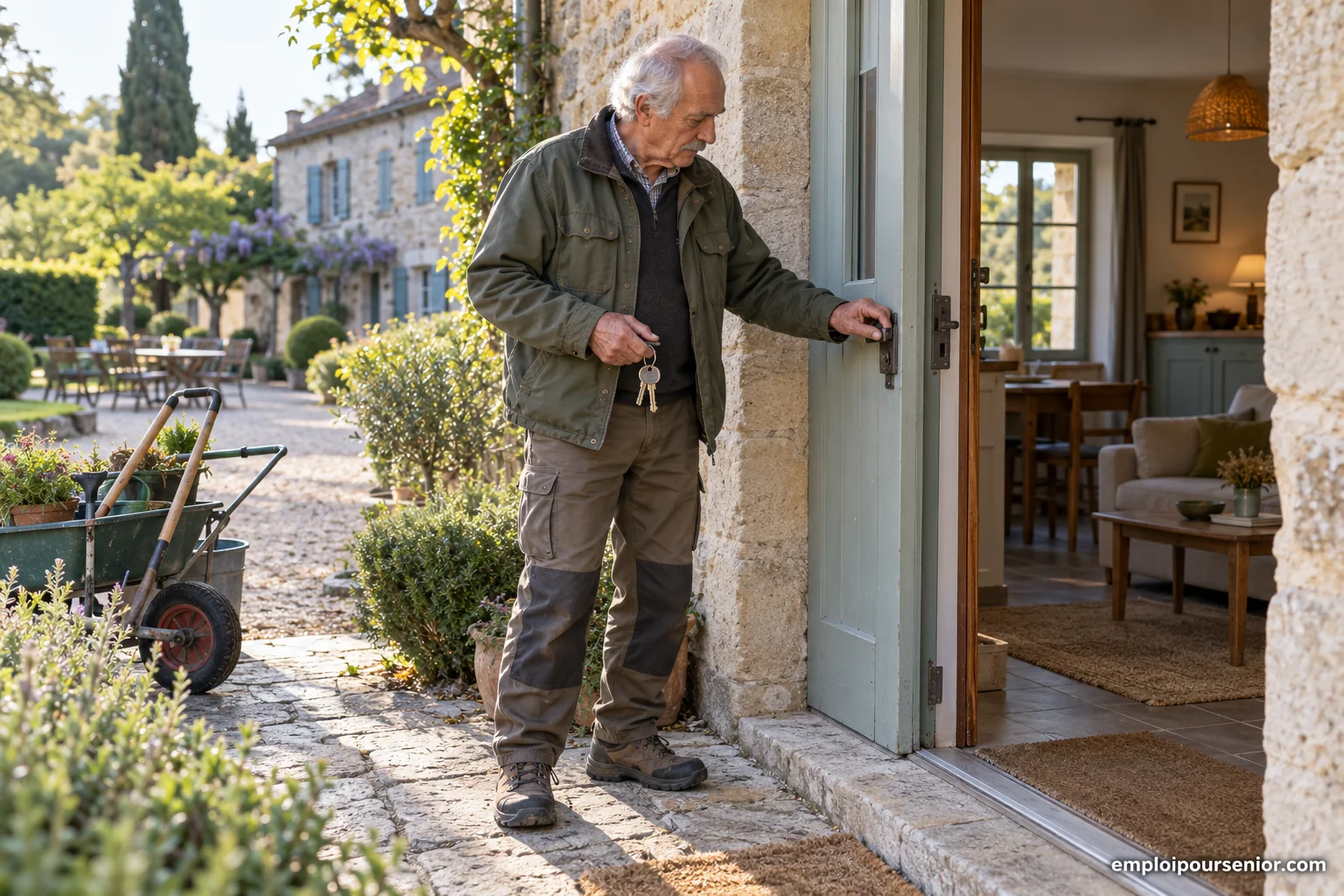
What a job with accommodation really means
A live-in job is an employment contract under which the employer also provides somewhere to live, either for the whole length of the contract or only during the working periods. The accommodation may be a room in an establishment, a studio, an outbuilding on an estate or a caretaker's lodge.
The sectors involved are varied: looking after properties or residential blocks, guesthouses, hotels, campsites, holiday centres, care homes and farms. In some cases meals are provided as well, and several holiday-village groups advertise posts that are "housed and fed".
The accommodation is part of the working arrangement. It is therefore not an ordinary tenancy, and the rules that apply to it depend on the contract.
Jobs that most often come with a home
A handful of roles come up again and again in advertisements.
- Property caretaker or estate manager: security, routine maintenance, gardening and receiving contractors. Some owners look for a couple, with one person looking after the house and the other the grounds.
- Building or residence caretaker: handling post, keeping communal areas clean and dealing with residents.
- Hotel or holiday-village employee: reception, serving, room cleaning, entertainment and maintenance.
- Seasonal or permanent farm worker, sometimes housed on the holding.
- Campsite or leisure-centre warden.
Having a home tells you nothing about how demanding the job is. Looking after a rarely used house is not the same as working in a holiday village at the height of the season.
Who this arrangement can suit
The formula can appeal to an older worker who wants to move to another region, who has left a home that had become too expensive or too large, or who is looking for a full season without accommodation costs. For a couple it can be a practical solution, provided both partners are accepted for the post.
It suits less well anyone who wants to keep a clear line between work and private life. Living at the workplace means you may be called on at unusual hours, and a disagreement with the employer affects both your job and your roof.
It is worth asking yourself whether you are comfortable with that balance, taking into account your health, your family and your habits.
Accommodation as a benefit in kind: what it means
In France, when an employer houses an employee, the accommodation is generally treated as a benefit in kind. It is given a value and added to the salary when social contributions, the CSG and the CRDS are calculated, unless special provisions apply. In practice, the payslip may show a housing value added to gross pay and then deducted from the net amount paid.
This means that housing carries a cost in the calculation of contributions even if you are not charged for it. The exact arrangements depend on the contract, the collective agreement and each person's situation.
If in doubt, ask the employer, the social security contributions body (Urssaf) or a public information service on employment law before signing.
Points to have clarified before committing
An advertisement that mentions accommodation should be read as a complete offer. Ask for the following in writing.
- The exact nature of the housing: floor area, fittings, heating, access, floor level, distance from shops.
- The running costs: water, electricity, heating, internet and any local housing tax.
- Whether a partner, a pet or visitors are allowed.
- Working hours, days off and on-call duties, and how the latter are compensated.
- The length of the contract and what happens to the accommodation at the end, or if you resign or the contract is terminated.
- The conditions for leaving and the time allowed to vacate the premises.
A visit in person, with photographs, lets you check the real condition of the accommodation and how easy it is to reach.
On-call duty, hours and rest time
Living on site easily blurs the line between being available and working. On-call duty is a period during which the employee must stay reachable in order to step in if needed, without working continuously. It is not the same as hours actually worked, and it has its own compensation rules, which vary between collective agreements.
To avoid misunderstandings, ask who covers your days off, how night-time call-outs are counted and what happens if you are off sick. A clear contract on these subjects protects both sides.
If the role requires someone to be present at all times, this should appear in the advertisement and in the contract, rather than being discovered after you have moved in.
Health, mobility and everyday comfort
Before moving, take a realistic look at the place. Isolated accommodation can mean long journeys for medical care, shopping or administrative appointments. Stairs, the distance between the home and the workplace, the state of the heating and the quality of the insulation all affect comfort, especially in winter.
The physical tasks should also match your abilities: lifting, outdoor maintenance, long periods on your feet. It is better to turn down a job that is too demanding than to risk an injury or a quick end to the contract, which would force you to leave the housing as well.
Finally, think about social isolation. Living on site, far from family, means keeping in touch by other means.
How to find this kind of vacancy
Live-in vacancies are scattered. You can find them on general job sites by searching for words such as "housed", "caretaker", "couple" or "tied accommodation", on the recruitment pages of holiday-village and hotel groups, and among the offers of agencies placing domestic staff.
Tourist offices, property management firms, wine estates and farms also pass on local needs. An unsolicited application, with a short CV and a letter stating your dates of availability, can open doors before the high season.
Be wary of offers that ask for payment in advance, an unusual deposit or a bank transfer before you have met anyone.
Example of a retired couple taking a caretaker post
As an illustration, consider a retired couple who answer an advertisement for a country property. The owner wants a continuous presence, upkeep of the grounds and someone to watch the house during absences.
Before committing, the couple ask in writing for a description of the accommodation, the hours, the days off, how the tasks are divided between the two partners and the length of the contract. They visit the site, check access to shops, and then contact their pension fund to find out how the income from the post fits with their pensions.
The example is not universal. Every offer has to be studied on its own terms.
Retirement, income and the security of the contract
If you draw a pension, going back to work falls under the French rules on combining employment and retirement. Depending on your age, contribution record and the nature of your pensions, the combination can be total or capped. These rules change, so check with your pension fund before signing.
Bear in mind too that losing the job usually means losing the home. Plan a fallback, such as staying with a relative or a budget for temporary accommodation, and keep your main residence or a stable address if you can.
Frequently asked questions
Is the accommodation free for the employee?
Not always. It may be provided free of charge, but it is then generally treated as a benefit in kind and valued when contributions are calculated. In other cases an amount is deducted from the salary. The terms should appear in the contract or an annex, together with details of the running costs.
Can I be housed with my partner or my pet?
That depends on the employer and the accommodation. Some offers expressly look for a couple, while others limit housing to one person. For a pet, the employer's agreement is needed. Have this confirmed in writing before you move, to avoid an unpleasant surprise on arrival.
What happens to the accommodation if the contract ends?
Because the housing is tied to the job, it generally has to be vacated when the contract ends, within a period set by the contract or the applicable agreement. The arrangements vary with the situation, particularly in cases of termination or illness. Ask about this period before signing and arrange somewhere to stay as a fallback.
Is on-call duty paid like working hours?
No, not in the same way. On-call duty is a waiting period during which the employee must be ready to step in. It is compensated as set out in the applicable agreement, while the call-out itself counts as working time. The details are in the contract and the collective agreement.
Can a retiree take a post with accommodation?
Yes, within the French rules on combining work and a pension, provided the pension fund's requirements are met. The post may be seasonal or long-term. Before committing, it is wise to ask the fund to confirm how earnings and pension fit together in your own situation.
How can I avoid suspicious advertisements?
Check that the employer exists, ask for a written contract and visit the accommodation before you move. Refuse any request for money before signing, whether a deposit, an administration fee or a transfer. If in doubt, call the establishment directly on a number found independently of the advertisement.