A safety role built on calm, reassuring presence
A school transport escort is the adult who travels on a coach or minibus to look after the children during the journey. The escort does not drive: the driver alone is responsible for the vehicle and the road. The escort looks after the passengers.
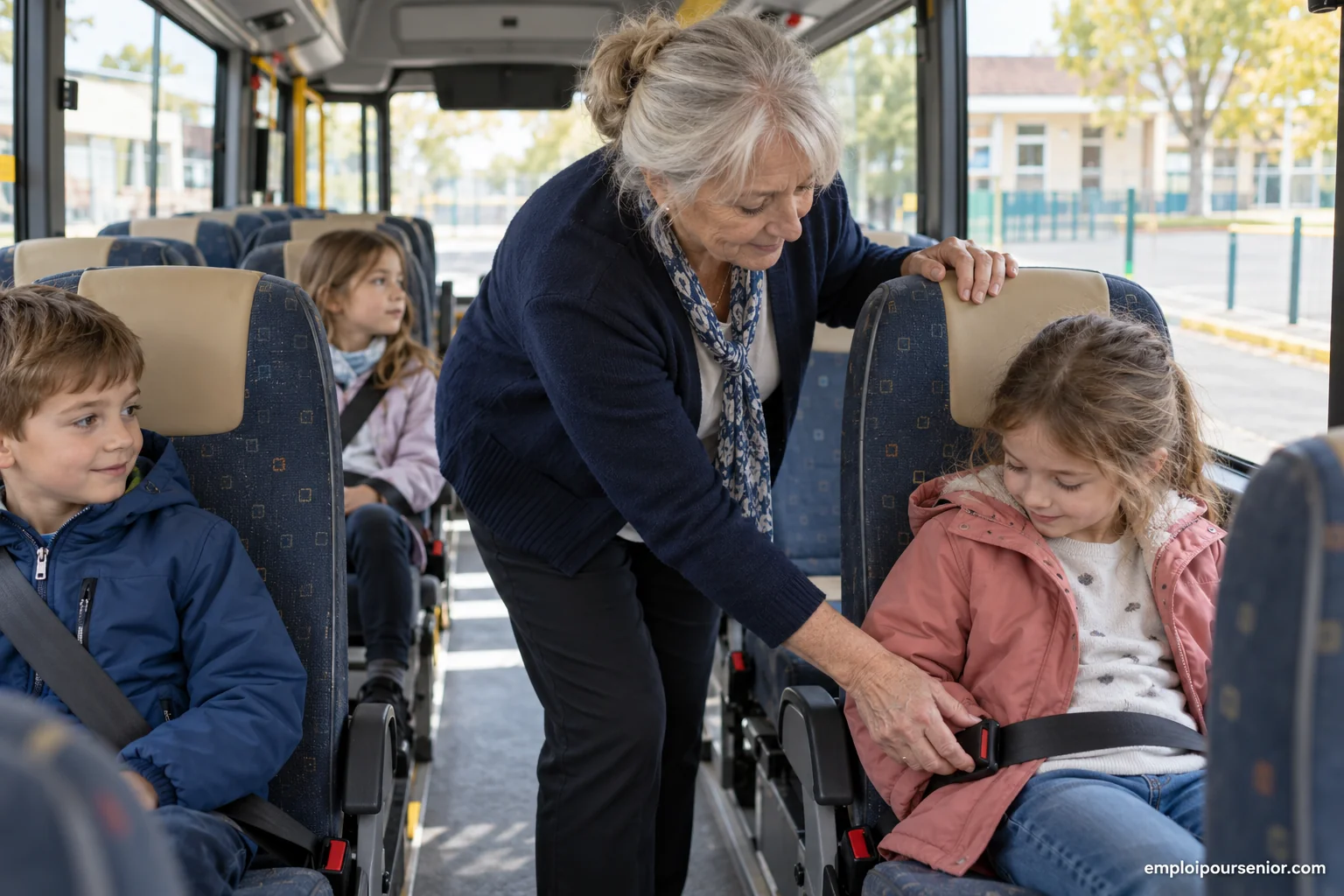
In practice that means helping the youngest children to climb aboard and settle, checking that seat belts are fastened, keeping an eye on the general atmosphere and making sure every child gets off at the right stop. For nursery-age pupils the escort may also walk them to the school gate or hand them over to the adult waiting there.
The detail varies a great deal from one area to the next. In some French towns and groups of municipalities the escorts are employed directly by the local authority; elsewhere the service is contracted out to a coach company. Whatever the set-up, the written instructions of the transport organiser are what count.
Why the work can suit someone over 50
The post asks for neither physical performance nor speed. It rewards qualities that age and experience often strengthen: quiet authority, patience, and the knack of comforting a tearful child or defusing a squabble without raising your voice.
Former teachers, childminders, youth workers, care assistants and very involved parents or grandparents will recognise many of the gestures. But a career with no link to children can work just as well, provided you are reliable, punctual and at ease with young people.
- A sharp eye, to notice a child who is missing, worried or struggling.
- A steady manner, neither over-familiar nor needlessly strict.
- A good memory for names, stops and instructions.
- Comfort with short exchanges with parents, the driver and school staff.
A typical day follows the school timetable
The work is concentrated in two windows: early morning, before classes open, and late afternoon, after they finish. On some routes escorts also cover a lunchtime run or the Wednesday service, which in many French schools has different hours. Between the two main runs there are often several free hours.
That split day can be a real advantage if you want time for family, hobbies or another small activity. It can also be a nuisance if you live far from the vehicle depot or if the unpaid journeys to and from the start point are long.
The job follows the school calendar: no service during the summer break and very little during other holidays. The number of hours is therefore limited and, in most cases, does not add up to a full-time post.
Status, contract and how pay works
Depending on the employer, an escort may be a contract worker for a local authority or an employee of a coach operator. Fixed-term contracts lasting the school year are common, as are part-time hours of a few hours a day. The exact terms are in the job advert and the contract, so read both carefully.
Pay is normally an hourly rate applied to the hours actually scheduled. Because the volume is modest, it works as a top-up income rather than a full salary. No figure can be promised here: it depends on the employer, on how much travel time is counted and on the collective agreement that applies.
If you are already retired, check how earnings from work interact with your pension before you sign. In France the rules differ between pension schemes and personal situations, so do not assume anything until you have a clear answer, ideally in writing, from your pension fund.
Getting started, step by step
There is no single route in, but a simple sequence keeps you from scattering your efforts.
- Identify employers near home: the town hall, the local group of municipalities, the department or region's transport service, and passenger coach companies.
- Ask about current needs and about cover for absent staff, which is often a good way in.
- Prepare a short CV that highlights any experience with children, even voluntary, and your reliability.
- Supply the documents requested, usually including a criminal record extract, because work involving minors is subject to checks.
- Ask for a proper induction: a trial run without pupils, an introduction to the driver and a reminder of evacuation procedures and on-board equipment.
A formal qualification is generally not required, but some employers expect previous experience or a short course. It is better to ask at the very first contact.
What the role covers, and where it stops
An escort is neither a specialist educator nor a carer. The role is tightly framed: you watch, you help, you raise the alarm. You do not punish pupils yourself or take serious disciplinary decisions; if a child keeps misbehaving, you report it to the transport organiser, who decides what follows.
Handing children over is a delicate moment. The youngest are released only to an authorised adult who is known to the service. If nobody is at the stop, the organiser's procedure applies: the escort does not improvise but follows the written instruction and informs the right people.
Good reflexes for an incident such as a breakdown, a faint or an accident are explained at the start: where the emergency exits, first-aid kit and fire extinguisher are, and how to alert the emergency services. Ask to go over them again from time to time.
Transporting pupils with disabilities: a more demanding variant
Some rounds carry pupils with disabilities in adapted vehicles. The escort's role is closer and more hands-on: settling the child with the equipment provided, understanding how they communicate, and offering reassurance without talking down to them.
These assignments need specific preparation and often a conversation with the family and the school or care centre. It is entirely reasonable to ask for a clear explanation of what you may and may not do, of any medical instructions and of who to call if something goes wrong.
This variant suits patient people who accept a slower pace and the occasional moving situation. It also means being comfortable with supervised physical contact, such as helping a child into a harness or seat.
Health, tiredness and day-to-day comfort
Although the physical effort is limited, a few points deserve attention. Climbing on and off the vehicle several times, standing as the coach brakes, bending to fasten a belt or carrying a schoolbag all put some load on the back and knees.
Sustained vigilance is tiring too, especially in rain, in the gloom of winter mornings or with restless children. Good shoes, a high-visibility jacket and a genuine break between runs help you keep going over a whole year.
If you have a health condition, talk to your doctor before committing and choose a route that suits you, rather than discovering your limits halfway through the school year.
A worked example of a week, for illustration only
Imagine a retired person who escorts a country route serving two villages and a primary school. She starts early, helps the little ones aboard, keeps the list of stops and hands the children over at the gate before the bell.
In the afternoon she does the same route in reverse. Between the two runs she goes home, tends her garden and helps run a local club. On Wednesdays she has no service.
The arrangement leaves her a lot of free time but demands strict regularity: she warned her employer about medical appointments well in advance and agreed on a stand-in. Every case is different, and it is the job description that sets out the real conditions.
Alternatives and neighbouring jobs
If riding the coach does not appeal, other school-related jobs offer a similar kind of presence: crossing patrol outside a school, lunchtime supervision, after-school activity leading, classroom support for pupils with disabilities, or school caretaking.
Each has its own hours, possible qualifications and employment framework. The school transport escort has the advantage of a very focused commitment and little preparation; on the other hand it offers few prospects of quick progression, which is worth knowing before you count on it.
Frequently asked questions
Do I need a qualification to look after children on a school coach?
Generally no specific qualification is required for this role, though it depends on the organiser and on the children being carried. Experience with children, even as a volunteer, is valued. For pupils with disabilities some preparation may be requested. It is sensible to ask the employer at the first conversation.
Can I work as a school coach escort if I am already retired?
In principle nothing prevents you from taking up work again, but the rules on combining a pension with earnings vary between pension schemes and personal circumstances. Before signing a contract, ask your pension fund what the consequences will be, preferably in writing, so there are no surprises about your pension.
Is the job full-time?
Usually not. The work is concentrated on the morning run and the late-afternoon run, following the school calendar, so it amounts to a few hours a day and stops during the holidays. It suits someone wanting extra income or a regular activity, but rarely works as a main source of income.
Can an escort punish a badly behaved child?
The role is mainly to prevent problems and remind children of the rules, not to punish. If behaviour is repeatedly disruptive or dangerous, the escort reports it to the transport organiser, who alone decides on a warning or a firmer measure. Ask for precise instructions before you start.
What happens if no parent is at the stop?
The escort never leaves a young child alone. The organiser's procedure is applied, which usually means keeping the child on board and then handing them to a designated place or service while the family is contacted. Ask for this instruction in writing before your first run.
How do I find a vacancy near me?
Start with the town hall, the local group of municipalities and the transport service of your department or region, then local passenger coach firms. Public-sector job portals and transport recruitment sites also post adverts, but no hiring is ever guaranteed.