A job market where experience can count, with no guarantees
Work in Chile is concentrated around Santiago, Valparaíso and Concepción, and the type of activity differs sharply from region to region: fruit and agriculture in the central valley, mining in the north, tourism in the Lake District and Patagonia. Candidates over 50 tend to find openings in roles where experience matters most, such as team supervision, quality control, logistics, customer relations and in-house training.
That does not make hiring easy. Some job advertisements are still aimed at younger people, and competition varies a great deal from one city to the next. It is usually more realistic to aim for a handful of specific occupations in one chosen area than to apply everywhere at once.
This guide is general in scope. It is no substitute for advice from a local adviser or for reading the official texts, and it promises neither a job nor an income.
Pensions and paid work: questions to ask before accepting a job
Chile's pension system rests mainly on individual savings accounts run by the AFPs (pension fund administrators), topped up by means-tested public support. The usual retirement ages are 65 for men and 60 for women, but nobody is obliged to stop working at that point, and some pensioners do return to employment.
Several points depend on precise rules, so ask for confirmation of each of them:
- how earnings affect a pension already being paid, or a public benefit such as the universal pension;
- the health and social contributions payable by an employee who is already a pensioner;
- how the work has to be declared if it is done on a self-employed basis;
- the position of a member who also receives a pension from another country.
The AFP, the Superintendencia de Pensiones and public information desks are the usual contacts. Keeping any written answer on file will spare you many misunderstandings later.
The main ways to find vacancies
Three families of channels complement one another, and it pays to use at least two of them.
- The public employment service. The Bolsa Nacional de Empleo gathers job adverts and guidance services, while the OMIL, the municipal labour information offices, support residents of each commune. Local job fairs are also announced through these channels.
- Private job boards. Several general sites list thousands of vacancies. One of them has a section for people over 50, featuring employers who say they value experienced candidates, plus online guidance for revising a CV.
- Your own network. In Chile as elsewhere, former colleagues, professional associations, chambers of commerce and expatriate communities often lead to useful contacts.
For every advert, note the exact town, the type of contract and the working hours before you reply: the job title alone says very little.
Putting together a credible application in Spanish
Working Spanish is in practice essential for most positions. Conversational ability rarely suffices when you have to write an email, understand a contract or handle an interview. A candidate whose first language is French, English or German can build up trade vocabulary before applying and prepare specific examples in the language of the interview.
A Chilean CV is generally short: contact details, recent experience, education, skills and sometimes references. A few practical tips:
- Lead with the achievements closest to the job you want rather than a full chronology.
- Give examples of safety, organisation or passing on know-how, which recruiters understand well.
- State plainly where you are able to work and which hours you will accept.
- Offer references who can be reached, and a local contact if possible.
Sensitive personal details need not appear beyond what is actually requested.
Sectors and tasks that older workers meet most often
Depending on the region and the season, a range of tasks may be open to you. These are ideas to explore, not existing vacancies.
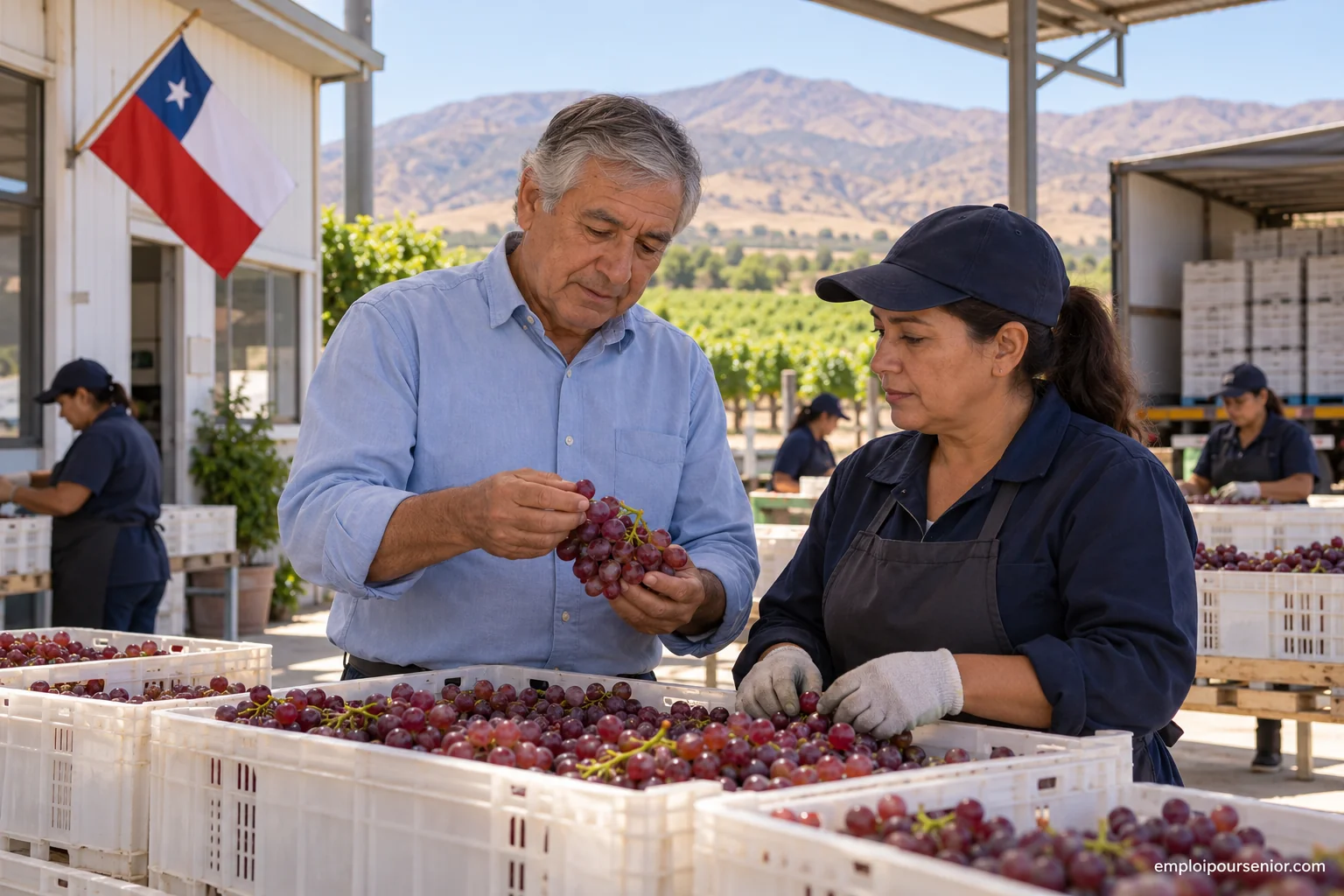
- Agriculture and food processing: quality checks, supervising seasonal staff, sorting and packing, especially during the fruit harvest.
- Retail and services: advising customers in shops, reception, till work, security or concierge duties.
- Tourism and hospitality: front desk work or guiding visitors, particularly in tourist areas where a foreign language is appreciated.
- Teaching and training: language lessons, tutoring, training colleagues, often in private schools or institutes.
- Independent consulting: auditing, organisation or accounting, drawing on an established career.
For each assignment, check how physically demanding it is, how much travel it involves, and what the altitude and climate are like, which vary enormously across the country.
Contracts, hours and status: read before you sign
Employment rests on a work contract governed by the Código del Trabajo. You will come across permanent contracts, fixed-term contracts or contracts tied to a specific task, as well as services invoiced by self-employed people. These forms do not carry the same protections or the same obligations.
Before accepting, it is sensible to check:
- the real place of work and the travel time involved;
- the length of the contract and any trial period;
- the weekly pattern and any weekend on-call duty;
- how pay is delivered and declared;
- the contributions deducted and the health cover that goes with them.
Seasonal jobs call for particular care: income that stops for several months does not meet the same needs as a stable post. If a clause is unclear, a local adviser or a trade union can help make sense of the text.
Certifying your know-how and retraining
Someone who learned a trade on the job may have no local qualification to show. Chile has a national system for certifying work skills, run by ChileValora, which describes occupational profiles and allows people to have their abilities assessed. Such a certificate can help put a value on experience, though it does not guarantee a job offer.
The national training service, SENCE, also offers courses, training programmes and online guidance, with access conditions that vary by profile and by year. Comparing your usual tasks with the existing occupational profiles is a good preparatory exercise: it helps you choose the words for a CV, spot a gap and decide whether a refresher course is worth the effort.
For each programme, check the length, any cost, the location and whether the qualification is recognised.
Coming from abroad: the right to work is a separate question
Receiving a French, Belgian or Swiss pension and wanting to work in Chile involve two different files. The first concerns the pension fund: some continue to pay a pension abroad, subject to proof-of-life formalities. The second concerns residence: the type of visa or residence permit decides whether paid work is allowed.
These authorisations change over time, and the conditions depend on nationality and on the category of stay. The relevant Chilean consulate, the Chilean migration service and, where appropriate, a local lawyer are the people to settle the matter. It is unwise to start work on the strength of an employer's verbal promise before you hold written confirmation.
Also plan for health cover, taxation between the two countries and possible recognition of your qualifications, all of which can change the financial balance of the project.
A sample three-month plan
As an illustration, here is how a 58-year-old former logistics manager living near Valparaíso might organise a search. The example does not predict any result.
- Month one: update a CV in Spanish, compare his tasks with the ChileValora profiles and visit the OMIL in his commune.
- Month two: targeted applications to warehouses and exporters in the region, plus an online guidance session to review his file.
- Month three: interviews, a written request for details about the contract and contributions, and then a decision taken with full knowledge of the facts.
A timetable like this leaves room to check every condition without rushing into a commitment.
Frequently asked questions
Can a retired person work in Chile?
As a general rule, retirement does not forbid working, but the effects on the pension, on contributions and on health cover depend on each person's situation. An employed pensioner and a self-employed one do not have the same obligations. Ask the AFP or the competent public bodies for written confirmation before signing a contract.
Where can I find vacancies suited to people over 50?
Adverts appear on the Bolsa Nacional de Empleo, at the municipal OMIL offices and on private portals, some of which have a section for the over-50s. A professional network is also very useful. Compare several sources and check each advert before you apply.
Is Spanish essential?
For the great majority of jobs, yes. Contracts, interviews and safety instructions are all in Spanish. A few tourism or teaching roles value other languages, but they are scarce and do not remove the need to understand what you sign. Learning the vocabulary of your own trade is a reasonable investment.
What is the ChileValora certification for?
It lets you have a skill gained through experience officially recognised against a defined occupational profile. It can strengthen an application, open the way to certain training courses or make talks with an employer easier. It guarantees neither a job nor a right to work for a foreigner.
Is a retired foreigner allowed to do paid work?
That depends on the residence permit and the nationality. Living in Chile legally is not always enough to be allowed to work. The Chilean consulate or the migration service can tell you which procedure applies. It is best to have that answer in writing before starting any activity.
How can I avoid unpleasant surprises with a seasonal contract?
Ask in writing for the exact workplace, the start and end dates, the hours, the amount and date of payment, and the contributions deducted. Weigh the offer against the cost of housing and travel. If in doubt, speak to a municipal office or a trade union before signing.