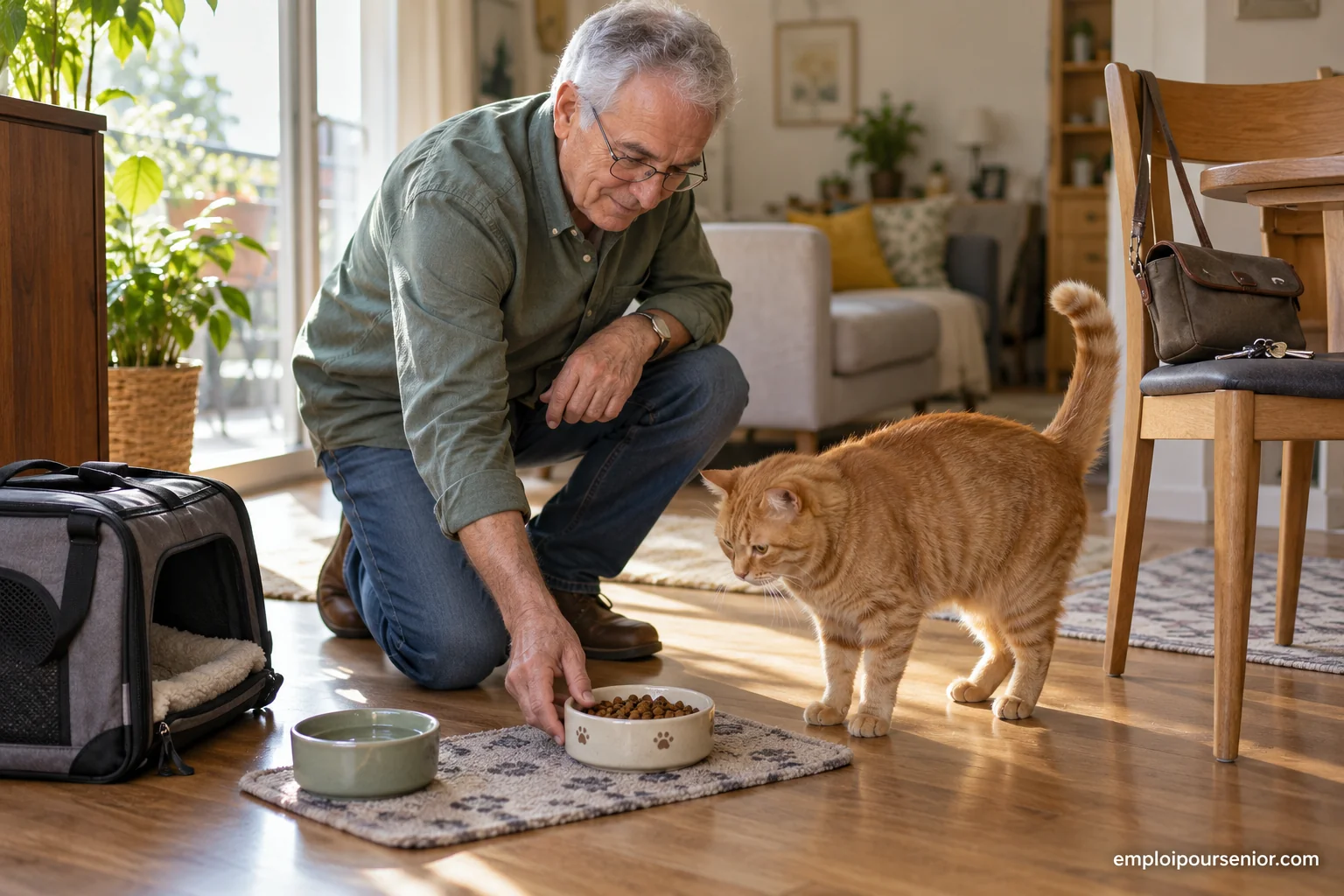
What the pet sitter's job covers
A pet sitter looks after companion animals while their owners are away: on holiday, in hospital, or during long working days. They can travel to the client's home or take the animal into their own. The animals concerned are mostly dogs and cats, sometimes rodents, birds or aquarium fish.
The daily routine comes down to a few precise tasks: serving meals, changing the water, cleaning the litter tray or bowl, walking the dog, and giving medication when the vet has prescribed it and the owner has asked. Alongside this comes a less visible but essential part: company, play, cuddles, and news sent to the owner to reassure them.
It is a service activity, not the post of an animal keeper or a vet. A pet sitter makes no diagnosis and never replaces an animal health professional.
Why the activity appeals to retirees
Several reasons come up often. The work can be done at your own pace, in bursts, which suits anyone who does not want a full-time job. It gives you a reason to get outside every day, especially if you walk dogs. It also values qualities that age tends to develop: patience, reliability, availability during the day, a sense of punctuality.
Owners are indeed sensitive to the regularity and calm of a steady person, above all when entrusting an elderly or nervous animal. Long personal experience with dogs or cats is a concrete advantage, as long as you can describe it simply: which breeds, which temperaments, which situations you have already handled.
The three formats: visits, walks and boarding
The home visit
Once or twice a day, the pet sitter drops in at the client's home to feed the animal, change the litter and spend a little time with it. It is the simplest format to organise, because it needs neither space nor any special set-up. It suits cats well, as they are more at ease in their usual surroundings.
The walk
Taking the dog out during the day, sometimes in a small group. It calls for good physical condition, suitable equipment and control of the animal on a lead, even when it pulls or reacts to other dogs.
Boarding at your own home
The dog or cat stays at the pet sitter's home for a few days or weeks. This format needs suitable accommodation, a garden or easy access to the outdoors, possibly the agreement of the landlord or the building's owners, and serious thought about living alongside your own animals. It also brings the activity into a stricter regulatory framework.
Professional framework: status, training and insurance
As soon as pet care is paid on a regular basis, it becomes a professional activity. In France, according to the practical sheet from Adie, it generally requires declaring the activity, often under the micro-entrepreneur scheme, through the one-stop formalities portal, together with proof of knowledge: either a professional certification or the certificate of knowledge for domestic companion animals, better known by its acronym ACACED.
The page from the regional agriculture directorate points out that the training requirement applies in particular to the transit or care of animals on a professional basis. The exact scope for pet sitting in the client's home or for simple walking may vary, so it is wise to ask the departmental directorate in charge of population protection, or the regional agriculture directorate, before starting. These are French rules; elsewhere, the licensing and registration requirements are different.
Professional liability insurance is strongly recommended, and often required depending on the type of care. It covers damage the animal in your care might cause to third parties or property. Platforms sometimes provide cover during stays booked through them, but you need to read the terms to know what is covered.
Finally, a retiree must check how the activity fits with their pension: combining work and a pension follows rules that depend on each person's situation, to be confirmed with the pension fund.
How to get known and find bookings
Several routes coexist and are often combined. Specialist platforms put owners and sitters in touch: registration is sometimes free, with the platform earning its money in other ways, and some include insurance during stays booked through them. They require a detailed profile, with photos, a description of your home and experience, and a review system that gradually builds a sitter's reputation.
Neighbourhood word of mouth remains very effective: neighbours, the local vet, pet-shop owners, your apartment block. A neat notice and a few references from people who agree to be contacted reassure more than a long advertisement.
At the start, it is wise to accept only a few jobs, do them well and ask the client for a written review. The first testimonials build trust much faster than any presentation.
Income: a price-per-service logic
Income depends on the number of stays, their length, the type of format and the area. Sitters generally set their own rates on platforms, taking local competition into account. No amount is guaranteed: the activity is seasonal, with peaks around school holidays and long weekends, and quieter periods the rest of the year.
Costs linked to the activity must be deducted from turnover: self-employed social contributions, insurance, any platform commission, travel, equipment and training. A simple notebook listing each service, its date and the amount received makes the periodic declaration easier.
It is wise to treat this activity as a top-up rather than as a stable income, especially in the first months, while you build a loyal clientele.
Health, fitness and personal limits
Looking after an animal involves your body. Walking a large dog takes strength in the arms and good balance, because a sudden pull can bring you down. Bending to clean a litter tray, climbing stairs several times a day or carrying sacks of food all put strain on the back and knees.
A few commonsense rules reduce the risks: refuse dogs whose size or temperament goes beyond your abilities, choose times outside the heat of the day, wear stable shoes, carry gloves and pick-up bags, and make sure your tetanus vaccination is up to date. Bites and scratches must be treated without delay.
On the emotional side, you also need to be able to cope with an animal that refuses to eat, falls ill or, in the hardest cases, dies during the stay. Having the owner's vet's number and a written emergency procedure ready beforehand is part of the preparation.
Preparing a stay smoothly: information sheet, agreement and first meeting
Before any job, a preliminary meeting with the owner and the animal avoids many disappointments. It lets you watch the dog's or cat's behaviour, spot its habits and ask the useful questions:
- the animal's age, health, treatments and allergies;
- meal times, quantities and outings;
- the vet's details and a person to contact in an emergency;
- access to the home, keys, alarm and house rules;
- the no-go areas: sofa, garden, meeting other dogs.
A written document sums up the dates, services, price, cancellation terms and the authorisation to consult a vet if necessary. Platforms often provide a template; otherwise a quote signed by both parties does the same job.
During the stay, a daily message with a photo reassures the owner and serves as a record that the job is going well.
A sample week to picture the activity
By way of illustration, imagine a retired person who devotes a few half-days a week to this activity. In the morning she calls on one client to feed two cats and clean the litter trays, then walks a small dog at midday. At the weekend she takes in a dog for two nights while its owners are away.
This example indicates neither an income nor a guaranteed volume: it simply shows that a typical week is made up of short visits, walks and an occasional boarding stay, with a lot of small journeys to organise.
Everyone adapts the rhythm to their health, home, region and wishes. The first weeks serve mainly to test what you enjoy and what you turn down.
Alternatives and other ways to be around animals
If professional status seems too constraining, other options exist. Volunteering at a shelter or an animal-welfare association lets you stay in touch with animals without any commercial stakes. Fostering an animal temporarily at the request of an association also gives hands-on experience.
Salaried posts exist as well in pet shops, boarding kennels, veterinary clinics or home-help services that include walking a dog as part of caring for an older person. These jobs have their own demands and do not always fit the hours you want.
Lastly, some people prefer to stay at the edge of the service, helping neighbours without payment, in order to keep a social link. In that case the professional framework does not apply, but caution remains advisable regarding liability in the event of an accident.
Frequently asked questions
Do I need a qualification to look after animals professionally?
For professional pet care, proof of knowledge is generally requested in France: a professional certification or the ACACED certificate, according to the sheets published by Adie and the agriculture services. The exact scope varies with the format chosen, client's home or boarding at your own place. Check with your regional or departmental authority.
Can I combine pet sitting with a retirement pension?
Taking up an activity as a retiree is possible, but the rules on combining work and a pension depend on age, contribution record and retirement date. They also change over time. Before starting, ask your pension fund, which will explain the conditions that apply to your situation, and declare the activity as required.
Is insurance compulsory?
For a professional activity, professional liability insurance is presented as compulsory by Adie. Some platforms include cover during stays booked through them, but it does not necessarily cover everything. Read the platform's terms and those of your own policy before accepting a first job.
Can I take a dog into my home in a shared building?
It depends on the building regulations or your lease, as well as on the tolerance of the neighbours. Barking, comings and goings and nuisance can cause trouble. It is prudent to read these documents, to tell the managing agent or landlord if necessary, and to keep boarding for calm animals.
What should I do if the animal falls ill during the stay?
Contact the owner without delay, then the designated vet, following the emergency sheet handed over at the start. A written authorisation for treatment, signed beforehand, avoids delays. The pet sitter prescribes nothing and gives medication only on the owner's instructions or according to the prescription.
How long does it take to find my first clients?
No timescale is guaranteed. Beginnings are often slow, while you create a credible profile, collect reviews and become known in your area. Some periods, such as holiday departures, concentrate demand. It is better to see this as a gradual extra activity rather than an immediate source of income.