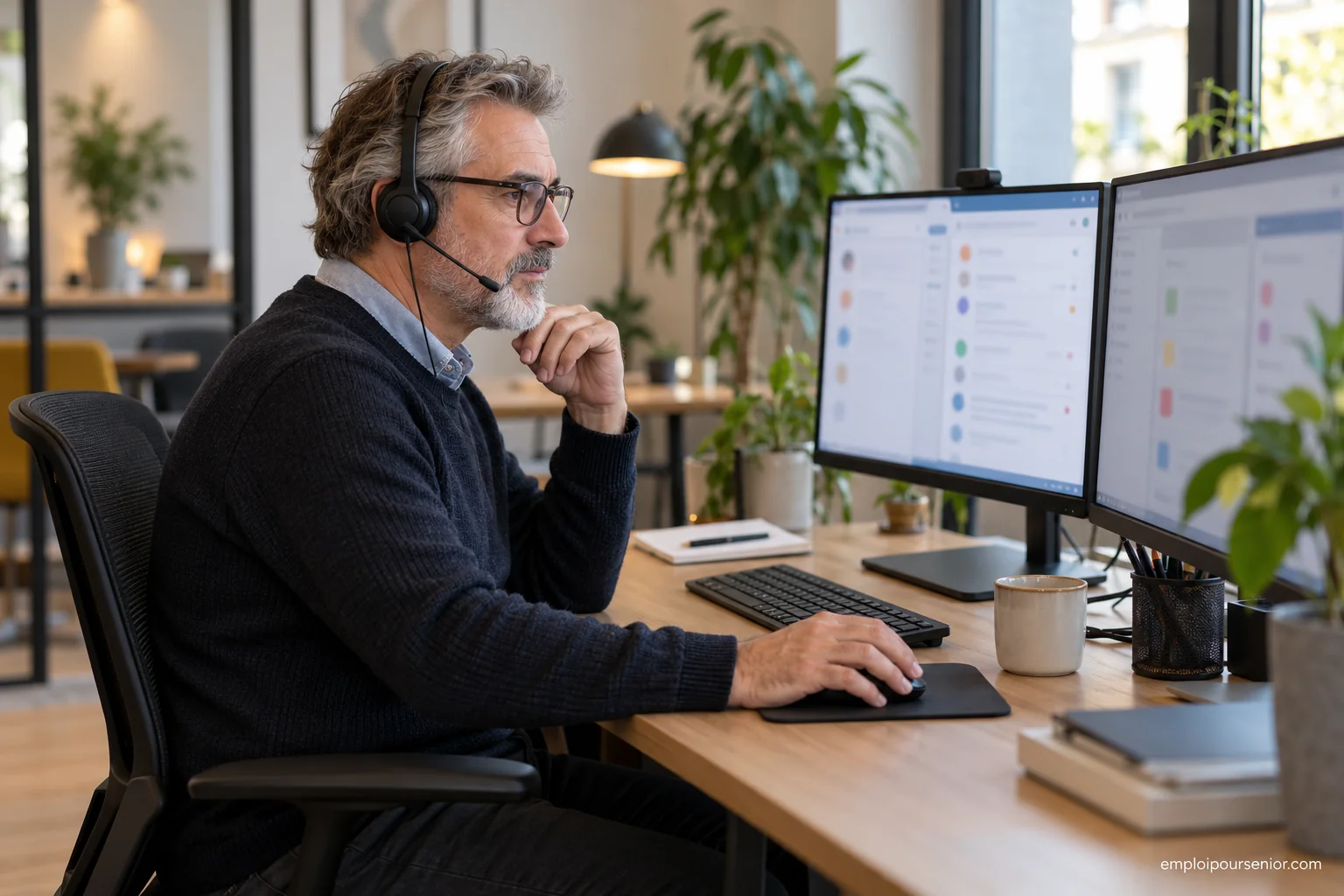
Moderating or animating: two neighbouring but different jobs
A moderator examines content posted by internet users (messages, comments, photos, adverts) to check that it complies with a set of rules or with the law. They approve, reject, hide or pass it on. The work is governed by precise criteria and by processing targets.
A community manager runs a space for exchanges: posting, replying, reviving discussions, relaying what members expect and reporting back to the organisation. There is more room for initiative, but an editorial line still has to be followed.
In some organisations the two roles overlap, which is why it pays to read the job title and description closely.
What an older worker can bring
Maturity helps in staying calm in the face of an aggressive message, in qualifying a reply and in not reacting in the heat of the moment. Good command of writing, spelling and tone is highly valued, as is patience with members who are not comfortable with the tools.
For communities aimed at older people (charities, mutual-help forums, services for retirees), someone of the same age understands members' concerns better. On the other hand, knowing how a platform is used can be learned quickly but cannot be improvised: you need to be ready to train and to pick up the codes of social networks.
Applying a charter without substituting your own preferences
A moderator's quality is measured by consistency. Two similar messages must be treated in the same way, whoever wrote them and whatever mood you are in that day. Decisions rest on written rules, on examples agreed by the team and on escalation procedures for ambiguous cases.
The point is not to push your own opinion but to apply the established criteria. When a case falls outside the framework, the right reflex is to pass it to the designated person with a factual note rather than decide alone.
Distressing content: a point to take seriously
Some assignments expose workers to violent, hateful or shocking content. Several public testimonies have shown that repeated exposure can have psychological effects, and it would be unwise to treat it as harmless.
Before committing, it is therefore reasonable to ask:
- what types of content will be reviewed, and in what proportions;
- whether scheduled breaks, task rotation or periods without sensitive content are in place;
- what psychological support is offered and how to access it;
- whether you can refuse or leave a queue that becomes too hard to bear;
- what alert procedure exists when content is covered by the law.
Moderating comments on a charity forum or a local blog is generally nothing like this.
Organisation of work: hours, tools and eligible countries
Many assignments are done remotely, but the arrangements differ greatly. Large platforms often hand moderation to contractors, with quotas, speed targets and team rotas that include evenings, weekends or nights. Smaller organisations tend to offer flexible part-time work instead.
The languages required, the equipment supplied, the connection needed and the country of eligibility all have to be checked: some offers are open only to residents of certain countries or to bilingual profiles. The privacy of your working environment is also part of the requirements.
Contracts, status and income
Posts can be offered as permanent contracts, fixed-term contracts, agency work, freelance services or part-time work. Pay depends on the organisation, the language and the workload. It is pointless to rely on figures that circulate without a source, and wise to compare several offers.
A retired person returning to work should find out about the combination rules of their pension fund, which vary by scheme. For self-employed work, registration and contribution formalities come on top of organising your working time.
Applying convincingly
A convincing application shows that you can write and keep a sense of proportion. A few elements help:
- A short text explaining how you would handle a borderline message, with the criteria behind your decision.
- Examples of measured replies to a disagreement, without reproducing private conversations.
- A list of the tools you have already used: forums, social networks and ticket-handling tools.
- The languages you work in and your real level in each.
- Your availability and the working rhythm you can sustain over time.
Some companies require a moderation test before any interview.
A concrete example (illustrative)
A former library manager aged 61 offers to run a retirees' association forum for three hours a day. She welcomes new members, reminds people of the rules when an exchange turns sour, passes sensitive messages on to the committee and writes a monthly report. The example is fictional, but it illustrates an activity with little exposure to shocking content, very different from a mass moderation queue.
Limits and alternatives
Professional moderation can be repetitive, measured by numbers and undervalued. Long hours at a screen tire the eyes and the back, so regular breaks and a suitable workstation are needed. Offers guarantee neither a volume of hours nor any progression.
If this path does not suit you, neighbouring activities exist: writing, proofreading, running digital workshops, written customer service and volunteer moderation for a charity. They use the same qualities without exposure to the hardest content.
Frequently asked questions
Do I need a qualification to become a moderator?
Generally not. Employers mostly look at the quality of your written language, your sense of proportion, your reliability and your ability to follow rules. A short course on the tools, or experience running forums or in customer service, can help. Requirements vary between organisations.
Is an older worker at a disadvantage in this job?
There is no general rule. Recruiters look first at skills, language level and availability. Digital ease has to be shown, but maturity, calm and writing quality are often seen as assets, particularly when answering members who are worried or angry.
Is moderation always exposed to shocking content?
No. It depends on the platform and on the type of queue handled. A charity forum or a local site rarely raises the problem, whereas certain social networks or video platforms expose workers to more. Ask what will be reviewed and what support is provided.
Can I work entirely from home?
Often, but not always. Some companies demand a secure workplace, set hours and supplied equipment, while others accept work from home. Countries of eligibility and confidentiality rules can also limit applications, so check each offer.
What is the difference between moderation and community management?
Moderation checks that content complies with a set of rules, whereas community management runs a space, replies to members and keeps the relationship alive. The first mostly follows processing criteria, the second calls for more editorial initiative. Some offers combine both, so read the full description.
Does this work guarantee a stable income?
No. Depending on the case it is an employee contract, a contractor assignment or limited part-time work. The number of hours can vary with the platform's activity. Compare contracts, payment terms and duration, and check the combination rules if you receive a pension.