The background: working for longer, often differently
In South Korea, the mandatory retirement age set by many employers is around 60, while the public old-age pension is paid only from a later age, which is gradually being raised. That gap explains why a large share of people over 60 carry on working, sometimes in a different sector from their original career.
Situations are varied: re-hiring at the original company on a different contract, a transitional post in services, local jobs supported by local government, or setting up a small business. Pay and stability differ widely from one case to another.
For an outside reader, it is therefore useful not to project one’s own career model onto this context: a realistic plan is built from a concrete trade, a city, a working language and an administrative status.
Starting from a specific skill
A senior project is stronger when it rests on a skill you can demonstrate in a few minutes. Technical, maintenance, quality-control, accounting, teaching, training or international advisory profiles are easier to place than very general careers.
A few questions can help clarify the project:
- what precise task can you carry out without supervision?
- in what kind of organisation: factory, school, firm, association, or a foreign company based in Korea?
- how many hours a week are realistic?
- what level of Korean is required to understand instructions?
International experience may interest an employer, for instance in dealing with foreign clients, but it does not replace understanding the documents and procedures the team uses every day.
Korean and the working language
In most local posts, Korean is indispensable. The level expected varies with the function: a technical task guided by diagrams involves less spoken exchange than a customer-advice or reception job.
A few pointers for preparing your profile:
- assess your spoken and written level honestly, for example with a recognised test such as TOPIK;
- learn the vocabulary specific to your trade: safety, quality, technical documents;
- plan a part-time start so that you can progress on the job;
- aim for environments where English is used: international companies, training, consulting.
You also need to get used to the politeness register and the importance of hierarchy, which affect how you give an opinion or put a question to a younger superior.
Search channels: public and private portals
Several routes complement one another. The public portal Work24 brings together vacancies, information on training and guidance services for job seekers, but it is mainly in Korean. A national portal devoted to seniors publishes posts and programmes for older people, with eligibility conditions specific to each programme.
The big private recruitment sites list offers by sector, city and level of experience, which allows quick comparison. Foreign chambers of commerce, expatriate associations and former colleagues are other relays, often more effective than sending applications in bulk.
The basic advice remains to follow few channels but to do so regularly, noting dates, contacts and replies received.
Local support: the example of Seoul
The Seoul50Plus Foundation is an example of an organisation aimed at people aged 50 and over in the capital. It offers career guidance, training, second-career pathways and socially oriented activities, with centres and campuses in several districts.
For each programme, it is important to check:
- the exact age group targeted;
- the requirement to live in Seoul or in another local authority area;
- the language of instruction;
- whether it is paid or free;
- the difference between training, paid volunteering and a genuine job.
Attending a workshop or enrolling in a career-transition programme is neither permission to work nor a promise of a post. It is a way to get your bearings, meet others in transition and clarify a project.
Community jobs and transitional posts
For older people, South Korea has developed community jobs, often supported by local authorities: supervision and reception in public buildings, help in schools, cleaning, support for older people or children. Hours are generally limited and pay is modest.
In the private sector, the most common transitional posts involve security, building management, driving, delivery or in-store services. Some suit someone seeking extra income; others are physically demanding.
For a foreign national, access to these programmes generally depends on residence, nationality or status, and is checked with the managing body. Conditions should not be assumed: it is better to ask for them in writing.
Residence status and permission to work
In South Korea, the right to work depends on the type of visa or residence status. Some statuses allow paid activity freely, others regulate or forbid it. Receiving a pension, even a foreign one, gives no permission to work.
Prudent steps:
- identify exactly your current residence status and how long it remains valid;
- consult the immigration authorities’ information on permitted activities;
- ask the prospective employer whether they know the sponsorship or status-change procedures;
- do not start work until you have written confirmation that the activity is permitted.
Unauthorised work can lead to penalties and complicate a later stay. For a particular situation, consular advice or a lawyer specialising in immigration law is preferable to any summary.
Contract, pension and social protection
Before accepting a post, clarify the nature of the contract: fixed-term or open-ended employment contract, service contract or community job. That nature determines social protection, pay and rights if work is interrupted.
Points to ask about or check:
- the number of hours per week and how they are spread;
- the pay, the payment date and any bonuses;
- enrolment in social insurance and in accident insurance;
- the effect of earnings on a national pension already received or yet to be claimed, since some rules may reduce payments when income is high;
- the length of the contract and its renewal conditions.
The pension service or a competent adviser can estimate these effects case by case; a general summary is no substitute.
An example path and a few precautions
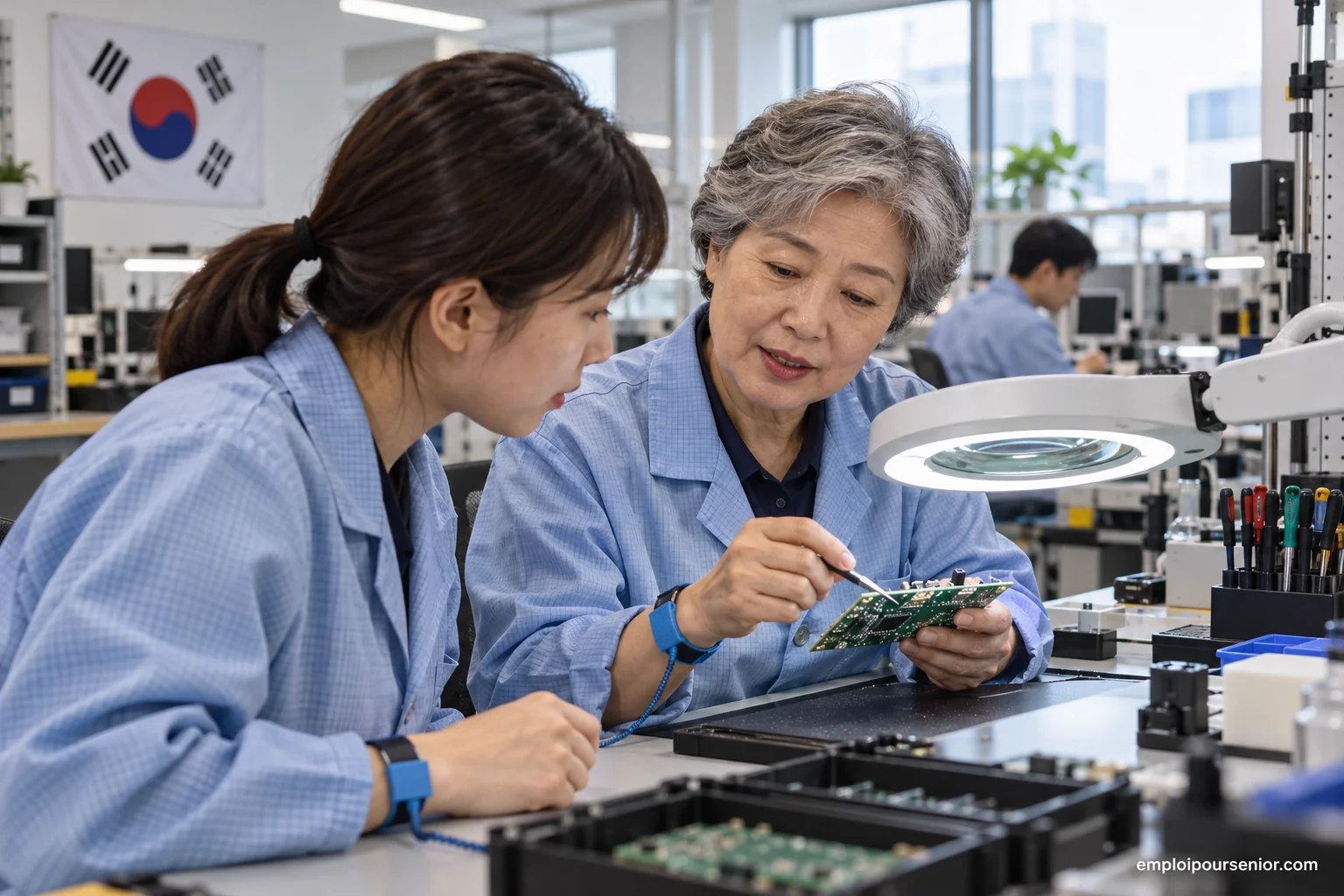
By way of illustration, a former electronics engineer, legally resident in Seoul, plans to pass on her knowledge part time.
- She writes a presentation in Korean and English, centred on circuit testing, training technicians and documentation.
- She asks a guidance centre for people over 50 about courses and second-career pathways.
- She consults public and private portals for advisory, training or quality-control posts.
- For each proposal, she asks for the contract, the pay and the possible effect on her pension, then confirms her residence situation.
This example does not predict any result. As a precaution, never pay to obtain a job, check the address of every official site because imitations exist, and hand over identity documents only to an identified contact.
Frequently asked questions
Can a foreign retiree work in South Korea?
Only if their residence status allows the planned activity. Receiving a pension, even a foreign one, gives no permission to work. Look at the activities the visa permits, ask the employer about the conditions and obtain written confirmation before starting. The immigration authorities remain the source to consult.
Is Korean compulsory?
In most local jobs, yes, at least to understand instructions, customers and documents. Posts where English dominates, such as in some international companies, training or consulting, are fewer. Stating your level honestly and planning gradual learning avoids disappointment.
Who is the Seoul50Plus Foundation for?
It is for people aged 50 and over in the capital, with guidance, training and second-career pathways. The exact age, residence and language vary by programme. Taking part in a workshop is neither a promise of a post nor permission to work.
Where can I find job offers?
The public portal Work24 and a national portal devoted to seniors form an official base, mostly in Korean. The big private recruitment sites complete the search, as do professional networks and expatriate associations. It is better to follow a few channels than to sign up everywhere.
What types of jobs do older people often hold?
You find community jobs supported by local authorities, security or building-management posts, roles in services and retail, and technical or training assignments for specialised profiles. Hours, physical demands and pay vary greatly and should be checked before committing.
Can working reduce a pension?
In some cases, high earnings can reduce payment of the national pension for those who draw it before the normal age. The rules change and depend on personal circumstances. It is best to ask the pension service for a calculation before accepting a post.