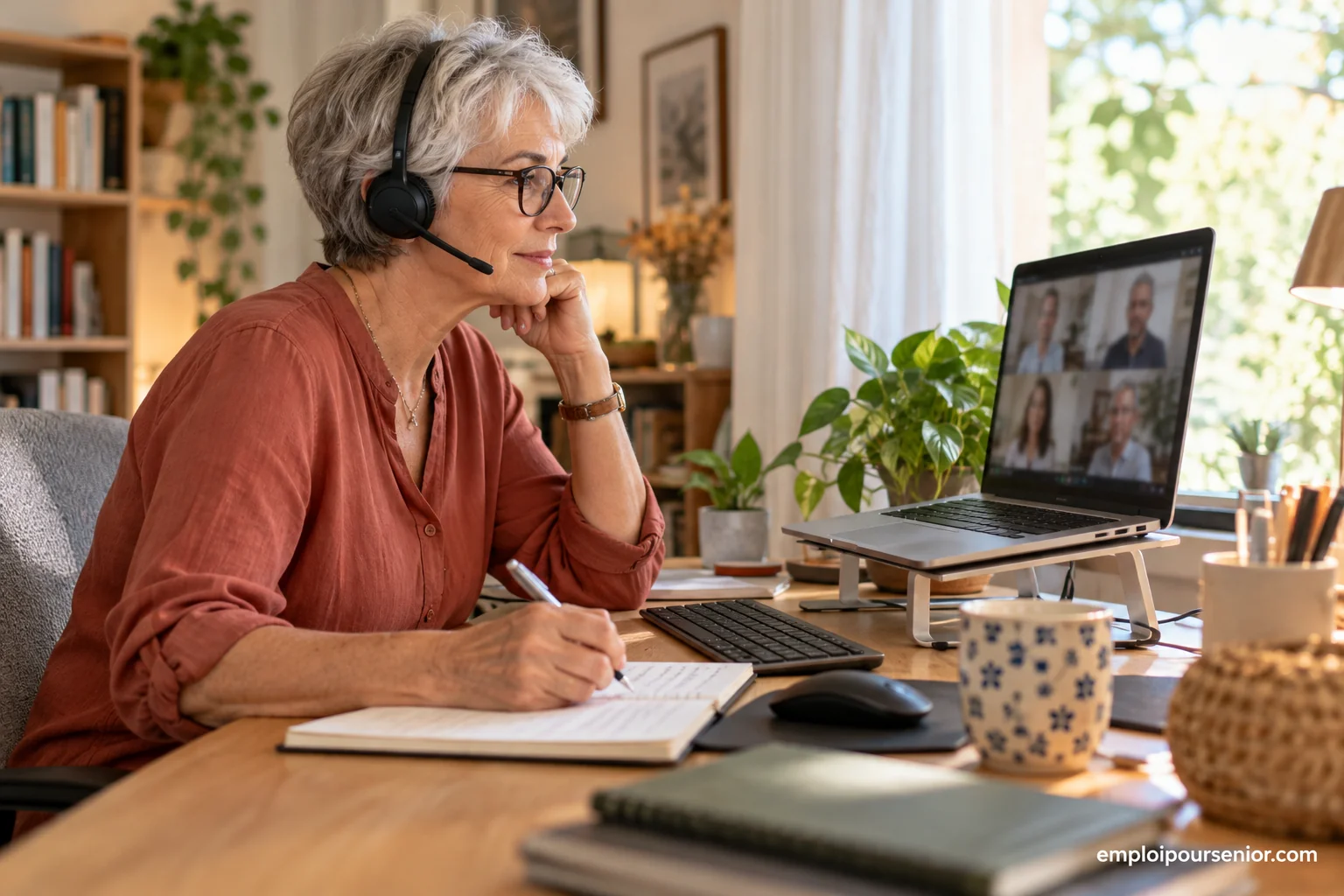
What counts as remote work, and what does not
Remote working means carrying out a professional activity away from the employer's premises, using digital tools, most often from home. It is a way of organising work, not an occupation: you can work remotely as an accountant, writer, customer adviser, executive assistant or trainer.
Three situations are common. There is the employee whose employer allows remote work one or more days a week. There is the employee hired for a fully remote post. And there is the self-employed person who delivers services from home, with no employer directing the work.
By contrast, adverts promising a regular, high income with no skills, in return for buying training or equipment, are not jobs at all. A genuine post names an identifiable employer, describes the duties, offers a contract and states the pay before you commit to anything.
Activities that suit remote work best
The best fit is work that needs a computer, a reliable connection and regular exchanges with a team. For experienced people, several families of tasks come up again and again.
- Management and administration: following files, data entry, invoicing, chasing payments, preparing payroll or accounts depending on your training.
- Customer service: help by phone, email or instant messaging, sometimes with fixed hours.
- Writing and translation: proofreading, editing, content writing, transcription.
- Teaching and training: video lessons, online tutoring, coaching colleagues.
- Consulting and expertise: analysis, audits, mentoring, generally as a freelancer.
What they share is that experience counts as much as the software. Someone used to juggling priorities, writing clearly and being accountable has strengths that recruitment platforms rarely value through their filters alone.
The framework for employees
In France's private sector, remote work can be introduced by a collective agreement or a company charter. Failing that, employer and employee can agree case by case, preferably in writing. The employer may refuse, and the employee is not obliged to accept a switch to remote working, except in exceptional circumstances.
Several points are worth settling before you start:
- the number of days worked remotely and the place where the work is done;
- how costs linked to the activity are covered, by reimbursement or allowance;
- who supplies and maintains the necessary equipment;
- the hours during which the employee must be reachable;
- the rules on confidentiality and data protection.
These rules apply according to the contract and the company. Public-sector staff are covered by separate provisions. If in doubt, the official government guidance and your employment contract are the reference, along with advice from a staff representative or an adviser.
Setting up a suitable workstation
Working several hours a day at home calls for a dedicated corner, however small. A steady table, an adjustable chair with good lower-back support and a screen at eye level prevent many aches in the back, neck and wrists, which set in faster with age.
Lighting matters too: natural light from the side, topped up with a lamp if needed, tires the eyes less than a screen in the gloom. Glasses suited to your screen distance, prescribed by an optician, are often more useful than a large monitor.
On the technical side, check you have a stable connection, a headset or microphone of decent quality for video calls and regular backups of your files. Ask your employer what they provide before buying anything in advance.
Getting ready for digital tools without apprehension
Fear of not mastering the tools sometimes holds back candidates who are in fact highly competent. In practice, most remote jobs rest on only a few building blocks: email, video calls, document sharing and one piece of business software. Each can be learned in a few sessions.
To gain confidence, you can practise a video call with a relative, organise your files in shared folders and learn the most useful shortcuts. Short courses, sometimes funded through personal training accounts or offered by charities and public digital help centres, can help you take the step.
At an interview, mention the tools you already use and how you picked up the latest ones. That ability to learn reassures more than a list of programs.
Staying effective and connected: daily life at a distance
The main challenge is not technical but organisational. With no colleagues around, days can stretch out or, on the contrary, dissolve into household chores.
A few simple guidelines
- Set start and finish times and keep to them.
- Plan breaks to stand up, walk and eat lunch somewhere other than your desk.
- Agree regular check-ins with the team, by phone or video.
- Keep a social life outside work to avoid isolation.
Some employers also ask for days on site, for meetings or training. This hybrid rhythm often suits older workers well: it cuts down on travelling without severing the link with the team.
Retirement and remote work: points to check
For a retired person, working from home is still paid work, subject to the same rules as a job on site. In France, combining a pension with earnings depends on personal circumstances: age, length of contributions, whether all pensions have been claimed and the type of contract. These rules change, so confirm them with your pension fund before you begin.
For self-employment you must also choose a status, register the activity and understand the contributions due. A business-start support organisation can help you see clearly.
Finally, extra income can affect your tax position or certain benefits. A check with the relevant authority avoids unwelcome surprises.
Avoiding the traps of fake work-from-home offers
The word remote is sometimes used as bait. A few signals should make you wary:
- a request for payment before starting, for equipment, a kit or access;
- a promise of high income with no qualifications or set hours;
- recruitment carried out only by messaging, with no interview or contract;
- a request to advance money or to receive transfers on behalf of a third party, which may amount to fraud;
- an employer you cannot trace, with no address or verifiable registration number.
Before replying, search for the company name, read reviews and check that it appears in the official registers. If in doubt, send neither ID nor bank details.
An example of how to go about finding a remote post
Here is an example, offered purely as an illustration. A former administration manager wants to return to part-time work from home. She lists the tasks she handles well: invoicing, supplier follow-up, payment reminders. She runs a search with the remote filter on two job sites, keeps four adverts and adapts her CV to each.
At the interviews she asks who supplies the computer, what hours of availability are expected and whether any days on site are planned. She consults her pension fund before accepting a fixed-term contract.
This scenario guarantees no result, but it shows the logic to follow: clarify your skills, compare offers, ask the right questions, check the framework.
Frequently asked questions
Can you work from home full time over 60?
Yes, if the employer offers a remote post or if you work as a freelancer. Age is not an acceptable ground for refusal. What remains is to check the nature of the contract, the equipment supplied and, for a retired person, the effect of going back to work on the pension, with the pension fund.
Who pays for equipment and costs when working from home?
For a private-sector employee in France, the employer should in principle cover costs linked to the activity, by reimbursement or allowance, and supply the necessary equipment. The details are set by the agreement, charter or contract. A freelancer bears his or her own business expenses.
Which occupations suit remote work best for an older person?
Administrative roles, customer service, writing, distance training and consulting are the most common. It all depends on your background: an accounting, legal or management post often transfers well. It is better to start from your skills than from a list of fashionable jobs.
How can I recognise a fake work-from-home offer?
It often asks for money upfront, promises big earnings for little effort, hides the employer's identity or recruits without a contract. Check that the company exists, read the contract before signing and refuse any financial transaction on behalf of a third party.
Is remote work suitable for someone who fears isolation?
It can be, provided you build in contact: regular team meetings, days on site where possible, activities outside the home. A hybrid arrangement with a few days in the office often gives a good balance. Isolation is a real issue to plan for before accepting a fully remote post.
Must a retired person declare remote work?
Yes, paid work should in principle be reported to the pension fund where the situation requires it, and declared for tax. The procedures differ depending on whether you are an employee or self-employed. It is wise to confirm your situation with the bodies concerned before starting.