An industrial economy that needs know-how
Czechia, also called the Czech Republic, is one of the most industrialised countries in central Europe. Carmaking, precision engineering, electrical engineering, glassmaking, optics and food processing employ a great many people. Prague concentrates services, finance, IT and tourism; Brno, Ostrava and Plzeň each have their own industrial and university base.
This orientation favours technical skills and precision trades: checking a finish, adjusting an instrument, servicing a machine, handling a complex file. An experienced candidate does well to describe a skill through its method, its tools and a verifiable result, because local recruiters compare tasks and competences first.
Status of EU citizens and residence
Citizens of the European Union, including the French, Belgians and Luxembourgers, can in principle work in Czechia without a work permit. For a stay of more than three months, registration of residence with the competent authorities is generally required, with proof of income or employment and health insurance.
People who are not nationals of an EU state follow a different procedure. The employee card, for example, is meant for certain third-country nationals who take up a specific job; it is not a special scheme for retired people. As the rules evolve, the Ministry of the Interior's official page and direct contact with the administration remain the references.
Pension and work: a combination to check
In the Czech system the retirement age is being raised gradually, and pension rules vary with the year of birth. It would be unwise to rely on a precise age without consulting a recent source. In practice, working while drawing a Czech pension is generally allowed, but the resulting contributions and rights must be confirmed with the competent body.
- A French or Belgian pension keeps the rules of its own fund: declaring work abroad, a possible income limit.
- Contributions are in principle due in the country where you work, under the European coordination rules.
- The taxation of each income depends on treaties between countries.
A written exchange with your pension fund before signing a contract avoids many later corrections.
Working language and level of Czech
Czech is the working language, and most documents, safety instructions and daily exchanges use it. In the international companies of Prague or Brno, English and German are common, and some functions look for French speakers for customer support, training or relations with subsidiaries.
For a workshop, a shop or an administration, a level of Czech sufficient to understand instructions and talk with colleagues is often expected. It is therefore useful to prepare an introduction suited to the required level: a few simple sentences about your trade, tools and methods, prepared in advance, are better than an improvised speech. Evening classes and language schools let you progress without stopping other activities.
Jobs and assignments suited to an experienced profile
Several types of post lend themselves to going back to work at a later age, provided you know their pace.
- Workshop and repair: watchmaking, optics, light engineering, finishing of parts.
- Inspection and quality: checking batches, writing reports, following up non-conformities.
- Administration: handling files, invoicing, contract follow-up.
- Reception and customer service: hotels, museums, retail in tourist areas.
- Knowledge transfer: mentoring young technicians, in-house training, documenting procedures.
The real rhythm depends on the place: shift work, standing, moving around a warehouse or seasonal hours. It is checked at interview, not from the job title.
Contracts, short agreements and self-employment
The ordinary employment contract remains the most protective form. Czech law also has short work agreements, the dohody, for tasks limited in duration or hours; their contribution and protection regime differs from the standard contract, which deserves a careful reading.
A senior may also choose self-employment, for instance for repairs, training or consultancy. It requires a declaration of activity, accounting duties and its own contributions. Before accepting an offer, ask about duration, working hours, probation, holidays and payment terms. Since the national currency is the Czech koruna, any salary comparison with the euro must take the current exchange rate into account.
Where to search and how to prepare an application
Vacancies circulate on the main Czech job portals, on company websites and through recruitment and temporary-work agencies. The local branches of the public employment service offer advice, vacancies and support to jobseekers, within the limits of their status and place of residence.
The file works best when kept short: a two-page CV, dated achievements, the tools and standards you master, and diplomas translated if the job requires it. For regulated professions, ask the competent authority whether recognition of qualifications is necessary. At interview, stating the pace you want and the responsibilities you accept avoids misunderstandings and shows a considered approach.
An example of a project
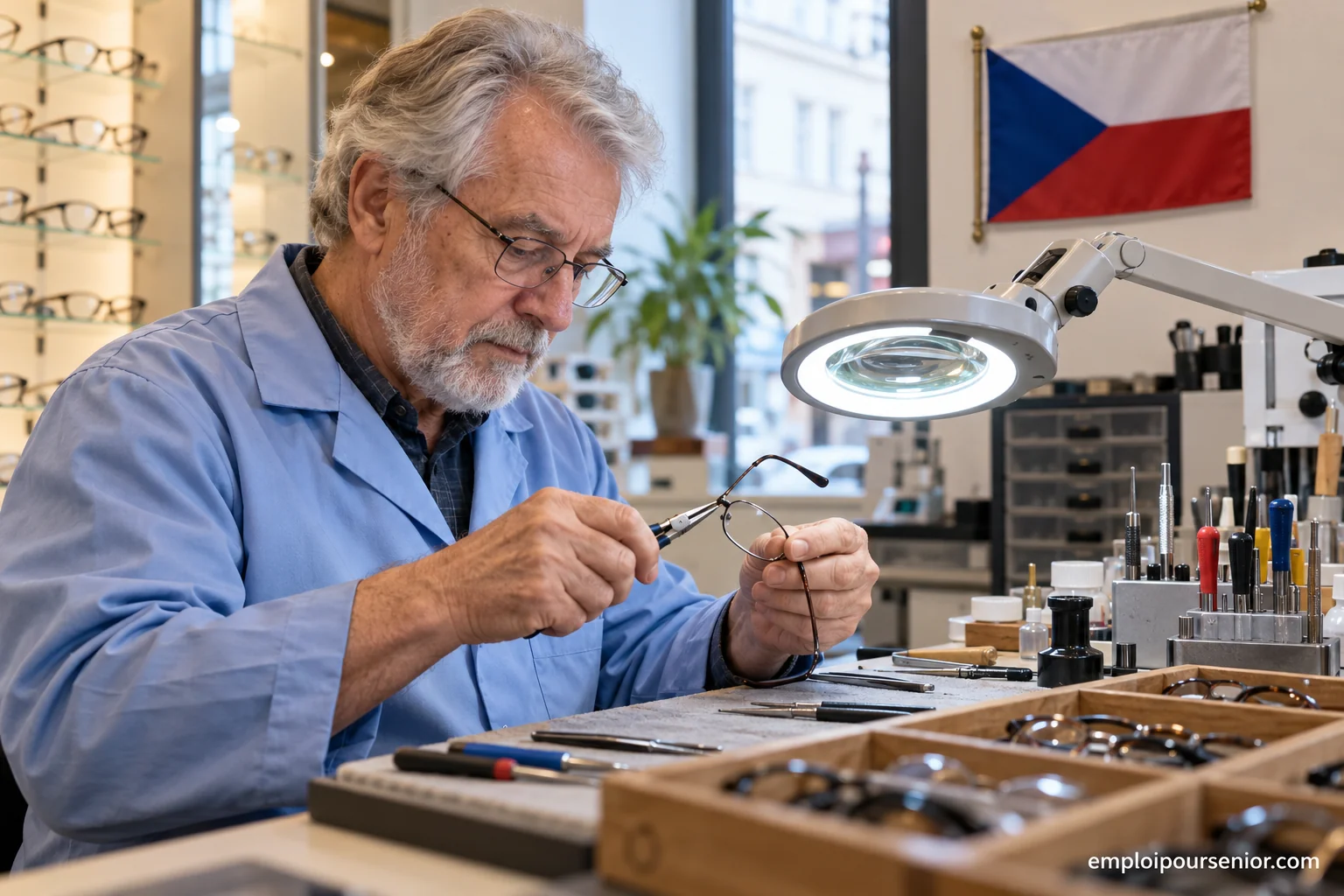
As an illustration, a 61-year-old French optician wants to work half-time in an assembly workshop near Brno. In the adverts he picks out the terms used for frame adjustments, prepares a two-page sheet showing his skills and has it translated. He contacts two workshops and offers a trial day.
He then asks his pension fund about declaring work abroad and checks which health insurance applies. If selected, he asks in writing for the type of contract, the hours and the language of instructions. This scenario describes a method; it indicates neither that a post exists nor a level of income, which vary with the employer and the period.
Precautions to keep in mind
A return to work abroad needs anticipating. Look at the cost of housing, particularly in Prague, daily transport and the availability of a doctor who speaks a language you know. Health cover, European or national, must be clarified before arrival, and your usual prescriptions checked.
It is prudent to be wary of unusually high salaries, requests for payment in return for recruitment, or intermediaries promising a guaranteed job. The employer's existence can be checked in company registers. Finally, a trial of a few weeks, without giving up your original home, lets you gauge the climate, the language and the real tiredness of the job.
Frequently asked questions
Do you need a work permit in Czechia as an EU citizen?
In principle no, since Czechia is a member of the European Union. Beyond three months, registration of residence is generally required. The employee card, often mentioned, concerns certain third-country nationals and is not aimed at retired people. As rules evolve, an official check remains necessary.
Can you work while receiving a pension?
For a Czech pension, combining it with a job is generally possible, but the effect on your rights should be confirmed with the competent body. For a French or Belgian pension, the rules of the original fund apply: possible declaration, income ceilings, taxation. A written exchange before signing protects you.
Do you have to speak Czech?
For most local jobs, yes, at least to a level that lets you follow instructions. In international companies, English or German may be enough for some posts. French-speaking roles remain occasional. Taking lessons and preparing a short presentation of your trade in Czech clearly improves an application.
Which kinds of company recruit experienced people?
Engineering, car, electrical and optical industries, services, retail and tourism employ varied profiles. The need often concerns quality, maintenance, administration or passing on know-how. No hiring is guaranteed: everything depends on the region, the period and the post aimed at.
Which contract should you prefer?
The ordinary employment contract offers the fullest social protection. The short agreements called dohody suit limited tasks, with a different contribution regime. Self-employment gives autonomy but requires a declaration and accounts. Each option should be compared with your personal situation before committing.
Are my French qualifications recognised?
For a non-regulated job, the employer mainly judges experience and proof of competence. For a regulated profession, recognition by the competent authority may be required, with translated documents. It is better to put the question to the employer and the administration at the outset, to avoid a block at the time of hiring.