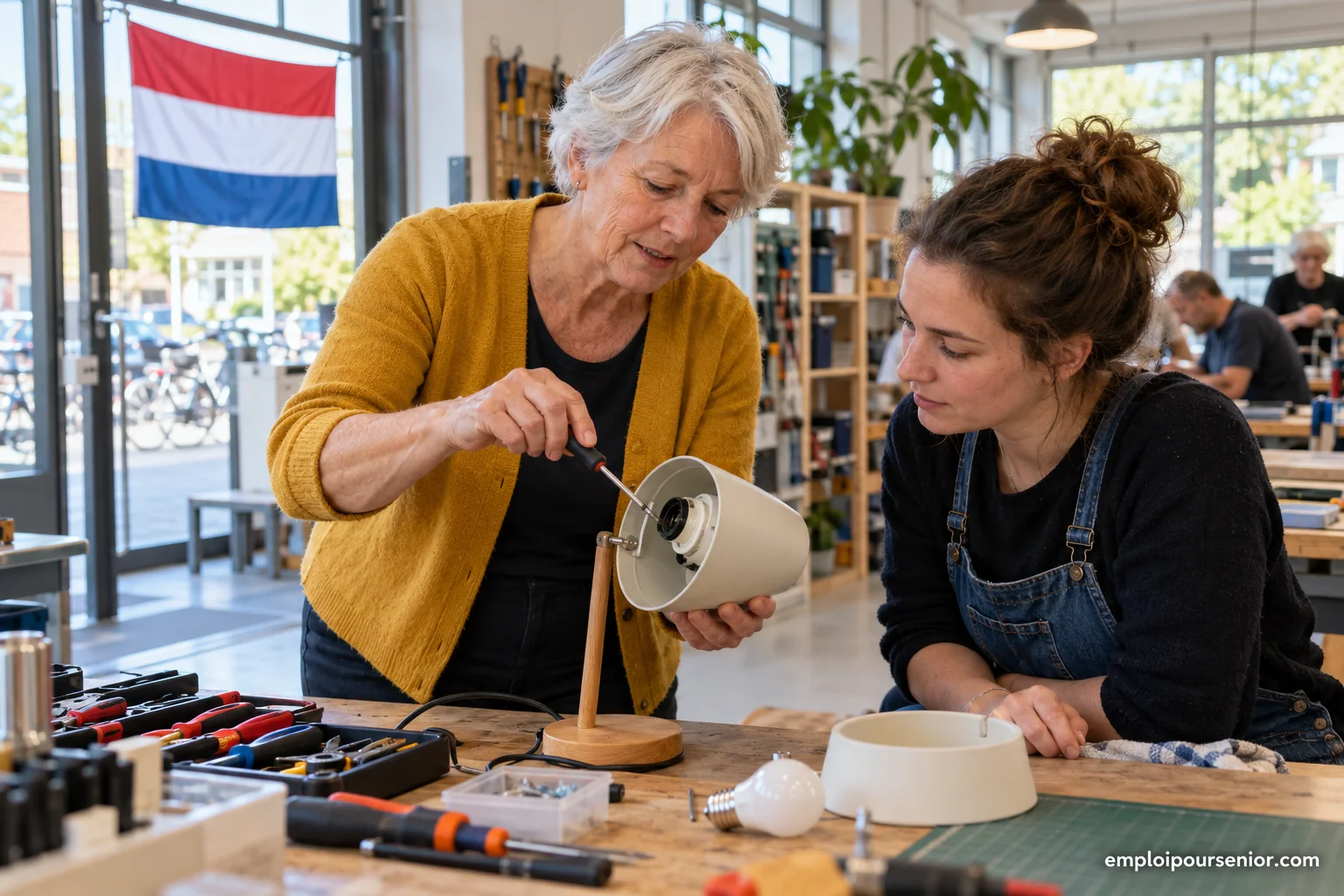
A country where part-time work is widespread
The Netherlands stands out for its very widespread use of part-time work, including among experienced adults. Working three or four days a week is not seen as an exception there, which makes it easier to discuss a rhythm of your own choosing. For an older worker this custom is an advantage: employers are not surprised when you say which days you are available.
The market also offers a wide range of forms of employment: direct contracts, assignments through agencies, temporary work, on-call contracts and self-employment. This variety calls for vigilance, because the flexibility advertised does not always match a person’s need for regularity.
As always, the information below is general guidance. The precise rules on contracts, taxes and pensions evolve, and should be confirmed with the competent bodies.
Telling a neighbourhood activity from a genuine job
A repair workshop, a shop, an administrative service or a community centre may suit your experience. Yet before any application, the role must be defined precisely. In the Netherlands the line between volunteering and paid work is a real issue, and both associations and employers pay attention to it.
A few pointers help clarify the situation:
- voluntary activity brings no salary, only a limited expense allowance;
- a paid post comes with a contract, contributions and a payslip;
- an unpaid “internship” or “trial” should be limited and supervised;
- a job of a few hours for a private individual may follow a different regime from that of a conventional employer.
If you are unsure of the status of an activity, ask for the conditions in writing before you begin, and consult a competent body if the answer remains vague.
Searching with precision: mastered tasks and Dutch level
On the public employment portal and on agency sites, searches are made by occupation, town and number of hours. To get useful results it is better to start from the tasks you truly master: reception, routine accounting, shop work, repair, team supervision, teaching a skill.
The level of Dutch required is the second criterion to examine. Some roles, notably in international companies, IT, logistics or hospitality, operate in English. Others, such as administration, healthcare or local retail, require fluent Dutch. The advert does not always say so, which is why it pays to ask in the very first exchange.
In your introduction, state the days you are available rather than just writing “part-time”. “Available Monday, Tuesday and Thursday” helps a recruiter picture a concrete schedule.
Going through an agency: know who signs the contract
Temporary-work agencies play an important part in the country. They recruit candidates and then place them with client companies for an assignment. This arrangement suits anyone who wants to test a sector or top up their income, but it requires a good grasp of how it is set up.
Questions to ask when you receive a proposal
- Who signs the employment contract: the agency or the client company?
- How are hours communicated, and with how much notice?
- What happens between two placements: is there pay, do you have to stay available?
- How long is the assignment expected to last and can it be extended?
- How are public holidays, leave and sick days handled?
These answers let you compare the advertised flexibility with your real need for regularity. Someone who wants a stable income will not get the same benefit as another person who simply wants a few weeks of work a year.
The AOW pension and work: what to check
The basic Dutch state pension, the AOW, is paid by the Sociale Verzekeringsbank, the SVB. It is linked to the years of residence in the Netherlands and to the statutory age, which is being raised gradually on an official timetable. In general, receiving earned income does not remove the AOW, but other elements, such as certain supplements, tax or means-tested benefits, may be affected depending on the situation.
The SVB gives information on your personal situation and on the changes that must be reported, for example moving house, living with a partner or a stay abroad. A foreign pension, the right to work in the Netherlands for a non-European, or a supplementary occupational pension all require their own checks with the competent bodies.
No figures are given here, because amounts and thresholds are revised regularly. Before you sign, ask in writing what effect the planned income will have on each of your resources.
Right to work and practical steps
Citizens of the European Union and the European Economic Area have in principle the right to work in the Netherlands, with registration formalities if the stay becomes longer. For other nationalities, a residence or work permit is generally needed. This requirement does not depend on age and does not disappear because you are retired.
In practical terms, a new worker needs a tax identification number, a local bank account and compulsory health insurance. An employer may help you find your way through these steps, but is not obliged to complete them for the employee.
One last piece of advice: never sign a contract before these points are clarified. It is simpler to ask the questions before the first day than to correct a situation after several months of work.
Example: a former logistics manager on a workshop assignment
By way of example, picture a 66-year-old man, a former logistics manager living near Utrecht, who receives the AOW and wants to work three days a week. He registers with an agency, states his days and explains that he can organise the receipt of goods, train a newcomer and keep a stock register.
He is offered an assignment in a small appliance-repair business. He asks who signs the contract, how hours are communicated and what happens between two placements. He also asks the SVB what effect this income will have on his situation.
This example describes a method and not a promise: no application guarantees an interview or an assignment, and conditions depend on each organisation.
Frequent pitfalls and further options
Among the most common stumbling blocks are confusing volunteering with employment, signing a contract without understanding how it is structured, forgetting to report a change of situation to the pension body, and underestimating the level of Dutch expected. Be wary as well of adverts that promise quick income or ask for payment to access an assignment.
When employee work does not suit, other options exist: volunteering in a neighbourhood association, mentoring young entrepreneurs, small-scale self-employment, or passing on a skill in a vocational school. Each option has its own administrative and tax regime, to be confirmed with the authorities.
The essential thing is to proceed in stages: clarify the framework, define the rhythm, and only then compare offers.
Frequently asked questions
Can I work while receiving the AOW?
Generally yes: earned income does not prevent you from receiving the AOW pension. Other elements of your situation, such as tax, a supplement or means-tested benefits, may nonetheless be affected. The SVB explains the changes to report. It is best to contact it before signing a contract.
Do I need to speak Dutch to find a job?
It depends on the occupation. International companies, IT and logistics often work in English, whereas healthcare, administration and local retail generally ask for fluent Dutch. As adverts do not always say, it helps to ask the question in the first exchange.
What is the difference between volunteering and paid work?
Volunteering brings no salary, only a limited expense allowance, whereas a job involves a contract, contributions and pay. The boundary is watched by associations and authorities. If in doubt about an activity, ask for the conditions in writing before you start.
What should I ask an agency before accepting an assignment?
Ask who signs the contract, how hours are communicated, how long the assignment is expected to last and what happens between placements. These answers let you compare the flexibility advertised with your need for regularity. A serious agency does not charge candidates for registering.
Can a non-European pensioner work in the Netherlands?
In principle a residence or work permit is required, and retirement does not exempt anyone from that requirement. Conditions vary with nationality and residence situation. A check with the competent immigration services is needed before accepting an offer.
How should I state my availability in an application?
It is better to name the exact days, for example Monday, Tuesday and Thursday, than to write only “part-time”. A recruiter can then picture a concrete schedule. If relevant, add travel constraints or planned absences, to avoid unsuitable proposals.