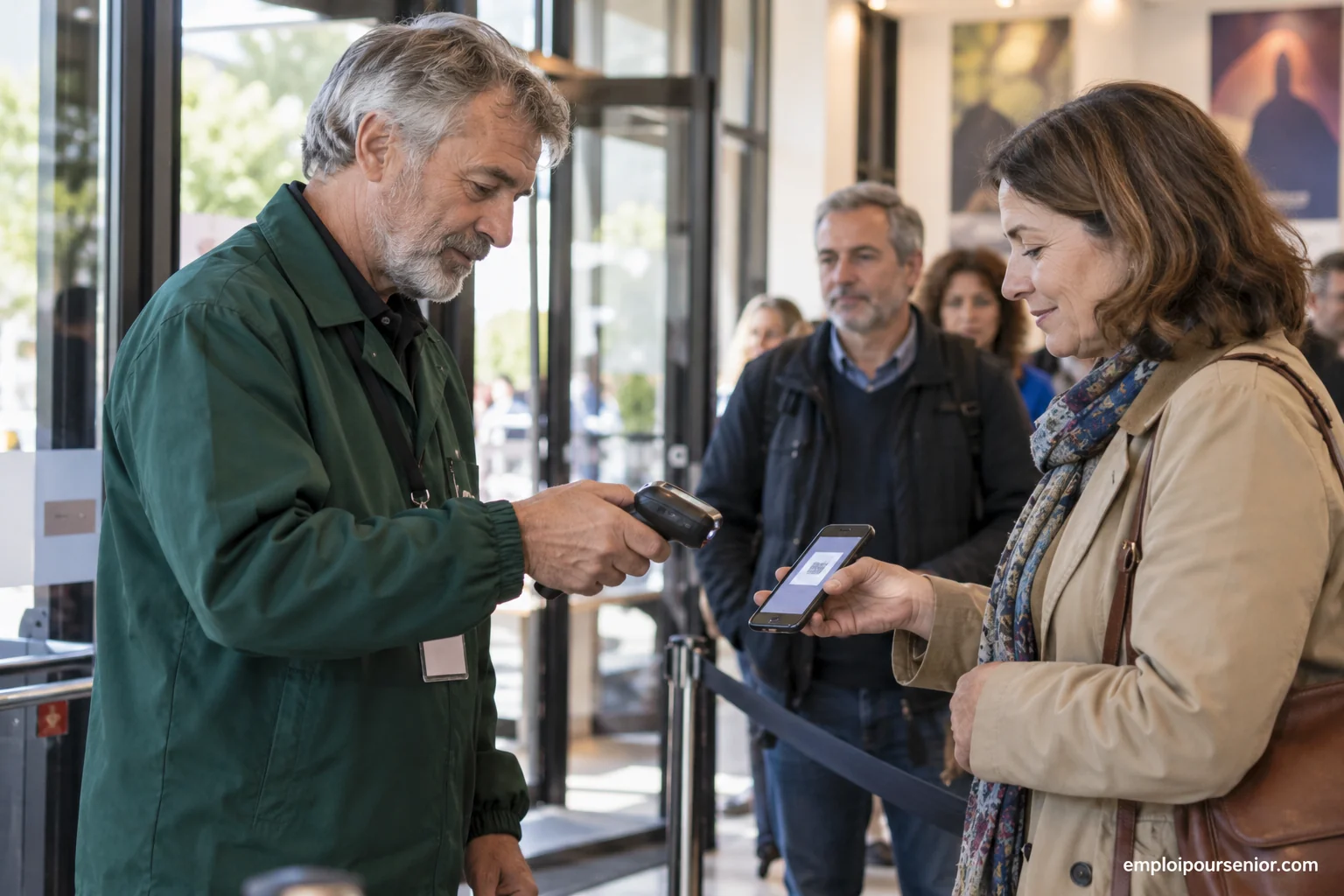
What ticket checking really involves
Checking a ticket means verifying that a person holds a valid pass for the venue, the date and the time slot, and then directing them to the right door or area. The gesture looks simple, but it is repeated hundreds of times per shift, often with visitors who are in a hurry, impatient or a little lost.
Today, most entrances rely on a handheld scanner or a fixed terminal that reads a barcode or QR code. Many spectators show their ticket on a phone screen, others on paper, and others have not printed it at all. The steward therefore does not simply “wave people through”: they read the result on the display, understand the message from the device (ticket already used, wrong zone, wrong date) and apply the instruction laid down by the organiser.
This function belongs to reception, not to security. The steward informs, directs and reports; they do not decide an exception on their own and do not intervene physically in the event of a dispute.
Where these assignments are found
Ticket-based access control exists wherever entry is paid for or reserved. The most common settings are:
- concert halls, theatres, cinemas and festivals;
- stadiums and sports halls on match days;
- trade fairs, exhibitions and temporary shows;
- museums, monuments and leisure parks;
- certain one-off events: open-air concerts, paid Christmas markets, local fairs.
Assignments are offered directly by organisers, by hosting agencies, by reception service companies or by temporary work agencies. Depending on the venue, the same post may be called ticketing host, event reception agent, access controller or usher. It is therefore worth reading the description rather than the job title.
The qualities that count after 50
The job does not call for any particular qualification. Employers mainly look at behaviour: punctuality, a tidy appearance, clear speech, patience and the ability to repeat the same sentence pleasantly. On these points, a long professional or voluntary career is a real asset.
Two skills weigh more than you might imagine. The first is ease with a small terminal: knowing which button to press, understanding an error message, restarting the scanner. The second is reading a situation quickly: noticing that a family is hesitating in front of the door, that someone is having difficulty moving around or that a group is arriving all at once.
A little foreign language, often English, is appreciated in tourist venues or at large events, without being systematically required.
Pace, hours and physical demands
Hours follow those of the events: evenings, weekends, public holidays, sometimes very early in the morning for a trade fair. A shift can last four hours or a whole day, with a peak of arrivals concentrated in the first hour after opening, followed by a calmer period.
Standing is frequent, sometimes outdoors, in cold or hot weather. Before accepting, it is best to ask:
- whether a seat or regular breaks are provided;
- whether the post is sheltered or exposed to the weather;
- whether a uniform or specific clothing is supplied;
- how the journey home works after a late finish.
Someone who finds prolonged standing difficult might prefer a seated box-office post or a gentler reception assignment in a museum.
Contract, status and how income works
Ticket checking is most often done as an employee: a fixed-term contract, agency work or, in some event-industry sectors, a short-term contract for one-off assignments (in France, the contrat à durée déterminée d’usage). Pay offered is generally around the minimum wage, with possible premiums for evenings, Sundays or public holidays, depending on the applicable collective agreement. Nothing guarantees a regular volume of work: income depends on the number of assignments accepted during the year.
For a retiree, the question of combining pension and salary arises before the first assignment. In France, combining work and retirement generally requires that your pensions have already been drawn, and is subject to caps depending on your situation. These rules vary, so it is prudent to check them with your pension fund before signing.
Ticket checking and private security: a boundary worth knowing
Checking an access ticket is not a private security activity. By contrast, certain neighbouring tasks are: security pat-downs, visual inspection or search of bags, and human surveillance of a site. They fall under their own regulation, with conditions of professional fitness and a professional card issued by the competent body.
In practice, advertisements sometimes blend the two worlds under vague job titles. Before applying, ask clearly what the job includes. If the steward has to open bags or pat down visitors, the assignment is no longer simple reception and presupposes a regulatory framework that the employer must be able to explain. An evasive answer is a warning sign.
Delicate situations and the right attitude
Ticket rejected by the scanner
An error message does not prove fraud. A ticket may have been read twice, printed in duplicate or poorly synchronised. The usual instruction is to direct the person to the resolution point, without labelling them a fraudster and without blocking the queue.
Annoyed or hurried visitor
Rephrase calmly, point to the quickest solution and call the supervisor if tension rises. Keeping a steady voice often brings the tone back down.
Special needs
People in wheelchairs, with pushchairs or with an invisible disability sometimes have a dedicated entrance. Knowing this door in advance avoids pointless waiting.
How to get started in practice
- State your real availability: days, time slots, maximum travelling distance.
- Prepare a short written profile: experience of reception, of dealing with the public, of volunteering at festivals or in associations.
- Apply to event hosting agencies, temporary work agencies and directly to organisers in your region.
- Ask for the exact description of the post, the place, the type of contract and the method of payment.
- Reserve some time to get to know the equipment before opening.
Volunteers at festivals or cultural seasons sometimes have a head start: the teams know their experience, and it can lead to paid assignments.
An example of a day, by way of illustration
Take a fictional example: a medium-sized concert hall, doors opening at 7 p.m. The steward arrives at 5.30 p.m. for the briefing. The supervisor presents the zones, the list of ticket types and the location of the resolution desk. Everyone tests the scanner on a few codes.
At opening, a first wave arrives over half an hour. The steward checks, directs and answers questions about cloakrooms and toilets. Around 8.15 p.m. the pace calms down: they stay at their post for latecomers, then help close the queue. After the show, the assignment may end or continue for the exit. This example is not a rule: each organiser sets its own running order.
Pitfalls, limits and alternatives
Several precautions apply. Never pay to obtain a reception assignment. Be wary of advertisements that promise regular income without describing the job. Check the employer’s identity, the place and the payment date.
If the pace of entrance checking seems too demanding, other similar jobs exist: theatre usher or seat attendant, reception in a museum or monument, corporate reception host. They call for similar qualities, often at a calmer pace. Conversely, a successful experience of ticket checking sometimes opens the way to team responsibilities at large events.
Frequently asked questions
Do you need a qualification to check tickets?
No qualification is generally required for ticket checking. Employers mainly look at punctuality, appearance, clear speech and ease with a scanner. A short on-site briefing is often given before opening. Conditions vary with the employer: read the advertisement carefully and ask what is expected at the interview.
Can a retiree work as a ticket checker?
Yes, nothing in itself prevents a retiree from doing this work. What remains is to check how it fits with the pension: in France, combining work and retirement generally requires that your pensions have been drawn and may be capped depending on your situation. Contact your pension fund before signing a contract to learn the rules that apply in your case.
Is checking tickets the same as security work?
No, not in principle. Verifying an access ticket is a reception task. By contrast, security pat-downs, bag inspections or surveillance of a site are regulated activities requiring conditions of fitness and a professional card. If an advertisement mixes the two, ask for written details of the tasks actually assigned.
What hours should I expect?
Hours depend on the events: evenings, weekends and public holidays are frequent, with sometimes very early starts for trade fairs. An assignment lasts from a few hours to a full day. You also need to allow for preparation before opening and a late journey home. State your availability from the application onwards to avoid misunderstandings.
How much can you earn from this kind of assignment?
No amount can be guaranteed. Pay is generally around the minimum wage, with possible premiums for evenings, Sundays or public holidays depending on the applicable agreement. Annual income depends mostly on the number of assignments accepted. Always ask for the hourly rate, the expected duration and the method of payment before you start.
How do I find these assignments near me?
Three routes combine: event hosting and temporary work agencies in your area, organisers of festivals, venues and trade fairs, and vacancies published by the public employment service. Volunteering at a local event can also serve as a first reference. Prepare a short profile with your availability and the area you can travel to.