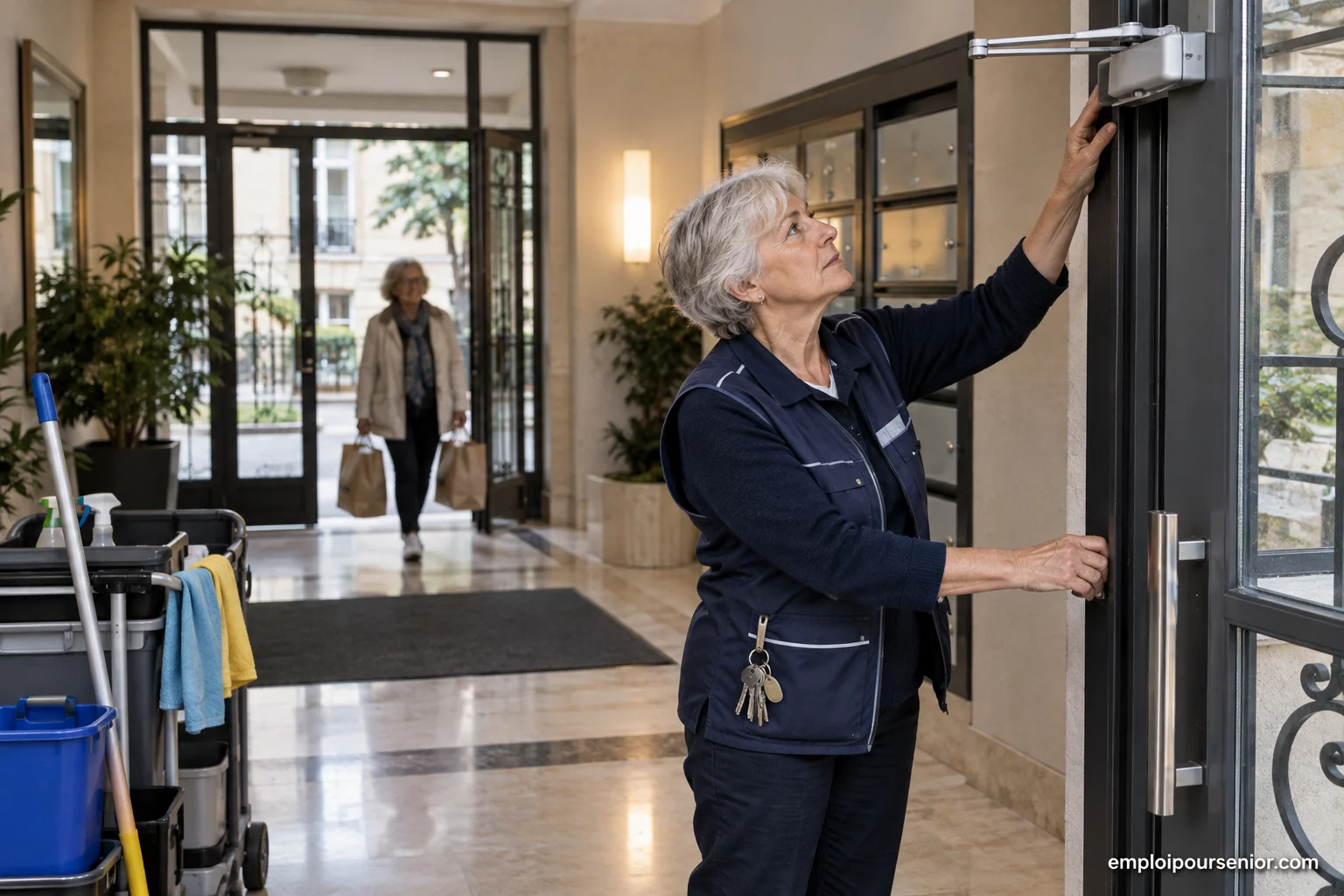
What covering for a caretaker involves
In a housing complex, the caretaker is the person residents meet every day. They watch over the communal areas, put bins out and bring them in, clean certain spaces, receive contractors and report breakdowns. When they go on leave or are away for several weeks, someone has to hold the post. That is the relief caretaker’s role.
Covering is therefore not a separate occupation but a temporary way of doing the same job. Depending on the employer, it may be a fixed-term contract covering the summer holidays, a short stand-in of a few days or a roving post that moves from one residence to another. The detailed duties always depend on the job description for the site.
Why this post attracts people over 50
Employers mainly look for steadiness: someone punctual and discreet, able to stay calm in front of an angry resident and to report precisely. These qualities come with experience, whether it comes from retail, reception, maintenance, administration or the health and social care sector.
The post also suits people who want an activity limited in time. A cover of a few weeks lets you try the job without committing to a long period. On the other hand, it should not be seen as restful by nature: the pace is daily and the days include light to moderate physical tasks.
Usual tasks and the limits of the assignment
Tasks vary from one residence to another. In general you will find:
- supervising and cleaning halls, stairs, lifts and surroundings;
- managing waste: putting out the bins, checking sorting, keeping the bin room clean;
- checking lighting, doors and simple equipment, and reporting faults;
- welcoming residents, delivery staff and visiting firms;
- writing reports for the landlord or the managing agent.
The limit is essential: the stand-in does not take the place of a technician. Electrical work, working at height or a repair needing a certified qualification belongs to a specialist firm. Reporting is better than improvising.
Who employs a relief caretaker
The most common employers are social and private landlords, managing agents of co-owned buildings and some co-ownerships that employ their staff directly. Large organisations publish caretaker vacancies on their recruitment pages, sometimes with roving caretaker posts without accommodation. Others go through specialist agencies or temporary-work firms.
The job is generally covered by the French national collective agreement for caretakers, concierges and building employees. It sets out, among other things, rules on categories of employee, whether accommodation goes with the post and working time. The exact conditions depend on the contract offered: check them with the employer before signing.
Contract, hours and pay: what to clarify
Before accepting, it is better to obtain the following in writing:
- the length of the cover and the name of the employee being replaced;
- the number of hours or the way work is counted, since it differs depending on the applicable regime;
- the periods of presence, any on-call duty and rest days;
- the pay, bonuses and travel costs covered;
- whether or not accommodation is provided during the cover.
Income depends on working time and the pay scale applied: no figure should be treated as certain before reading the contract. For a retired person, salaried work falls under the rules on combining work and a pension, which change over time: asking your pension fund before signing avoids unpleasant surprises.
Preparing a usable handover from day one
The quality of a cover is often decided in the first hour. An absent caretaker can no longer answer the phone, so information must be set down on paper or in a shared tool.
What to ask for
- the status of keys and badges, with a list of what is handed over;
- emergency numbers: landlord, technical on-call service, lift engineer, fire brigade, site contact;
- the instructions for sorting, cleaning and rounds;
- the list of ongoing jobs and unresolved complaints;
- the reporting tool used to log incidents.
Habits worth keeping
A short visit to the technical rooms and cellars, with the regular caretaker or an area manager, avoids costly mistakes. At the end of the cover, a factual report (dates, facts, action taken) lets the regular caretaker pick things up again without conflict.
Dealing with residents: the art of staying neutral
A stand-in arrives in a place where habits are settled. Some residents test the limits, others are simply worried about having a new contact. The most effective approach is to listen, note the request and state a realistic response time, without promising what only the landlord can decide.
Neighbour disputes, nuisance and situations where a resident is vulnerable should be reported to the manager rather than settled alone. Confidentiality also matters: what you know about a tenant should not circulate in the building.
Health, ergonomics and everyday safety
The job involves walking, stairs, carrying moderate loads (bags, bins) and repeated postures during cleaning. With age, it is wise to plan ahead:
- ask whether the site has working lifts and suitable trolleys;
- check the protective equipment supplied (gloves, safety shoes);
- know where the cleaning products are kept and how to use them;
- avoid isolation during night rounds or in poorly lit basements.
If you have doubts about your physical condition, a talk with the occupational doctor or your own doctor will clarify what is compatible with a post of this kind.
An example of a typical day on a medium-sized site
By way of illustration, here is how a day might go on a residence with a few buildings. Hours and tasks change from one employer to another.
- Early morning: putting out the bins and a tour of the communal areas to spot what is broken or dirty.
- Late morning: cleaning the halls and welcoming a contractor who has come to check a piece of equipment.
- Early afternoon: entering the reports in the landlord’s tool and answering residents who come to the lodge.
- End of day: a last round, handing instructions to the on-call teams and a summary note.
This outline shows the importance of method: a successful day is one where every incident is logged.
How to make yourself known to an employer
The simplest approach is to check the recruitment pages of landlords in your region regularly and to send an unsolicited application when a form exists. A CV centred on useful skills (reception, rigour, upkeep, dealing with the public) is better than an exhaustive list of past posts.
It helps to state your availability (summer, school-holiday periods) and your mobility, because some covers span several residences. Temporary-work agencies and the public employment service can also pass on vacancies. No step guarantees an interview: the aim is to multiply contacts with real employers, without paying an intermediary to obtain a job.
Frequently asked questions
Do you need a qualification to be a relief building caretaker?
No qualification is generally required, but some employers value a short course or a professional certificate for building caretakers. Experience dealing with the public, rigour and the ability to write a report count for a lot. The exact requirements are given in each advert and should be confirmed with the employer.
Can a retired person be a relief caretaker?
Yes, salaried work is possible in retirement, but it falls under the French rules on combining work and a pension, which vary with the retirement date, age and scheme. Before signing, it is sensible to ask your pension fund about the possible effect of this income on your pension.
Does the relief caretaker live on site?
Not necessarily. The regular caretaker sometimes has tied accommodation, but a stand-in or roving caretaker is often non-resident. Check in the advert and in the contract whether housing is provided, on what basis and for how long, to avoid any confusion when you start.
Can you carry out repairs in the building?
Only the simple tasks set out in the job description, such as changing an accessible bulb or freeing a bin. Electrical work, work at height and repairs needing a certified qualification are given to specialist firms. The caretaker’s role is to notice, report and follow up the matter.
How many hours do you work on average?
Working time depends on the contract and the regime applied by the employer, with some posts counting work in hours and others by a scale of tasks. No figure is valid everywhere. Ask for details of hours, periods of presence and rest before accepting, then check them in the written contract.
How do you start well on an unfamiliar site?
Ask for a written handover, visit the technical rooms, note the emergency numbers and identify the manager to contact in case of doubt. Keeping a record of each incident, with the date and action taken, protects the stand-in as much as the regular caretaker. If something unusual happens, it is better to raise the alarm than to decide alone.