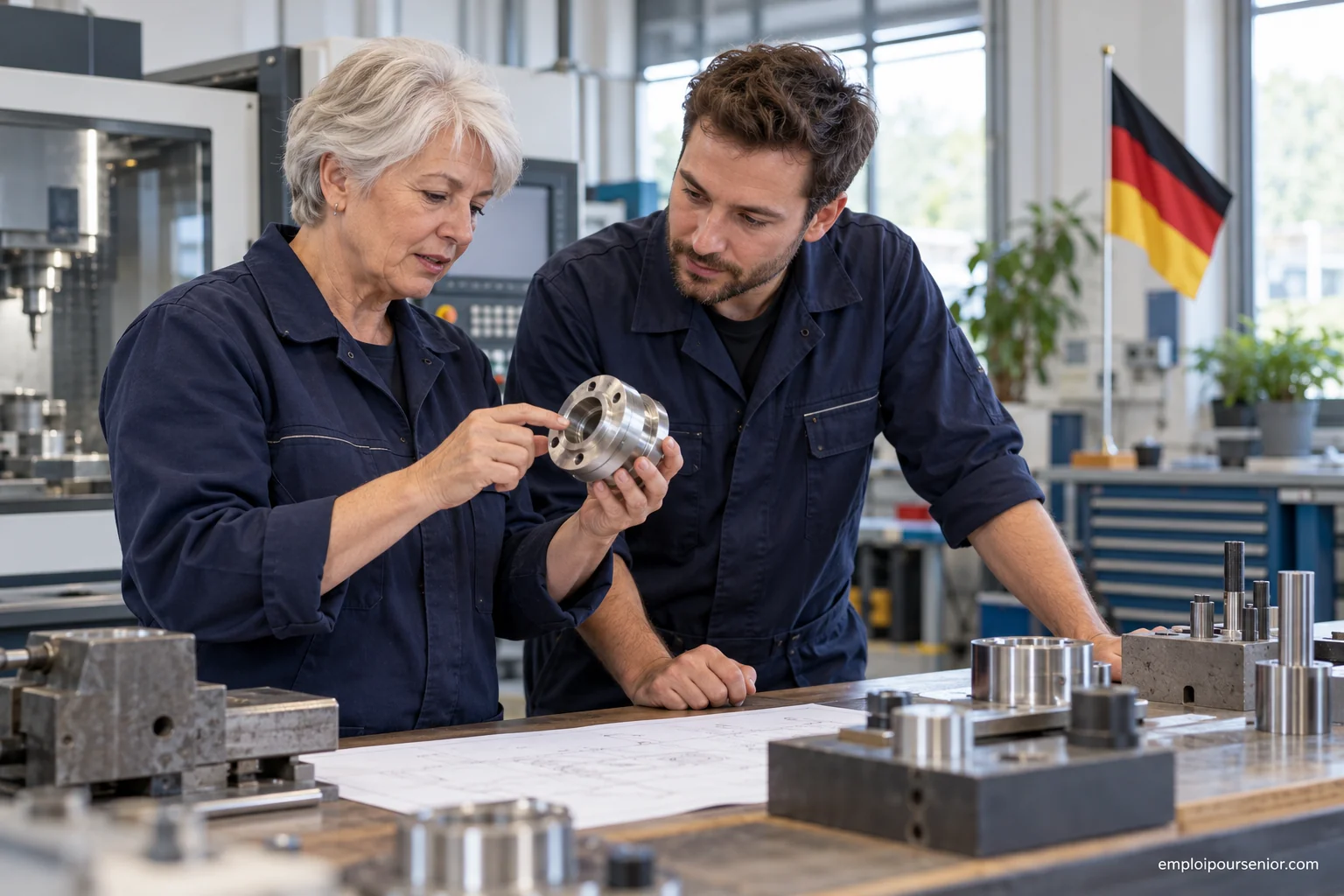
A labour market that wants skills, but in German
The German market is large and strongly regional: a vacancy in Stuttgart, in Hamburg or in a small town in Saxony will not come with the same pay or the same expectations. The sectors that regularly hire experienced people are engineering and industry, maintenance, logistics, health and elderly care, catering and hospitality, and some office jobs.
For a French-speaking reader, the first obstacle is almost always the language. Even an international company will often expect you to follow safety instructions, contracts and team discussions in German. Comfortable English opens a few doors, mostly in big cities, but it is no substitute for German in a job that involves local contact.
It therefore helps to start with one simple question: in which language will the day-to-day exchanges of the job you are looking at actually take place?
Working while drawing a pension: the rules to keep apart
In Germany the statutory retirement age is being raised step by step and reaches 67 for the most recent generations. Once you have reached it, combining an old-age pension with earnings from work is generally possible without an earnings cap. This is quite different from early retirement, where the rules have changed in recent years and need to be checked again.
A recent measure, often called Aktivrente, provides, according to the information available, an income tax exemption up to a monthly ceiling for employees who have reached the statutory age. Its exact conditions (type of employment, self-employment excluded, contributions still due) should be confirmed with the authorities or an adviser before you build a plan around it.
If your pension is French, Belgian or Swiss, the combination depends first on the rules of your own pension fund. Ask it before you sign: going back to work abroad can have effects that the employment contract never mentions.
Right of residence and work depending on your nationality
Citizens of the European Union, the European Economic Area and Switzerland generally enjoy free movement: they can look for and take up a job, subject to the usual residence formalities, including registering with the local municipality.
Other nationalities, for example a dual national living outside Europe, need a residence permit that allows work. Receiving a pension never replaces that permission. The official Make it in Germany portal describes the steps for applicants coming from abroad.
Think about social protection too: health insurance is compulsory in Germany for people who work there, and the way it operates (public funds or private cover depending on your status) differs from a French scheme. Ask the employer how your enrolment is organised from the day you start.
Getting a qualification or career path recognised
In regulated professions (health, teaching, some building and craft trades), a foreign qualification must be recognised before you can practise. The procedure takes time and may require certified translations. It is better to start it before leaving your current job or signing a lease.
For non-regulated occupations, employers care mostly about references, employment certificates and concrete examples. Turn your responsibilities into precise tasks: number of people supervised, machines mastered, standards applied, training completed. French job titles translate poorly word for word; look in German adverts for the title that really matches what you do.
- Keep a copy of your diplomas and certificates together with a translation.
- Note the level of German you can prove, however modest.
- Prepare two or three work situations that you can tell in a few sentences.
Where to look: adverts, the public agency and knowledge-transfer missions
The Jobsuche of the Bundesagentur für Arbeit, the public employment agency, gathers vacancies by occupation, town and working time. It is also a good way to pick up the vocabulary employers use. The large job boards work in the same way, and some offer a filter or a dedicated page for retirees.
Other routes exist for people whose main wish is to pass on what they know: the Senior Expert Service, an organisation of retired volunteers, places former professionals in advisory missions abroad or in mentoring roles for young trainees in Germany. This is voluntary work, with expenses reimbursed under some programmes, and not paid employment.
Finally, personal networks count for a great deal: former colleagues, Franco-German chambers of commerce, mutual-aid associations and regional fairs help you understand local customs before you apply.
Types of contract: part-time, mini-job, self-employed
Part-time employment is common and well accepted. The mini-job, a low-paid job subject to a monthly ceiling that moves with the minimum wage, has its own contribution rules; read the current conditions on official sources before making any decision.
Self-employment, with its own declaration regime, suits consultants, trainers or craftspeople who already have clients, but you will need to learn the local obligations: registering the activity, social protection and tax. It is also excluded from certain schemes reserved for employees.
Whatever the form, ask for a written contract in German and have it read by someone who understands legal language. Clauses on the trial period, working hours and notice period matter as much as the advertised salary.
Working rhythm, health and everyday organisation
A job that looks attractive on paper can become wearing if it involves long commutes, rotating shifts or repeated physical movements. Look at the real hours, the distance between home and workplace, and whether the workload can be adjusted if tiredness builds up.
Care, logistics and building jobs demand good physical fitness. Advisory, training, quality control or reception roles often leave more room for manoeuvre. Seniors who manage the transition well usually choose a workload they can sustain rather than the maximum full-time schedule.
Lastly, think about life outside work: housing, insurance, a doctor close by, banking formalities. Settling in Germany for the long term is a life project, not just a job application.
Example of an approach for a maintenance technician
As an illustration, take a 58-year-old maintenance technician living near the border who wants to carry on working in German industry. He starts by noting, in the Jobsuche, the job titles close to his own trade and the language requirements. He builds a two-page file: skills, machines he knows, safety certificates, references.
He then follows a few months of technical German classes and applies to medium-sized companies that accept part-time work or a hand-over arrangement with younger colleagues. Before signing, he asks his pension fund how the income would affect his pension.
This example is not a promise: results depend on the region, the sector, the language and each person's situation.
Common pitfalls to avoid
Some pitfalls come up again and again: promises of unrealistically high earnings, offers asking for payment before you are hired, accommodation tied to the job with no separate contract, or intermediaries with no verifiable company identity. A serious employer never asks you to pay money in order to be hired.
Also avoid presenting a diploma as equivalent to a German title before recognition has taken place, and avoid leaving your home before you hold a written job offer. Be wary of adverts with no company name or address.
If you have doubts about a contract, turn to a trade union, a chamber of commerce or an association that advises foreign workers. This check costs little and spares you long complications.
Frequently asked questions
Can I work in Germany while drawing a French pension?
Your right to work in Germany depends on your nationality and residence permit, not on your pension. Combining work with a French pension is a matter for the rules of your own fund. As a rule you should tell it before you start and keep proof of your earnings, to avoid a later adjustment.
Do I need to speak German to find a job?
For the great majority of jobs with local contact, yes, at least for safety instructions and team discussions. A few international companies work in English, especially in big cities. It is better to state your real level in your application than to overstate it: the employer will test it very quickly at interview.
How can I tell whether my diploma will be recognised?
It depends on the occupation. In a regulated profession, recognition is compulsory before you practise, with waiting times and documents to supply. For a non-regulated trade, the employer mainly judges experience and references. The Make it in Germany portal and the competent authorities of the Land explain the steps.
Is a mini-job suitable for a retiree?
It can suit light, occasional work, for example a few hours a week. The contribution rules, the earnings ceiling and the effects on social protection change over time and should be checked with official bodies. Do not expect a stable income from it, nor the status of a full employee.
Can volunteering replace a job?
No, it meets a different need. A voluntary mission, such as those run by the Senior Expert Service, lets you pass on your experience and stay active, with expenses reimbursed under some programmes. It brings no salary and does not give the same protections as an employment contract.
What should I arrange before moving?
Check your right of residence, health coverage, housing and the timetable for recognising qualifications. It is wise to contact your pension fund, ask for the contract in writing in German, and not leave your home country without a firm offer from the employer.