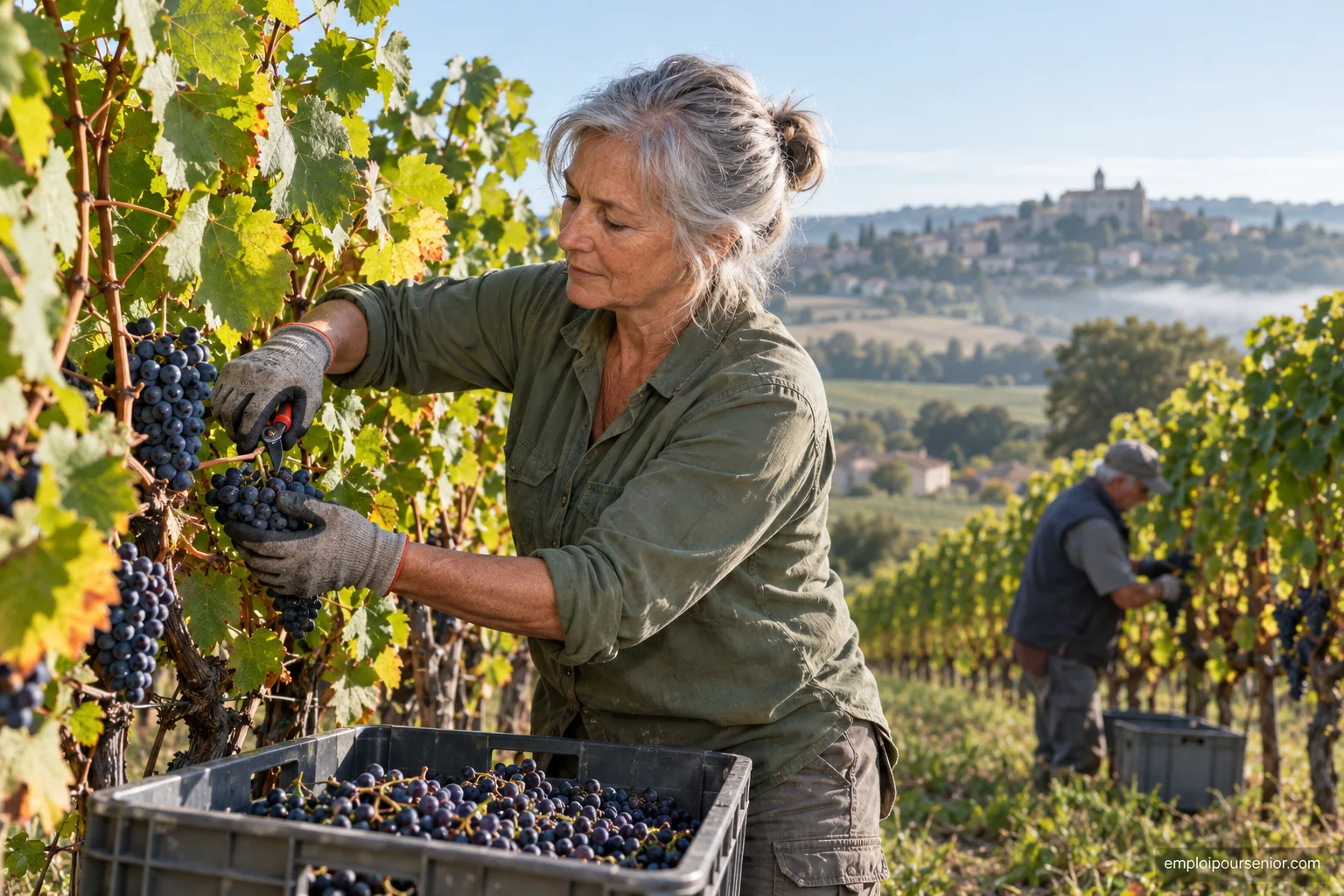
What "seasonal" really means on a farm
On French farms the season often starts in spring with pruning, thinning or planting, carries on with fruit and vegetable harvests in summer, and ends in autumn with the grape harvest, apple picking or walnut gathering. In between, other needs arise: sorting at the packing station, weighing, labelling and crating.
Each activity demands a different kind of effort. Picking strawberries means bending for a long time, grape harvesting involves cutting and carrying buckets, and sorting on a conveyor means standing in a cool or noisy room. The word "seasonal" therefore says almost nothing about what a particular job is really like.
The movements to review before you choose
Rather than thinking crop by crop, it helps to think movement by movement. If you are over 50, a few simple questions are worth asking:
- Can I stay on my feet, bent forward or crouching for several hours?
- What weight will I lift, and how often?
- Is the ground flat, sloping or slippery after rain?
- Is the work done in the sun, in a greenhouse or in a cold store?
- Is the pace set by a machine, a team or a yield target?
Gardening gives you some idea of how tiring it can be, but it is not the same as a full day of harvesting repeated several days in a row.
Vineyards, orchards and packing sheds: three different worlds
The vineyard
The grape harvest lasts a few weeks, with early starts and a strong dependence on the weather. Work in the rows means walking along sometimes steep slopes. There are also jobs in the winery or at the reception of the grapes, which are more static but noisier.
Orchards and market gardens
Picking fruit or vegetables alternates between high positions, on a ladder or platform, and low ones. Precision matters as much as speed, because damaged produce is downgraded.
Packing and grading stations
Sorting, grading and packing are done under cover, but sometimes at unusual hours and at a steady pace. This kind of job suits some people who tolerate the sun or uneven ground badly.
Contracts, declaration and pay: the basics to know
Seasonal farm work is generally based on a fixed-term contract, sometimes declared by the employer through a simplified form available in the sector. The worker should receive a payslip and know the hourly rate, the working hours and the applicable collective agreement before starting.
The "vendanges contract" that people often mention is a special arrangement for employees on paid leave who want to top up their income for a month at most. It was not designed for retirees: a retired person is more likely to be hired on an ordinary seasonal fixed-term contract, which you should ask the employer to confirm.
Pay depends on the job, on the collective agreement and sometimes on piecework in part. No amount can be promised in advance, so ask for it in writing.
Retirees: working a season without putting your pension at risk
Going back to work while drawing a pension falls under the French rules on combining work and retirement. Generally, you must have drawn all your pensions and meet the conditions for a full-rate pension to combine them without an income limit; otherwise the combination is capped. These conditions vary according to the scheme and year of birth.
Another point of caution: the work you take up does not, in principle, earn you any new pension rights. It is therefore wise to ask your pension fund for a written estimate before accepting an assignment of several weeks, and to report the extra income to the bodies concerned, particularly for tax and for means-tested benefits.
Accommodation, transport and breaks: details that decide the season
Many farms are far from towns. Before you say yes, it is better to clarify:
- the exact place of work and the start time;
- whether there is car-sharing, a shuttle or parking;
- access to drinking water, toilets and a place to rest;
- meals: provided, shared or brought from home;
- any accommodation, its conditions and its cost.
Basic shared accommodation suits some people and much less so others. It may be preferable to choose a farm near your home so that you keep your usual place to rest.
How to look for an assignment without scattering your efforts
Labour needs are very local and concentrated in short periods. Several routes complement one another: websites specialising in farm jobs, temping agencies focused on rural trades, bodies that give information on seasonal work, and direct contact with farms in your own commune or region.
In an application it is better to describe honestly what you can do, your real availability and your physical limits, rather than claiming you can do anything. Employers appreciate reliability: arriving on time, warning them if you cannot come and following safety instructions count for a great deal in a short season.
Health, safety and equipment: do not neglect preparation
Farm work exposes you to heat, cold, insect bites, crop-protection products and sharp tools. An employer must provide the protective equipment needed for the job and explain the rules, for example for areas that have recently been treated.
For your part, you can prepare for the season: sturdy closed shoes, covering clothes, a hat, sun protection, a water bottle and waterproofs. A word with your GP can be useful if you have a joint, heart or lung condition. If pain persists, stopping is better than pushing on, even if it means asking for a less demanding job.
A worked example: two weeks of picking close to home
As an illustration, imagine a retired person used to walking who wants to top up their income with a short assignment. They rule out vineyard harvests on hillsides as too steep and contact two apple growers near home. One offers platform picking, the other a sorting job at the packing station.
They ask about hours, contract, the nature of the work and access to breaks, and choose sorting because it suits their back better. Before signing, they check with their pension fund what effect this income will have. This example is not a promise: offers, durations and conditions change every year.
Frequently asked questions
Can I pick grapes after 60?
In principle there is no maximum age for farm work, but the employer must make sure you are fit for the job and that conditions are safe. Vineyard work remains physical: long periods on your feet, uneven ground and buckets to carry. It is worth asking which tasks are really on offer, especially in the winery or at reception.
Can a retiree sign a vendanges contract?
The vendanges contract is designed for employees on paid leave, for a limited time. It is not intended for retirees. A person who has retired is more likely to be hired on a standard seasonal fixed-term contract. The exact type of contract must appear in writing, and the employer is best placed to confirm it.
Is seasonal work compatible with my pension?
Often yes, under the rules for combining work and retirement, but conditions vary by scheme and situation: all pensions drawn, full rate, possible income ceiling. Before accepting an assignment, the safest course is to put the question to your pension fund and keep the written answer.
Which farm jobs are the least tiring?
No job is easy by nature. Sorting and packing limit exposure to bad weather but mean standing and keeping up a pace. Picking at height avoids bending but needs balance. The right choice depends on your weak points: back, knees, shoulders, tolerance of heat.
How can I tell whether an offer is genuine?
A reliable offer states the employer, place, dates, type of contract and job. Be wary of an advert that promises high earnings without detail, asks for money before hiring or refuses to give a written contract. If in doubt, contact the farm directly or the relay body in your region.
Do I need training to do seasonal farm work?
For most harvesting or sorting jobs no qualification is required: the employer explains the movements when you arrive. Some tasks, such as driving a machine or handling crop-protection products, do require a specific authorisation or training, which an employee should never improvise.