The Danish context: a labour market built on trust
The Danish labour market has a reputation for being flexible and not very hierarchical. Employers readily hire on the strength of a direct conversation, and colleagues often use first names, even with senior management. For someone who has spent thirty years in a very formal organisation, the change of tone can be surprising, but it often makes it easier for an experienced person to settle in.
The country has many small and medium-sized businesses: workshops, local shops, service firms, care homes. They need reliable people who can work independently. That does not mean there are plenty of jobs aimed specifically at older workers, but that professional maturity is a recognised quality when it is tied to a concrete task.
As everywhere, conditions vary by sector, region and employer size. The sections below give general pointers, which you should supplement with official information.
Language: an advert in English does not mean an English-speaking team
Many vacancies are posted in English, particularly in international companies, technology, industry and research. That tells you nothing about the language used at coffee break or in team meetings. A company can write its advert in English and still run day to day in Danish.
Before applying, it is therefore worth asking:
- which language is used with colleagues, with customers and in internal documents;
- whether Danish is required from the start or can be learnt on the job;
- whether the employer pays for, or helps with, language courses.
A person who commits to improving their Danish, however slowly, is often more welcome than one who relies on English alone. That said, some technical or training roles work perfectly well in a shared working language. It is better to check case by case than to assume.
Right to work and formalities: retirement settles nothing
One point is often misunderstood: drawing a pension, or being close to retirement, does not exempt you from any formality. The right to work in Denmark depends first on nationality and residence status. As a general rule, citizens of the European Union and the European Economic Area enjoy free movement, with registration steps to complete. Other nationalities normally need a residence and work permit.
The public portal New to Denmark, run by the immigration authorities, sets out the possible routes and lets you check what applies to you. Conditions change and depend on your personal case, so confirm them with the competent services before accepting an offer.
Once you are there, practical steps follow: a personal identification number, a digital ID for public services, a bank account, a tax card. A serious employer can usually point a newcomer in the right direction, but is not responsible for sorting these things out on your behalf.
Where to find suitable vacancies
Three kinds of channel complement each other. The first is the public service for international candidates, Workindenmark, which publishes vacancies in English, provides advisers from the EURES network and organises recruitment fairs. The second is made up of the large private job portals, among them Jobindex, which gathers tens of thousands of positions from across the country. The third is sites aimed at older workers, such as SeniorJob, which lists part-time, permanent, temporary and on-call work.
Looking at several sources helps you spot the sectors that genuinely recruit experienced profiles. It also stops you relying on a single shop window whose adverts are sometimes duplicated elsewhere.
Finally, unsolicited applications are common in Denmark, especially in small firms. A short letter that names a specific need has a better chance of being read than a general introduction.
Linking your application to an identified need
Stressing seniority is not enough. A Danish recruiter mainly wonders what you will be able to do in the first few weeks. It is better to connect your background to a precise task in the advert: diagnosing a fault, supervising an intervention, organising a schedule, training a newcomer, keeping the accounts.
An effective introduction fits in a few lines:
- one sentence naming the role you are aiming for and the type of work;
- two examples of problems you solved, described simply and without invented figures;
- the availability you want, for instance three days a week;
- a clear statement of which language you can use and at what level.
The CV can be prepared in a European format. Workindenmark’s advisory services offer tips on CVs, covering letters and unsolicited applications. What matters is to show that you have understood the employer’s need, not to retell your entire career.
Hours, responsibilities and practical conditions
At first contact it is perfectly reasonable to explain the pace you are after. The most useful questions concern how the job is organised in practice.
Working hours
Ask whether hours are fixed or annualised, whether on-call duties exist and how cover for absences is handled. Collective agreements, which are very present in Denmark, often govern these points; it helps to know which one applies.
Responsibilities
A supervisory post and a hands-on post do not have the same rhythm. Saying whether you want to pass on know-how, train people or simply carry out the work avoids misunderstandings.
Learning the job
Ask who will support you in the first weeks, which tools are used and how mistakes are handled. A culture of dialogue and of the right to make mistakes is common, but you cannot guess it without asking.
Commuting time is a final criterion: in a country where cycling and public transport shape so many journeys, a job twenty minutes away changes the balance of a day.
Pension and income: check before you accept
Denmark has a public pension system alongside occupational and private pensions, with a retirement age that is rising gradually. Working can affect certain elements of the public pension or some benefits, depending on your situation, and tax on earned income follows its own rules.
For someone who already receives a pension from another country, for example French, Belgian or German, the question arises in two stages: the foreign pension body may ask to be told about earned income, and the Danish tax authority may have its own declaration requirements. A tax treaty between the two countries may come into play.
No figures are given here, because the rules change. The safest approach is to ask the pension bodies concerned and the tax authority before you sign, describing the job and the planned income precisely.
Example: a former technician in a bicycle workshop
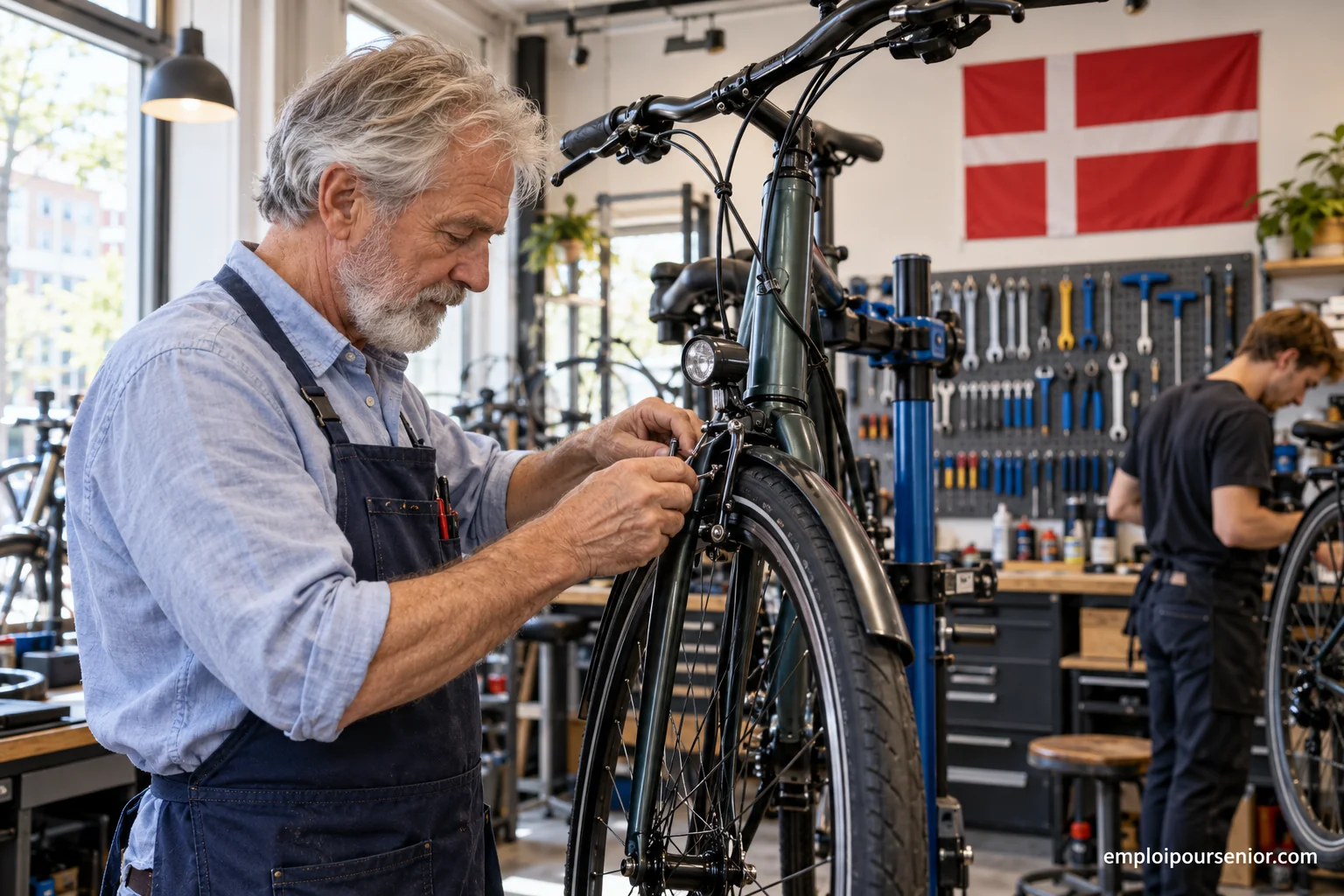
As an illustration, take a 63-year-old technician, a European citizen, who wants to work in a workshop near Copenhagen for part of the year. He browses the vacancies on a public portal and on a site aimed at older workers, and spots a bicycle shop looking for an experienced mechanic.
He writes a short letter mentioning that he can diagnose a brake or a drivetrain problem, train an apprentice and manage stock. He asks in writing which language is used with customers, how working days are split and whether there is a trial period. In parallel he checks the registration steps for a European resident.
This example describes a method, not a guaranteed result: no interview or job offer is assured, and real conditions depend on the employer. Still, the order of the steps carries over to many other trades.
Common mistakes and alternatives
Frequent mistakes include sending out identical applications in bulk, confusing the language of the advert with the working language, and forgetting to check the right to work before organising a move. Another trap is accepting a contract without reading the collective agreement attached to it.
If an employee post does not suit you, several alternatives exist: a fixed-term assignment, occasional consulting for a company, volunteering with an association or a local project, or a small-scale self-employed activity. Each has its own administrative and tax regime, to be confirmed with the competent authorities.
Finally, a trial stay of a few weeks with no commitment often gives a better sense of whether the pace, the language and the climate suit you before you settle for the long term.
Frequently asked questions
Do I have to speak Danish to work in Denmark?
Not always, but it is a major asset. Some international companies work in English, whereas many local employers work in Danish. An advert written in English does not tell you which language the team actually uses. It is best to ask, and to say whether learning Danish is possible or funded.
What is the difference between Workindenmark and a portal such as Jobindex?
Workindenmark is a public service for international candidates, with adverts in English, EURES advisers and fairs. Jobindex is a private portal that gathers a very large number of adverts, mostly in Danish. They complement each other, and it is common to look at both before deciding.
Can a foreign pensioner work in Denmark?
It depends on nationality and residence status. EU or EEA citizens generally have a right to move, with formalities to complete, while others usually need a permit. The official New to Denmark portal lets you check which procedure applies to you.
Does working change the amount of a foreign pension?
It depends on the scheme that pays the pension. Some bodies take earned income into account, others do not, and the tax authority may also ask for a declaration. No general rule replaces a check. Contact the pension body concerned before signing a contract and describe the income you expect.
Can I ask for part-time work at the interview?
Yes, it is a normal discussion in Denmark. Name the days you want rather than just saying part-time, and ask how cover and hours are organised. The employer may agree, propose another arrangement or decline: it all depends on the job and the agreement that applies.
Where can I find adverts aimed at older workers?
The SeniorJob site publishes vacancies suited to older workers, whether part-time, permanent, temporary or on-call, as part of an initiative on the transition to retirement. General portals and Workindenmark remain useful for widening the search. No platform guarantees an interview or a job.