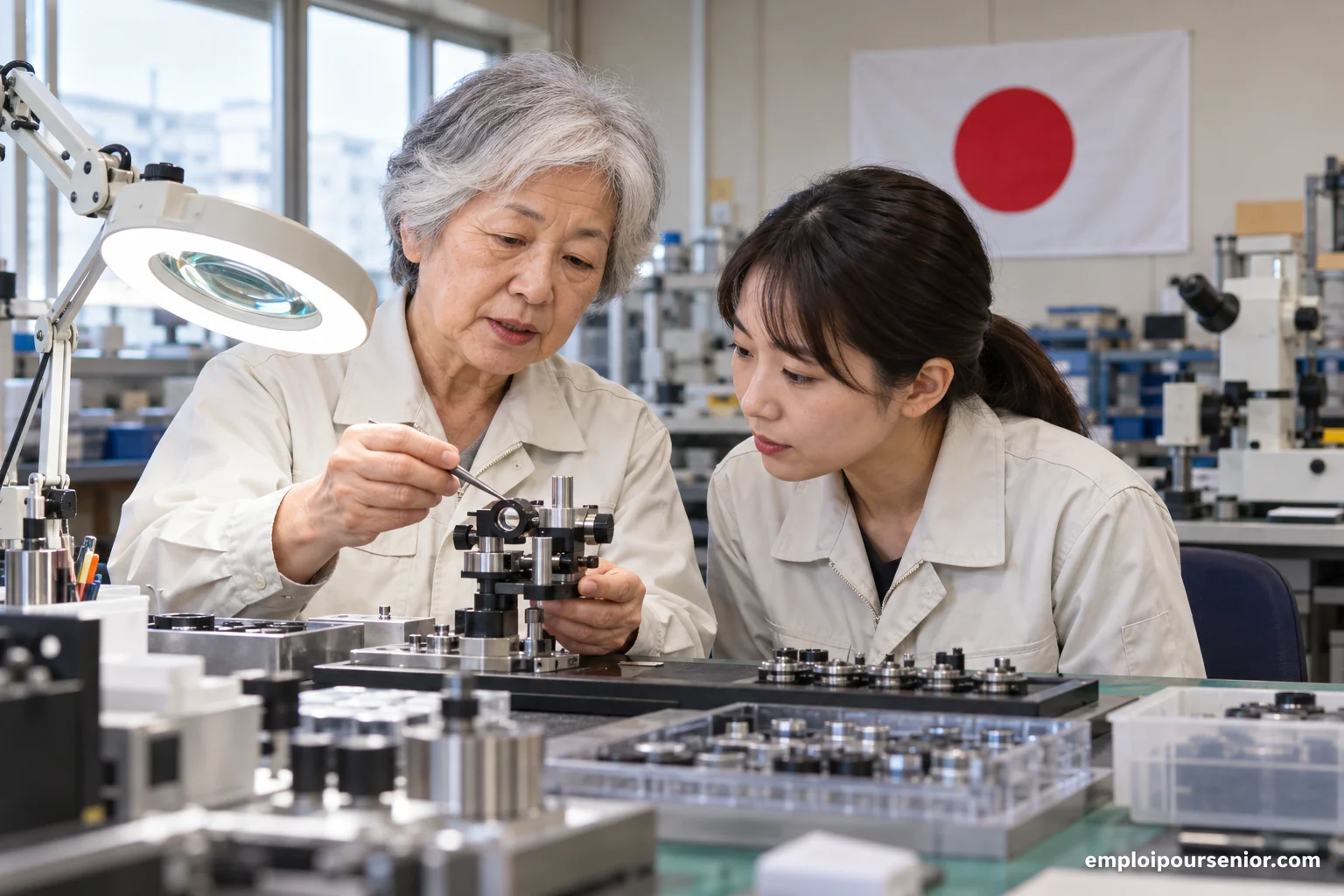
A country where working past 60 is common
In Japan, working life often extends beyond the age of 60. The legal framework encourages employers to keep employment opportunities open up to 65 and to look for solutions that go further, and many companies offer re-employment after the retirement age they set themselves. Details vary with the size of the organisation and the sector.
This extension takes very different forms, however. An employee can stay on at the same company with a renewed contract, often on different terms. A retired person can also turn to a Silver centre for occasional assignments, or look for a new post through public or private channels.
For an outside candidate, this background is useful to understand: older people’s employment is a social reality there, but it does not mean that every foreigner will find a job. Language, residence status and trade remain decisive.
Regular post, re-employment or assignment: three logics
Before comparing offers, it helps to know which logic they belong to.
The regular post
An employer recruits for an ongoing function, with an employment contract and fixed hours and pay. This is the framework of a standard salaried job.
Re-employment
This mainly concerns people who stay with the company after its retirement age. Duties, working time and pay may be revised; the practice is widespread, but it generally assumes you already have a link with the employer.
The one-off assignment
An organisation entrusts short or light tasks to a person, without this necessarily amounting to salaried employment. This is the territory of the Silver centres and of some small contracts.
Ask three simple questions about every proposal: who is the contracting party, how is the work paid, and what responsibilities are taken on?
Hello Work: the public employment service
Hello Work is the network of public employment offices. Its local branches present vacancies, guide job seekers and arrange interviews with advisers. The national website lets you search for posts by region, occupation and contract type, as well as for training courses and seminars.
Information and most exchanges are in Japanese. For a reader who does not speak it, two habits help:
- if possible, bring along someone fluent in Japanese on the first visit;
- prepare a simple document stating your occupation, skills, availability and residence status.
The advisers know the local offers and the programmes reserved for older people. Access to certain schemes may depend on residence, age or employment insurance, and is confirmed on the spot.
Silver centres: local activities close to home
Silver centres, found in many municipalities, are for retired people who want to stay active. Members, generally from around the age of 60, receive local assignments there: gardening and green-space upkeep, cleaning, car-park attendance, help with children or older people, and small office jobs.
These activities are generally temporary, short or light. The legal framework differs from standard salaried employment, and the financial return does not always take the form of a wage. Membership terms, any fee, the allocation of assignments and the pay are specific to each centre.
Registration is made at the centre in the municipality where you live, sometimes subject to residence conditions. A foreign national must also check that their residence status allows them to carry out these assignments.
Working Japanese, politeness and workplace culture
Command of Japanese weighs more than international experience in most local posts. Reading safety instructions, talking with colleagues or customers and filling in forms all call for a solid practical level, with particular attention to the polite register.
Workplace culture places importance on punctuality, precision and team spirit. The following can be prepared in advance:
- concrete examples of rigour, service or passing on know-how;
- a sober presentation, in Japanese if possible;
- a carefully written application, in the usual Japanese CV format;
- the ability to accept precise instructions and checking procedures.
Bilingual posts, in consulting, language teaching or international companies, offer more room, but there are fewer of them and competition is fierce.
Pension and earnings: points to check
The public system combines a basic pension and an earnings-related pension. Someone who works while drawing the employees’ pension may see it reduced, or partly suspended, if wages and pension together exceed a threshold. That threshold and the calculation rules change from year to year, and the basic pension is not affected in the same way.
Several factors come into play:
- the age at which the pension is claimed;
- whether or not you contribute to employees’ pension insurance in the post you hold;
- the amount of monthly pay and bonuses;
- the position of a former resident who receives a foreign pension.
The pension service, a social-security adviser or a specialist can work out the effect of extra income. The exact conditions cannot be deduced from a general summary.
Foreign nationals: residence status and permission
In Japan, the right to work depends on your status of residence. Each status is tied to permitted activities; some allow free employment, others restrict it heavily or forbid it. Retirement does not give any general permission to work.
Prudent steps:
- identify exactly which status is entered on your residence card or in your passport;
- consult the Immigration Services Agency’s information on the activities that status permits;
- if the planned activity is not covered, find out about a possible permission to engage in activity outside the status already granted, and do not start work before the answer;
- ask the employer or the Silver centre whether they know about these formalities.
Working without authorisation can affect your stay. For a specific case, a lawyer specialising in immigration law or the competent agency remains the reliable contact.
An example path for a technical profile
Take a former quality manager living in Japan under a status that allows it, who wants a part-time activity.
- He draws up a CV in Japanese centred on process control, training teams and keeping documentation.
- He makes an appointment at a Hello Work office and, in parallel, browses a job site aimed at bilingual profiles.
- He asks the Silver centre in his municipality about available assignments, for instance help at reception or light maintenance.
- For each proposal, he checks the type of contract, the pay and the effect on his pension.
This is an illustration: timescales and results vary greatly with the region, the language level and personal circumstances.
Health, pace and precautions
The Japanese working rhythm can be demanding: crowded commuter trains, overtime in some sectors, and heat and humidity in summer. Service or cleaning posts sometimes involve standing for long periods or handling loads.
A few checks before committing:
- hours per week and days off;
- the daily commute, especially at peak times;
- enrolment in health insurance and in workers’ accident insurance;
- trial period and renewal conditions;
- the precise role expected: it is better to turn down a post whose responsibilities remain vague.
As elsewhere, be wary of offers asking for payment up front, and hand over identity documents only to identified contacts.
Frequently asked questions
Can you work in Japan after 60?
Yes, it is common: many companies offer re-employment and local organisations arrange assignments for retired people. For a foreign national, however, everything depends on residence status, Japanese level and trade. No site can guarantee that an opening will be available.
What is a Silver centre?
It is a local association that puts retired people, generally from around 60, in touch with those who need small jobs done: upkeep, attendance duties, help with children, office tasks. Assignments are often short and the framework differs from salaried employment. Conditions are confirmed with the centre in your municipality.
Do I need to speak Japanese?
For the great majority of local jobs, yes, at least to read instructions, understand colleagues and fill in documents. Bilingual posts exist mainly in language teaching, consulting or international companies. It is better to present your level honestly and prepare concrete examples of your work.
Does working reduce my pension?
It can for the portion of pension linked to employees’ pension insurance, when wages and pension together exceed a threshold. The rule and the threshold change from year to year, and the basic pension is treated differently. It is best to ask the pension service for a calculation before accepting a post.
Can a foreign retiree work in Japan?
Only if their residence status allows it. Retirement gives no general permission. You need to look at the activities the status permits and, if necessary, consider permission for activity outside the status before starting. If in doubt, the Immigration Services Agency or a competent lawyer gives the reliable answer.
How should I prepare my application?
A carefully written CV, preferably in Japanese, a short profile and precise examples of accuracy, service or passing on skills are expected. State clearly the availability you want and adapt the document to each offer. A Hello Work appointment is worth preparing with these elements.