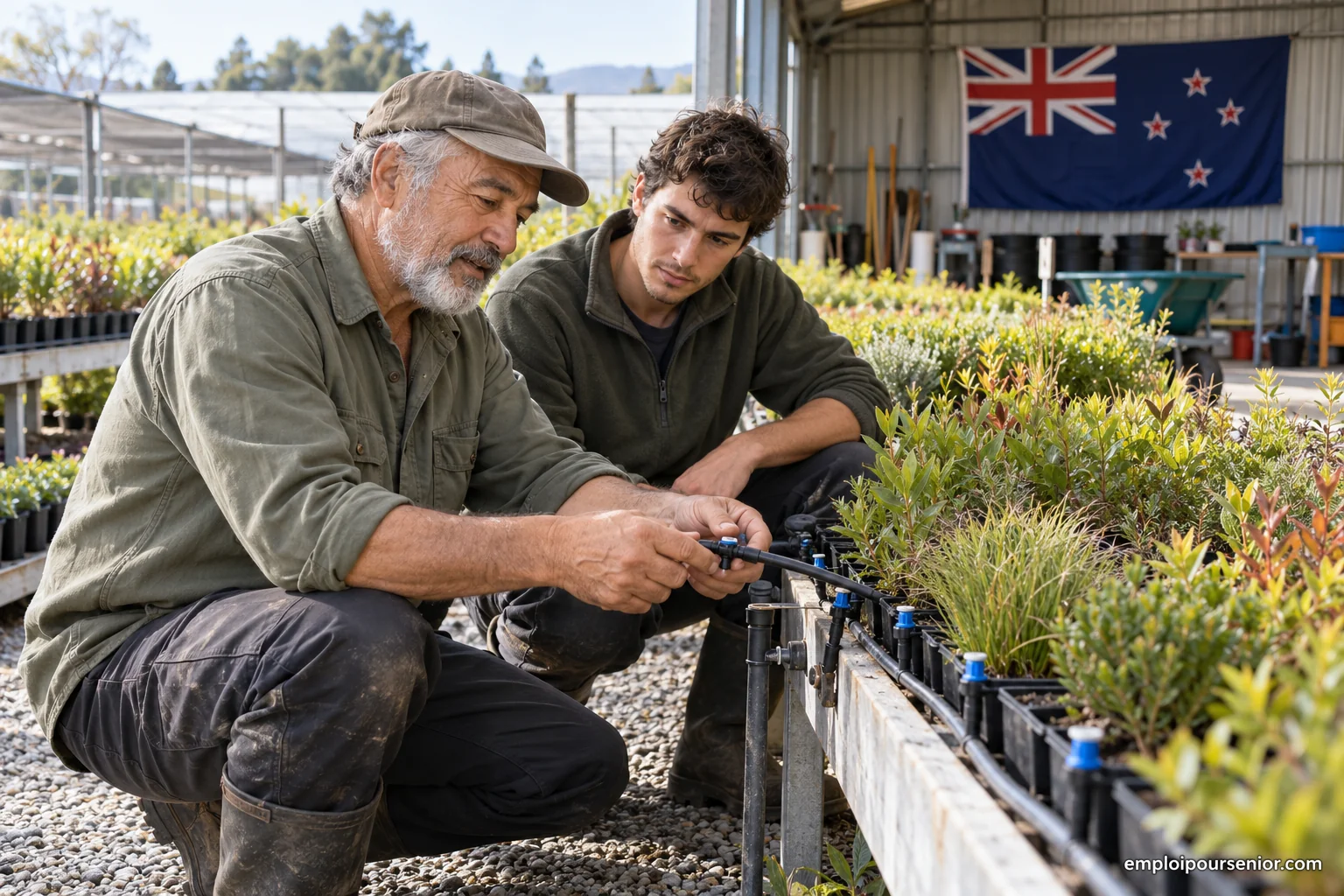
A country where age does not mark the end of working life
New Zealand sets no fixed retirement age. According to official information, 65 is common because it opens the door to the public pension, but an employer generally cannot force an employee to leave because of age. There are a few exceptions, for example for certain roles set by law.
Many people over 65 therefore keep working, often part time, in services, education, farming, retail or paid community roles. That makes it easier for older people to find work, though it does not remove the practical obstacles: distance, housing, competition and permission to work.
For a reader living in Europe, the first question remains status. A New Zealand resident and a foreigner passing through are not in the same position.
Visa and right to work: the check that comes before everything
Being retired or having personal savings does not replace checking the conditions that allow you to work. Depending on the type of visa, work is banned, limited to one employer, or permitted more widely.
- A visitor visa does not, as a rule, allow paid employment.
- An employer-specific work visa is valid only for the job and the location named on it.
- A resident or citizen works without any additional permission.
Before treating an offer as achievable, consult New Zealand's immigration authority and keep the conditions of your visa in writing. If in doubt, a licensed immigration adviser can look at your personal situation, whereas unregistered intermediaries are best avoided.
Pensions, savings and earnings from work
New Zealand's public pension is designed for residents who meet conditions of age and length of residence. Earnings from a job are, in principle, taxable, and the way they interact with the pension, retirement savings or other support must be checked with the relevant agency.
For someone who already receives a foreign pension, the question is different: the fund of origin may have its own rules on combining it with income from work abroad, and taxation depends on where you are resident. A consultation beforehand avoids costly corrections later.
This guide offers general pointers and does not replace personal legal, tax or pension advice.
Activities that are often open to older workers
Depending on region and season, older workers turn up in several families of activity:
- Horticulture and farming: pruning, harvesting, packing, nursery upkeep, with seasonal peaks.
- Retail and reception: sales, tills, welcoming visitors, tourist information.
- Technical trades: equipment maintenance, small repairs, driving, depending on recognised qualifications.
- Administration and management: order tracking, basic bookkeeping, secretarial work.
- Training and coaching: passing on know-how to younger employees.
Start from what you can explain and repeat: maintaining equipment, training a team, organising a reception or following orders. An application works better when it presents such achievements than when it retraces an entire career.
Region, season and transport: the real framework of daily life
A plan to work abroad should not be built only around the advertised pay. In New Zealand the region matters as much as the job: Auckland, Wellington and Christchurch offer more vacancies but high rents, while rural areas offer seasonal assignments with little public transport.
Always ask about:
- the schedule of the assignment, with start and end dates;
- the real working hours, including weekends;
- the exact location and how to get there, especially outside urban centres;
- housing options and what they cost;
- the equipment or clothing the employer provides.
A seasonal job can look easy to land and still prove incompatible with your budget if housing and a car are not sorted out in advance.
Preparing an application and using the right channels
A New Zealand CV is plain: no photo, written in English, with contact details, a short summary, recent experience and referees available with their consent. The cover letter answers the advertisement by linking your skills to the tasks described.
To search, combine several routes: regional job boards, temporary staffing agencies, your personal network, local associations and services for people over 50. Some platforms, such as sites reserved for older workers, were created by private or community initiatives; check that they are still active before you rely on them.
Avoid sending applications without a target. A few well-adapted applications aimed at a particular region, sector and working pattern usually work better than dozens of identical messages.
Example project: a former nursery technician near Tauranga
For illustration only: a 63-year-old reader, a former irrigation technician, wants to work for a few months around Tauranga. He first checks that his visa allows employment, then realises he will need a specific offer from an employer.
He writes an English CV describing three achievements: installing an irrigation network, training younger technicians and reducing breakdowns. He contacts a few horticultural businesses and local agencies, asks for a written schedule and compares the cost of housing with the pay on offer.
This scenario announces no hiring. It recalls the order of the steps: visa, region, written offer, budget, and only then departure, if everything adds up.
Health, physical effort and safety conditions
Outdoor work exposes you to strong sun, rain, uneven ground and repetitive movements. A handling or harvesting job demands stamina, and it may be sensible to discuss it with a doctor before committing.
Employers have health and safety duties: training on risks, protective equipment and clear instructions. Do not hesitate to ask about machinery, the products used and breaks.
For medical care, check what your travel or health insurance covers, because access to the public system depends on residency status. In the event of a workplace accident a national compensation scheme exists, but its conditions of access must be examined in light of your status.
Pitfalls to avoid and fallback solutions
A few mistakes come up often among foreign candidates over 50:
- leaving without having confirmed the right to work;
- accepting undeclared work, with no protection or recourse;
- paying money to an intermediary who promises a guaranteed post;
- underestimating the distance and the cost of returning home;
- neglecting the consequences for your pension and your tax position.
If paid work is not available to you, there are fallback options: remote work for an employer in your home country under the rules that apply, supervised volunteering, or teaching and mentoring at a distance. Here again, status has to be checked.
A scouting trip, shorter and less binding than a move, often lets you test a region before taking a lasting decision.
Frequently asked questions
Is there a compulsory retirement age in New Zealand?
No, there is no fixed retirement age. Sixty-five is common because it opens access to the public pension, but an employer generally cannot require you to leave on grounds of age. A few exceptions are set by law, so check them for your occupation.
Can a foreign retiree work in New Zealand?
Only if the visa allows it. Being retired gives no right to work, and a visitor visa does not usually authorise employment. A work visa is often tied to a specific employer. Consult the immigration authority before accepting any offer.
Which jobs are common for people over 50?
Older workers are found in horticulture, retail, reception, administration, technical maintenance and training. Needs vary by region and season. No offer is guaranteed: compare several local sources and ask for the schedule, hours and pay in writing.
Do you need to live in a big city to find work?
Not necessarily. Large cities offer more advertisements but higher rents. Rural areas offer seasonal assignments with little public transport. Weigh up housing and travel before choosing a region, because they often count for more than the pay.
Could a job affect my pension from home?
It depends on your scheme. Some funds accept a foreign income alongside the pension, others require a declaration or adjust the payment. Ask your fund before signing a contract, stating the country, duration and expected income, and seek tax advice if necessary.
Are there job-support services for older people?
Yes, public bodies, associations and private initiatives offer advice, job boards or coaching. Access often depends on residency status and region. Check the conditions of each service and whether it is still active before counting on it.