The Hungarian job market through the eyes of a candidate over 50
Hungary's jobs are concentrated around Budapest, but industrial hubs also exist in Győr, Debrecen, Székesfehérvár and Miskolc. Manufacturing, notably cars and electronics, shared-service centres, logistics and retail regularly recruit technical, administrative and supervisory profiles.
For an older candidate the aim is not to hide one's age but to make one's usefulness visible at once: which exact tasks can you carry out, with which tools, in what environment? Employers read a role and results first; length of service supports the case but never replaces a concrete description.
Describe what you actually do rather than your job title
A title from one country does not always translate into a Hungarian equivalent. Quality manager, team leader or maintenance technician can cover quite different responsibilities from one company to the next.
- List the operations you really carried out: dimensional checks, machine setting, scheduling, training colleagues.
- Name the standards, software and equipment you can use.
- Add one or two recent results, without inventing figures.
- State which languages you can use for written instructions and documentation.
Comparing this vocabulary with the wording of local adverts then lets you adjust the CV without distorting anything. A local certificate or training course is sometimes required for a given post, and experience does not always stand in for it.
Language: a real hurdle, though not an even one
Hungarian is very far from the Romance, Germanic and Slavic languages most of us know, and learning it takes time. In international companies, service centres and some industrial sites, English or German is common. In a local small business, in dealings with officials, or in everyday life, Hungarian is largely unavoidable.
It is better to state your level plainly, separating what you understand when spoken, when written, and in technical vocabulary. Starting lessons on arrival, however basic, signals seriousness. Your own language can also be put to use in language teaching, in looking after visitors from your country, or in certain services of foreign firms established locally.
Contracts and status: employee, agency or self-employed
The employment contract remains the commonest form, with a probationary period and notice that are regulated by law. Temporary-work agencies offer assignments whose terms depend on both the agency and the client company. Self-employment requires tax registration and independent management of contributions.
Whichever arrangement it is, ask in writing for:
- the exact place of work and any travel involved;
- the hours, and whether there is shift or night work;
- the contractual pay and how often it is paid;
- the length of the contract and the conditions for ending it.
Distinguish, too, between the advertised salary and the income you will really have left after tax, contributions and housing costs.
Pension and work: points to have confirmed
Combining a pension with a job depends on where the retirement income comes from. For a pension paid by a foreign scheme, that scheme gives the answer; for a Hungarian pension, the Hungarian pension services do. In general, a pensioner working in Hungary in the private sector may benefit from special contribution rules, which is one reason some employers take an interest in retired staff.
In the public sector, by contrast, the position differs: a pension may be suspended during employment, with exceptions in certain fields. These rules change from year to year. They need to be confirmed with the competent body before you give up another source of income or move.
Residence and formalities for a European citizen
A European Union citizen can in principle work in Hungary without a permit. For a stay beyond a short period, registration with the immigration office is generally required, with proof of address and of means or employment. A tax number and a social security number are then needed to be employed.
For someone who is not an EU citizen, a work-related residence permit follows a specific procedure, on which only the authorities can give a definitive answer. It is prudent to begin these steps before moving, since delays can be long.
Where to look: job boards, agencies and the public service
Job boards let you filter by town, sector and type of contract; recruitment agencies present temporary assignments or permanent posts for firms operating in the country. The public employment service, run through a regional network, explains registration as a jobseeker and the support available; access depends on where you live and on your personal circumstances.
It pays to follow the vacancies for several weeks to spot the job titles that keep coming up, to set alerts by town, and to prepare a CV in two versions, Hungarian or English depending on the employer. An application adapted to the advert generally has more effect than a general mailing.
Working pace, health and everyday organisation
Industrial jobs often run in shifts, sometimes at night, at a tempo that demands stamina and alertness. Office or service roles are steadier but can have peaks. Before replying positively to an offer, ask for a description of a typical day, break times and safety equipment.
Plan your health cover too: the European Health Insurance Card for a temporary stay, local registration if you are employed, supplementary insurance as needed. For a physical job a medical opinion beforehand is recommended, especially beyond sixty.
An example approach for an experienced technician
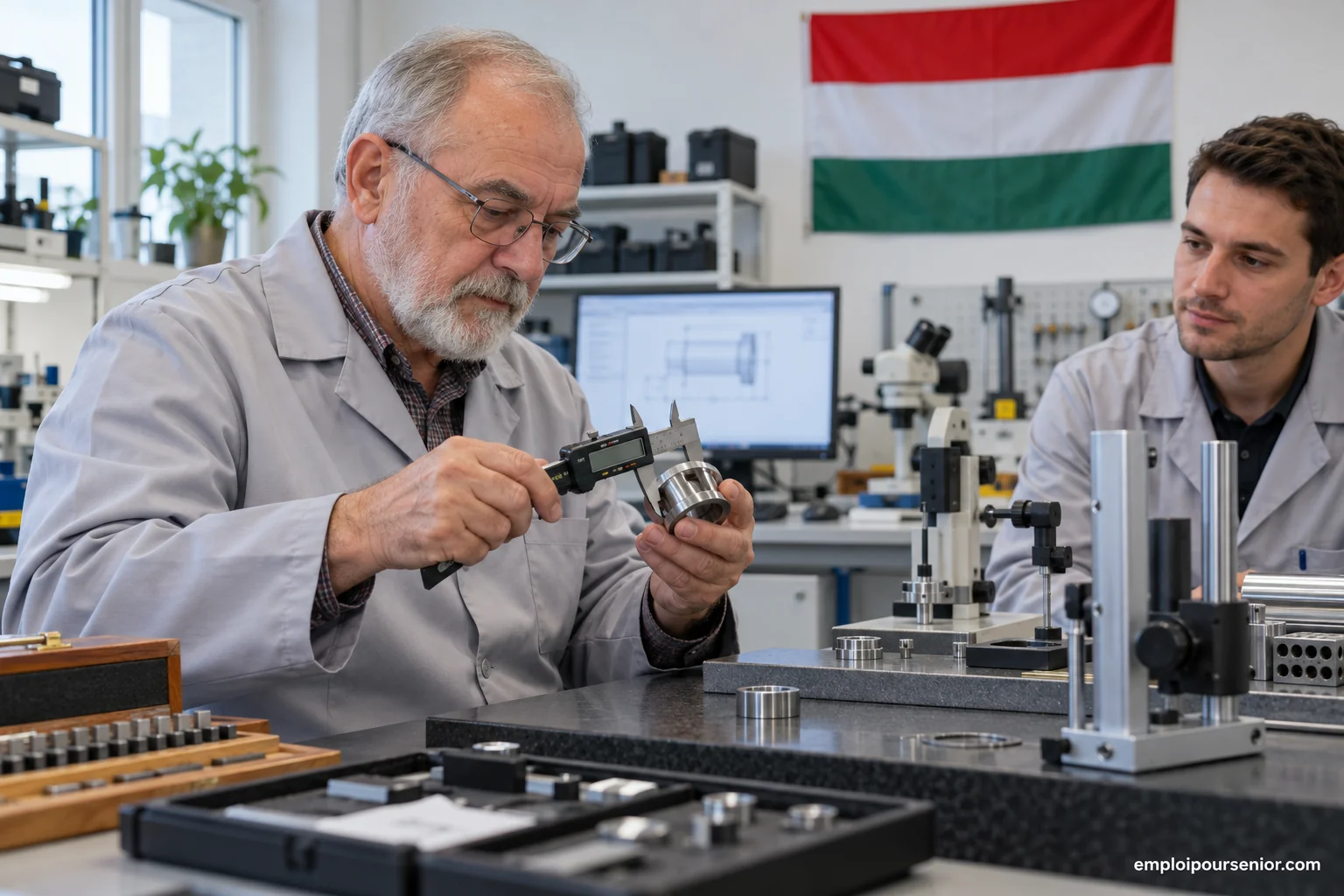
By way of example, a 58-year-old former metrology technician wants to work in an industrial laboratory in Hungary. He prepares a two-page file: measuring and inspection tasks, standards applied, instruments used, and the training of younger colleagues.
- He compares the titles in local adverts and adapts his vocabulary.
- He states his command of technical English and his progress in Hungarian.
- Before applying, he asks whether a local certificate is required.
- He has his pension and residence position checked before signing.
This example illustrates a method; it guarantees neither an interview nor a post.
Frequently asked questions
Can a retired person work in Hungary?
In principle yes, subject to residence status and the type of post. The effect on the pension depends on the scheme paying it and on the sector of work. For a foreign pension ask the scheme concerned; for a Hungarian pension, the competent Hungarian services. A written reply before signing is preferable.
Do I have to speak Hungarian to be hired?
That depends on the job. In international companies or service centres, English or German may be enough. In a local small firm, a public office or any job dealing with the public, Hungarian is usually expected. Stating your level precisely helps the recruiter judge the situation.
Which sectors recruit experienced people?
Manufacturing, logistics, maintenance, shared-service centres and retail regularly post vacancies. Needs vary by town and period, and no sector offers any guarantee. Comparing adverts over several weeks gives a more reliable picture than a few isolated offers.
Is a qualification from my own country recognised?
Not automatically. Depending on the profession, recognition of qualifications, local training or a specific certificate may be required. Put the question to the employer from the first exchanges and, if necessary, to the authority responsible for the profession concerned, before any move.
How do I compare an advertised salary with take-home income?
The advertised salary is a contractual starting point. What you actually have to spend depends on tax, contributions, rent, transport and healthcare costs. Asking the employer for a sample payslip or a worked calculation, then having the applicable tax regime checked by a professional, avoids overestimating.
Where can I find reliable job offers?
Established job boards, recruitment agencies and the public employment service are starting points. A legitimate offer never asks for money before hiring. Check the company name, its address and the written conditions before sending any identity documents.