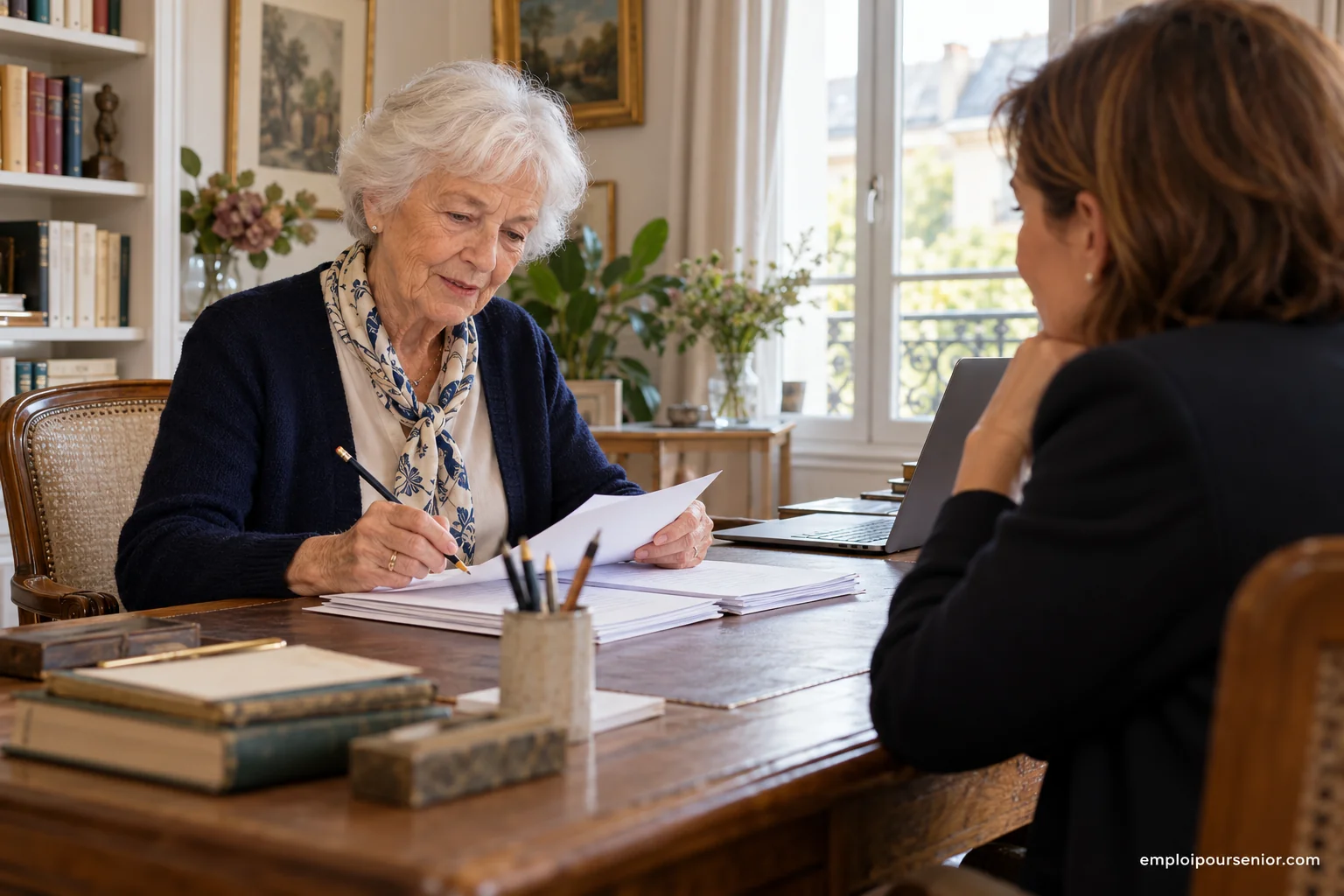
An approach that starts with the person’s own wishes
Beyond eighty, paid work is neither obvious nor impossible. It usually springs from a specific wish: to keep using a skill, to stay in touch with former colleagues, to pass on a trade, or simply to top up an income. Age alone says nothing about what a person can or wants to do.
The soundest starting point is therefore to ask what feels meaningful. Rather than looking for “a job”, it is more realistic to define a contribution: proofreading technical contracts, answering questions from young professionals, helping to sort archives, checking the accounts of a small association, explaining a manufacturing process. These tasks call for experience far more than for stamina.
No reputable organisation can guarantee an assignment or an income. The ideas set out here are for exploring, never for expecting as of right.
Short, precisely bounded assignments
The shorter and more clearly bounded the assignment, the better it fits personal constraints. A few forms are commonly met.
- One-off advice: an expert opinion on a file, a meeting of a few hours, a telephone or video call.
- Proofreading and writing: correcting manuals, reports, legal or technical texts, to be handed back by an agreed date.
- Passing on a trade: mentoring sessions for a young craftsperson, an apprentice or someone taking over a business.
- Small-scale training: a workshop for a handful of people on a subject you know thoroughly.
- Work from home: translation, data entry, checking figures, none of which involves travelling.
From the outset, spell out the expected result, the deadline and the preparation time. One hour of advice may take several hours of groundwork; if that hidden time is not reflected in the fee, the work quickly becomes thankless.
Pay: what should be agreed in writing
Money deserves to be settled without embarrassment. A written agreement protects both sides, even for a modest job.
- The amount or the way it is calculated: hourly rate, flat fee per assignment or per document.
- The payment date and method.
- The status: employee, independent contractor, or volunteer receiving expenses under the rules in force.
- Whether travel, equipment or software costs are covered.
- The length of the assignment and the conditions for stopping early.
A trial can be useful provided it stays short and defined: it must not turn into unpaid work. If a company asks for several hours of output before any agreement, it is legitimate to refuse or to propose payment for that phase.
No amounts are suggested here, because they depend on skill, sector and client. It is better to ask former colleagues or look at freelance platforms to get a sense of going rates.
Reconciling earnings with a retirement pension
Anyone who receives a pension and takes up professional work again is expected to tell their pension fund. The body will generally ask for supporting documents, such as a contract or certificate, to be sent according to the procedure it indicates. Depending on the scheme and the circumstances, the income may or may not affect the pension.
Other benefits are more sensitive. A survivor’s pension, the solidarity allowance for older people or certain social aids may take account of the income from a new activity. Before signing anything, it is better to ask each body how the planned income would be treated.
In France the rules on combining work and pension were changed for retirements starting from 2027, but people already retired in principle keep the conditions applying on their retirement date. In every case, the most reliable answer is the one from the fund itself, obtained in writing or at an appointment.
Adapting the workspace and the working time
A successful assignment at this age often rests on small adjustments that are easy to ask for and cost little.
Access to the place
A lift or ground floor, nearby parking, direct public transport and adequate lighting should be checked before accepting. Part-time or full remote working removes some of these constraints.
The workstation itself
A comfortable chair, a screen of a suitable size, enlarged characters or printed documents instead of digital ones can make a real difference. It is perfectly normal to ask for them.
The pace
Plan short sessions with breaks, and the option of postponing or interrupting a session without detailed justification. A flexible calendar is better than a rigid fixed schedule.
Health
Nothing replaces the family doctor’s opinion when the work involves travel, driving or a heavy mental load. The doctor can also help to settle on a reasonable number of hours.
Finding contacts without multiplying applications
At this age, the most effective approach is rarely a mass mailing of applications. A few targeted channels give better results.
- Your personal network: former colleagues, former clients and peers, who already know the quality of your work.
- Freelance platforms: they let you present a contractor profile and be approached by companies, with the platform handling contract and payment. Conditions and commissions vary and need to be read carefully.
- Skills-based volunteering associations: they connect active retirees with organisations that need advice, which may lead to paid work later, though that is never guaranteed.
- Local bodies: town halls, chambers of commerce and business incubators, which sometimes look for mentors.
A one-page presentation, centred on what you can do and your weekly availability, is more than enough.
Getting support without losing control
Online administrative procedures can be hard, especially for anyone unused to digital tools. Accepting help takes nothing from your independence, as long as the decisions remain your own.
A relative can read through a contract, help to set up an account or go along to an appointment. A local adviser can fill in forms alongside you. If you are unsure about a clause, a free legal consultation, offered in some town halls and justice centres, provides a neutral opinion.
A simple rule: never sign a document you have not understood, never give out your bank codes or log-in details, and take time to think, even when the other person is pressing.
A typical situation, as an example
A fictional example, meant only to illustrate the method: a retired accountant aged eighty-three wants to carry on checking the annual accounts of voluntary associations. He starts by informing his pension fund, which tells him which documents to supply. He then offers two associations a fixed-fee assignment, delivered within a month by email from his home.
The quote states the number of documents to check, the fee, the payment date and the conditions for stopping. When the assignment is finished, he reviews it with the associations: if the load was too heavy, he reduces the volume next time. This example is not a model to be followed to the letter, but it shows that an activity can stay short, well framed and entirely chosen.
Getting involved differently when pay is not the aim
Some people find that what matters to them is less the income than being useful. Skills-based volunteering, mentoring, sitting on a reading committee or on an association’s board all meet that wish with no consequence for the pension.
It is also possible to combine the two: start with an unpaid assignment, then consider a paid service if both sides wish it. Whatever form is chosen, the principle stays the same: a precise contribution, an agreed framework and the freedom to stop.
Frequently asked questions
Is it legal to work after eighty?
Yes, no law forbids working at this age. The most common forms are independent services and one-off assignments. An employment contract is rarer. Some occupations carry their own medical requirements, notably professional driving or care work, and these must be checked case by case.
Do I need to tell my pension fund?
Generally, yes. A person who receives a personal pension should inform the fund when taking up professional activity again, enclosing the documents requested. This step avoids later corrections. To learn the exact procedure, it is best to contact the body that pays the pension directly.
Could the income from an assignment alter other benefits?
It is possible. A survivor’s pension, the solidarity allowance for older people or means-tested aids may take a new income into account. The effect depends on the amount and on personal circumstances. It is better to ask each body before starting and to keep its replies.
What kind of assignment suits a very reduced pace?
Advisory, proofreading, mentoring or small-scale training assignments suit a few hours a week well, sometimes remotely. The essential thing is to fix the expected result, the deadline and the fee in advance, and to allow some margin for postponing a session without penalty.
Can a relative help me with the paperwork?
Yes, provided the person keeps the final say. A relative can read a contract, help to use a website or go to an appointment. France services centres also offer support with online procedures. The signature and the major decisions remain those of the person concerned.
How can I avoid job scams?
Be wary of any offer that asks for money in advance, promises a high gain for little work or demands an urgent reply. Check that the company exists, insist on a written document and never reveal bank codes. If in doubt, talk to a relative or an adviser before committing.