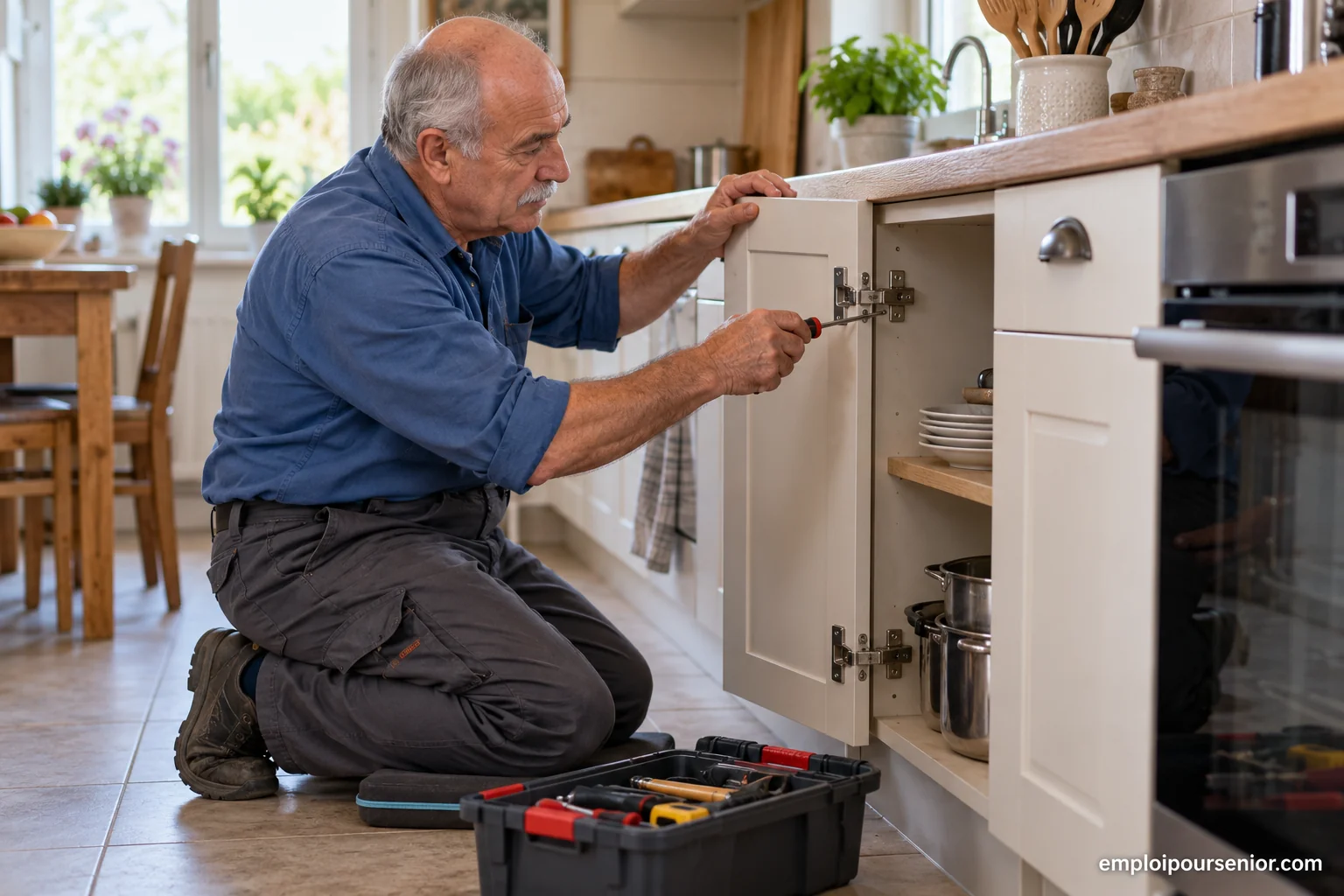
What paid handyman work covers
Offering small jobs means putting your practical skills at the service of households who have neither the time, the tools nor the wish to do certain tasks themselves. The most frequent requests are modest: assembling furniture, putting up shelves, curtain rails or mirrors, adjusting doors, replacing a tap or a washer, touching up paint, fitting a light without going near the fuse box.
These jobs often last from one to a few hours. They differ from renovation projects, which belong to building firms, and from regulated installations such as gas or complex electrical circuits.
Which former employees it suits
The activity suits people who enjoy repairing things and are at ease with customers. Former craftspeople, technicians, maintenance staff, electromechanical workers or plain DIY enthusiasts find it a natural continuation. Know-how counts, but reliability, a tidy job site, punctuality and clarity about what you can and cannot do count just as much.
You do have to accept a commercial side: answering quickly, estimating a duration, explaining a price and sometimes turning down a request. Being honest about your limits is better than a botched job.
Deciding what you do and what you refuse
A clear list of services reassures customers and protects the provider. It can sort jobs into three categories.
- Simple tasks that you master and offer without reservation.
- Tasks to assess case by case: replacing a tap, fitting a shutter or working on fragile surfaces need a look at the premises first.
- Work to refuse: gas, fuse boxes and heavy electrical installations, roofing, structural work, asbestos, risky work at height.
Some work can carry particular liabilities or require qualified professionals. If in doubt, it is better to point the customer towards a competent firm than to accept.
Legal status: private individual, micro-entrepreneur or employee
The framework depends on how regular the activity is. A favour done now and then for a neighbour is not the same as an activity offered repeatedly for payment. Once the activity becomes habitual, it generally has to be declared, often under the French micro-enterprise regime, which is simple to run but subject to precise rules (turnover declarations, contributions, ceilings).
Some platforms in fact list the self-employed among the accepted types of provider. Others also allow private individuals to offer their services. Precise rules depend on each platform and on your own situation, so check them before registering.
A retiree can also be employed directly by a private individual, for example through a service employment voucher scheme, for one-off tasks.
Insurance and liability: do not neglect them
A leak after a badly fitted washer, a shelf that falls, a scratched piece of furniture: handyman work is an area where damage can happen. Before starting, look at your insurance. Personal liability cover does not necessarily extend to paid activity, and professional insurance may be needed.
Some platforms say they offer cover for damage caused during a job booked through their app. Conditions, ceilings and exclusions are specific to each policy and need to be read carefully.
Keeping a written record of the agreed job (a message, a simple quote, before and after photos) makes it easier to settle any disagreement.
Finding customers: platforms, neighbours, local networks
Several platforms put households in touch with providers for DIY and small repair work. The principle is often the same: the provider creates a profile, lists skills, area and availability, then answers requests. Some take a commission, others charge for access to a customer's contact details or work by quotation. The way they operate therefore differs quite a lot.
Beside platforms, word of mouth remains effective: neighbours, apartment blocks, residents' associations, DIY shops, retirement housing. A serious profile with photos of completed work and reviews inspires confidence. It is better to start small, within a short radius, than to accept long and poorly paid journeys.
Setting your rates and organising your time
There is no universal rate: it varies by region, the nature of the task, urgency and the equipment needed. It helps to compare several local adverts, to factor in travel time, the tools you use and any charges linked to your status, and then to choose an hourly or fixed rate you can keep to.
Stating in advance who supplies materials, how travel is charged and what happens if the job runs longer than planned avoids friction.
A realistic pace also protects your health: vary the jobs, avoid overloaded days and leave a margin for the unexpected. Repetitive movements, stooping and carrying wear you out, especially after 65.
Retirement, combining income and declarations
The rules on combining a pension with earnings depend on your age, date of retirement, scheme and the type of activity, and they can change. The French pension insurance body publishes up-to-date information on the subject, which is worth reading before you begin.
You also need to plan for tax declarations linked to the income you receive. Personalised advice from the authorities or a professional remains preferable to a rough reading of general rules.
An example: a former maintenance technician takes two or three small jobs a week in his neighbourhood: assembling furniture, adjusting doors, replacing washers. He declares his activity, takes out suitable insurance and refuses anything to do with gas or electrical installations.
Frequently asked questions
Which small jobs can you offer without being a building professional?
Generally simple tasks: assembling furniture, fixing shelves or curtain rails, adjusting doors, small washers, paint touch-ups. Gas, heavy electrical work, structural work and roofing are for qualified professionals. If in doubt, decline or refer the customer elsewhere.
Do you have to declare this activity when you are retired?
As soon as paid activity becomes regular, it generally has to be declared, often under the micro-enterprise regime. Occasional arrangements between private individuals follow other rules. To know what applies in your case, ask the competent official bodies before you begin.
Do DIY platforms charge a commission?
It depends on each one. Some keep a percentage of every job, others ask for payment to see a customer's contact details, others work by quotation. The conditions are on their sites: compare them and read them carefully before creating a profile.
What insurance should you have for small jobs?
Personal liability insurance does not always cover paid activity. Depending on the situation, professional insurance may be needed, or you may rely on the cover a platform offers, subject to conditions. It is advisable to ask your insurer for a written opinion.
Can you combine this activity with your retirement pension?
Often yes, but conditions depend on age, scheme and retirement date, and some rules change. Before you start, consult the pension insurance body or your fund to find out whether the income may reduce your pension or earn extra rights.
How do you start with few customers?
The simplest way is to offer a few precise services to family and neighbours, photograph the results and collect reviews, then create a profile on one or two platforms. A small, well-served area is better than a wide one that is hard to cover.