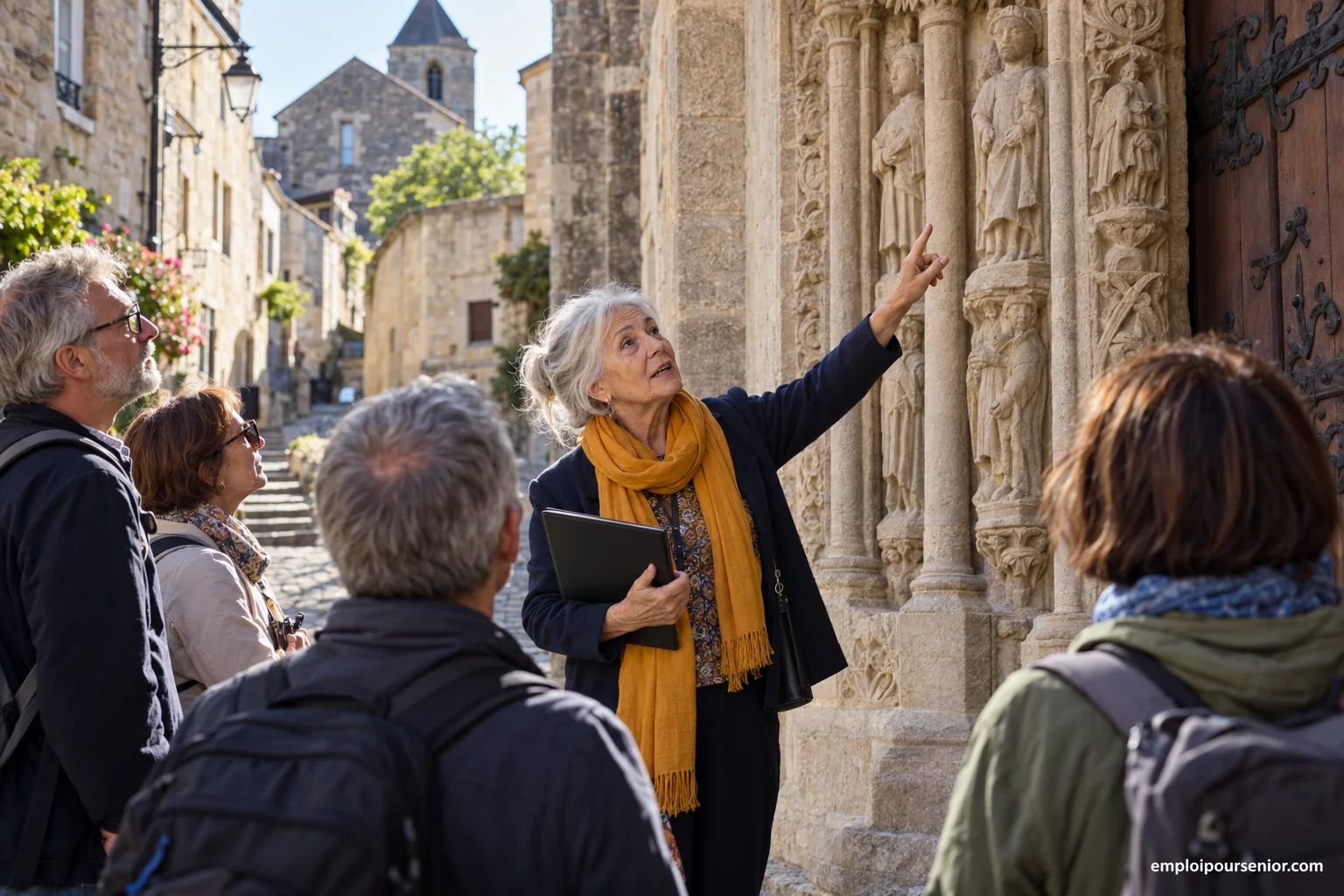
What being a local guide really involves
The phrase local guide covers very different realities. Some people lead visitors around an old town centre, others tell the story of a harbour, a vineyard, a former industrial district or a stretch of coastal path. What they share is the ability to turn knowledge into a route that is easy to follow, lively and reliable.
It is not about reciting dates. A good guide picks a handful of places, links the periods together, answers questions and knows when to stop because the group is tired. For someone over 50, memories of the area, of trades that have vanished or of the people who live there are often a genuine asset, provided they are checked against other sources.
Volunteer, occasional or professional: three separate frameworks
Before preparing a first tour, you need to know which framework it falls into.
- Volunteering: many towns have Greeter groups, local residents who show visitors their area free of charge. No pay is expected; the point is sharing and meeting people.
- The occasional paid tour: this can exist outside protected sites, for example a themed walk through streets or countryside. It generally requires a declared activity and compliance with trading and safety rules.
- The guide-lecturer: in France this is a regulated profession with a professional card, aimed at people who give commentary in museums and historic monuments.
Mixing up these three frameworks is the most common source of trouble. It is better to ask the question before promising anyone a service.
The guide-lecturer card: what to know
In France, a paid guided tour inside a museum or historic monument is in principle reserved for holders of the professional guide-lecturer card. According to the public information published by the authorities, working without the card in that setting is punishable by a fine, and the card is issued by the prefecture.
Getting the card requires a specific level of qualification, generally a bachelor-level degree geared towards guiding, or a master's degree with extra conditions, along with a good command of a foreign language. Conditions can change, so check them with the prefecture or on the official government website.
For a senior there are two routes: take a dedicated course, sometimes open to career changers or people returning to study, or stay with forms of tour that fall outside this regulated area.
Skills and qualities that matter
A successful tour rests on a mix of knowledge and people skills.
- Reliable knowledge of the area: written sources, local archives, testimonies that have been cross-checked.
- Storytelling: a voice that carries outdoors, short sentences, carefully chosen anecdotes.
- Group management: keeping to time, crossing streets safely, regrouping, looking out for slower walkers.
- Languages: a foreign language opens up new audiences, but only if your level is genuinely good.
- A welcoming manner and the ability to adapt to children, families or school groups.
Your working life, even in another field, often helps. A career in teaching, industry, retail or administration gives you a distinctive way of looking at places.
Building a solid tour, step by step
- Choose a thread: an era, a trade, a family, a style of architecture, rather than a simple inventory of sights.
- Document each stop by cross-checking at least two sources and separating what is established from what is legend.
- Walk the route at the times you plan to run it, noting noise, sun, benches, toilets and access for pushchairs and wheelchairs.
- Time the tour including stops and questions, then cut a quarter off it.
- Prepare a plan B for rain, heat or a closed site.
- Test it with friends or a small group and note where attention drops.
A tour improves through small adjustments; a first version that is too ambitious puts people off faster than it attracts them.
Pace, physical effort and the seasons
A two-hour tour often means four to five hours of your day once you count the welcome, the travel and the chat afterwards. Walking, standing and talking for long stretches are tiring, so assess them honestly before you commit.
In tourist destinations the work is strongly seasonal: very busy in spring, summer and school holidays, quieter the rest of the year. The slow months can be used to enrich your content, answer group enquiries or offer tours for local residents. On the practical side, comfortable shoes, water, a hat and planned breaks avoid a lot of discomfort.
Income and status: a question to settle early
What an independent guide earns depends on the number of tours, the price charged, any commission taken by a platform or tourist office, and costs such as insurance, travel and printed material. No regular amount can be guaranteed, and the first seasons are often modest.
Several arrangements are possible: a declared self-employed activity, for instance as a micro-entrepreneur in France, occasional assignments for a tourist office or an association, or a seasonal employment contract. For a retiree, whether the activity can be combined with a pension, and any limits that apply, must be checked with the pension fund. Professional liability insurance is one of the points to look at before any paid tour.
An example: a former secondary-school teacher
Illustrative example. A retired history teacher has lived for thirty years in a small port town. He starts by joining the local Greeter group and showing a few visitors around, which tells him whether his subject, the old shipyards, really interests people.
He then refines his route, times it and reads the municipal archives, before contacting the tourist office to find out which tours already exist. He looks into the guide-lecturer card, realises it would be required to give commentary inside a museum, and decides for now to limit paid tours to an outdoor route, after checking his insurance and declaring his activity. This kind of progression is cautious and can be reversed.
Common pitfalls and alternatives
Typical traps include presenting an anecdote as established fact, promising a visit to a site without permission, using a protected title without being entitled to it, or underestimating preparation time. Photos, texts and maps used in promotional material must also respect copyright.
If the regulated route does not suit you, other activities make use of the same knowledge: welcoming visitors at a museum or monument, mediation work for a heritage association, leading walks for local residents, writing booklets or content for a local website. These also need checking, but they do not all require the same level of qualification.
Frequently asked questions
Do I need a qualification to show people around my town?
It depends on the place and the type of tour. Giving commentary on paid visits inside a museum or historic monument is in principle reserved for holders of the guide-lecturer card in France. A volunteer walk or a stroll through public space follows different rules, which you should check with the town hall or tourist office.
Can I be a volunteer guide after 50?
Yes, volunteering has no age limit. Greeter groups welcome residents who want to show their area free of charge. You join a local group, or set one up with other volunteers, following the rules of the federation that coordinates the network.
How much can a local guide earn?
No regular income can be promised. Earnings vary with visitor numbers, the season, the price of tours, the guide's reputation and the costs to deduct. Many independent guides combine several sources: tours, assignments for tourist offices, talks or workshops.
Can I combine paid tours with a pension?
Combining work and retirement is possible in many cases, under conditions that depend on the pension scheme and on your own situation. Ask your pension fund for written information before declaring any activity, so that you know about possible income limits.
Which foreign language do I need?
No foreign language is compulsory for a tour in French. For the guide-lecturer card, a high level in a foreign or regional language is required. For other kinds of tour, a language is only worth offering if your level lets you answer questions and hold a natural conversation.
How do I find my first visitors?
The usual routes are the tourist office, heritage associations, works councils, schools, senior clubs and places to stay. A clear description of the theme, the length, the maximum group size and the price helps organisers decide quickly.