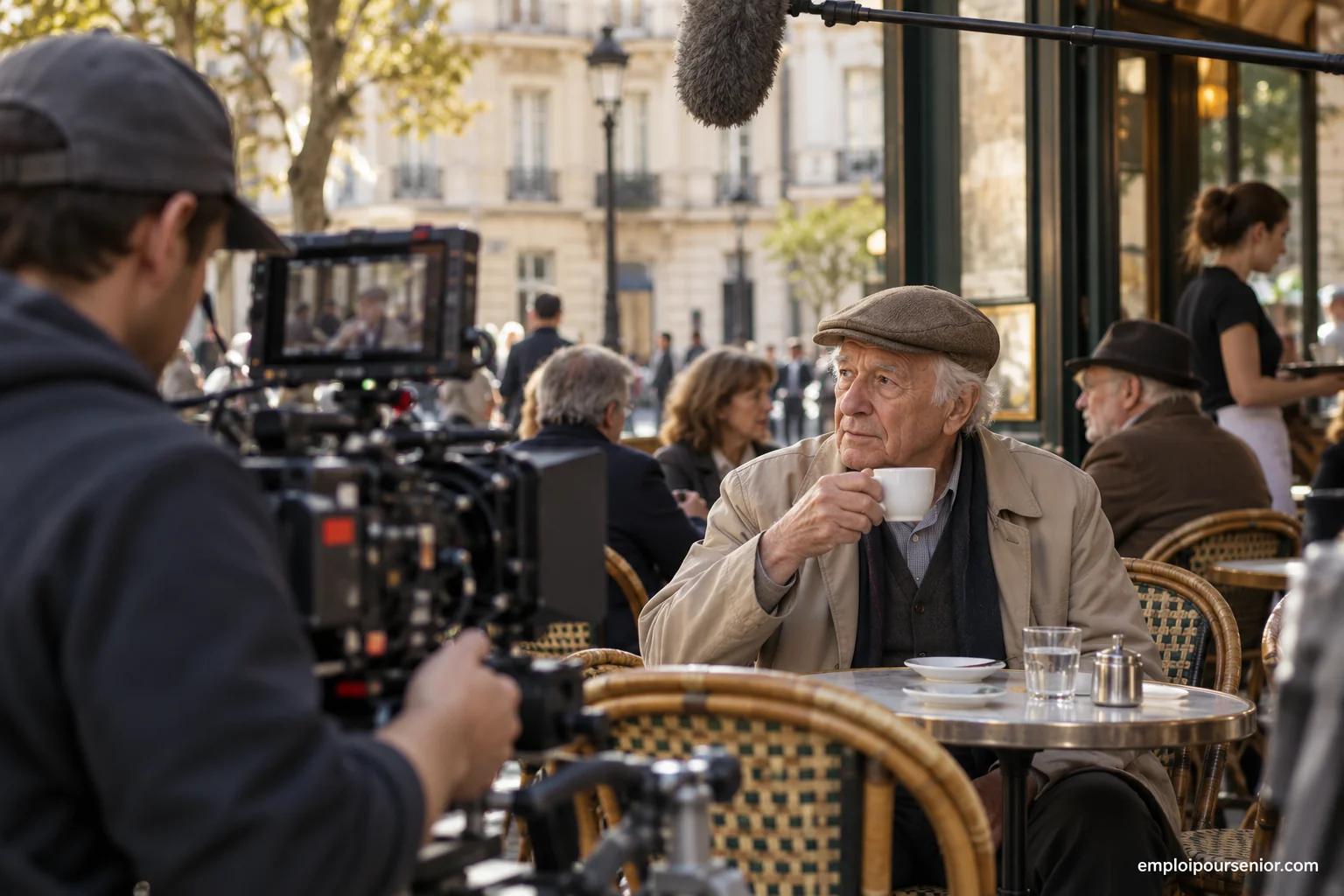
What an extra really does
An extra appears in the setting of a scene without a main speaking part: a passer-by in a street, a customer in a café, a spectator at a match, a patient in a waiting room, a guest at a wedding. They follow the instructions of the directing team, repeat the same gesture many times and keep continuity from one take to the next: same clothing, same position, same rhythm.
The work can look easy, but it takes discipline. You do not look at the camera, you do not speak aloud without instructions, and you stay discreet even when a celebrity is nearby. The aim is to be believable without drawing attention.
Why productions also look for older people
A story set in a village, a hospital, a market, a station or a care home needs faces of all ages. Casting teams build a human backdrop that fits the period and the place of the story. A period drama sometimes looks for particular profiles, for example silhouettes or looks that match an era.
Adverts usually state the approximate age wanted, the region, the shooting date and the characteristics expected: hair, height, clothing, any special features. An older person who matches these criteria therefore has a real chance of being chosen, though it is never certain.
Qualities and availability that make a difference
More than the wish to be seen, reliability counts. A production manager or assistant prepares the shooting schedule precisely, and a last-minute absence throws a whole day into disarray.
The most useful abilities are:
- punctuality, often at dawn, and the ability to reach a location that may be far away;
- patience, because the waits between takes are long;
- gesture memory: knowing how to repeat exactly the same action;
- the ability to put up with the weather, cold or heat, depending on the set;
- discretion about what is being filmed and respect for confidentiality instructions.
Wide availability, on weekdays as well as weekends, also increases the chances of being contacted.
Getting noticed: agencies, adverts and applications
Extras are recruited by casting companies, extras agencies or advert platforms. Some productions also use local calls, relayed by town halls, associations or the regional press. Adverts state the production concerned, the place, the date, the profile wanted and how to apply.
An effective application stays simple. It means answering only the criteria in the advert, attaching recent, natural photos, a portrait and a full-length shot with no retouching, plus the information requested: height, clothes sizes, availability, place of residence. Administrative documents are generally asked for only once your profile has been selected, as some adverts show by telling you not to send them at first contact.
Contract, pay and expenses: points to check
In France an extra is in principle an employee of the production, with a short-term employment contract and a payslip, which sets them apart from a volunteer. The precise terms depend on the type of production and the agreements that apply. Some adverts mention a standard agreed rate, others a gross amount for the day, others still travel costs that are not covered.
Before accepting, check:
- the identity of the production or agency, its contact details and its credibility;
- the date, the hours, the filming location and the transport arrangements;
- the pay announced, gross or net, and how it is paid;
- whether meals and travel are covered;
- the nature of the contract and the time limit for sending payroll documents.
No sum should be taken for granted until it appears in the advert or in the contract.
Beware of subscriptions and promises of roles
The sector attracts dubious offers. A site that charges a subscription or a registration fee cannot guarantee that an extra will be chosen: selection belongs to the production. A service that promises a role, a guaranteed casting or regular earnings in return for payment deserves the greatest caution.
A few markers help sort the genuine from the rest:
- read the subscription terms carefully, including their length and how to cancel;
- distinguish platforms that publish adverts free of charge from those that charge for access;
- refuse any payment requested by someone presenting themselves as a production;
- do not send ID documents or bank details at first contact.
If in doubt, look for the advert on a public source and contact the production through its official channels.
How a day on set unfolds
The day begins with arrival at the meeting point, often early, signing the paperwork and a visit to wardrobe or make-up. The extra sometimes brings several outfits, subject to the costume designer's approval, because the film requires particular colours and styles.
Rehearsals, takes, changes of shot and long breaks follow, sometimes outdoors. Meals are generally taken on site, depending on how the production is organised. The end of the day can come late, and its length is not always known in advance. It is therefore wise to plan a way home that does not depend on overly strict transport timetables.
Health, comfort and a concrete example
Filming exposes you to long periods standing, to cold, to heat and to moving over uneven ground. Anyone who copes badly with these conditions should say so when applying and find out about the nature of the scene: outdoors or indoors, night or day, the movements required.
By way of illustration, a retired man answers an advert to play a café customer in a series. He sends two recent photos and his availability. Once chosen, he arrives on time, stays seated for several hours, repeats the same gesture of stirring his coffee three times, then leaves late in the afternoon. What he remembers most is the waiting and the scrupulous respect for instructions. This example is not a promise.
Frequently asked questions
Do you have to be an actor to work as an extra?
No, extra work does not require actor training. Productions look instead for natural, punctual people who can follow precise instructions. Some extras later become featured extras or get small speaking moments, but nothing ensures it. It is better to approach the activity as an occasional experience.
Is extra work paid?
In principle the extra is employed and paid by the production, but conditions differ between shoots. Some adverts state a standard rate or a gross amount for the day, others stay vague. Read the advert carefully and ask for details before accepting, especially about travel costs.
Do you have to pay to register with an agency?
Some platforms publish adverts free of charge, others sell subscriptions, and no subscription guarantees you will be chosen. It is best to compare terms, read the cancellation conditions and be wary of promises of roles in return for payment. A reputable production does not ask for money to take part in a shoot.
Can a retired person combine extra work with a pension?
A retired person can in principle earn an occasional wage, but the French rules on combining employment and a pension vary by pension scheme and personal situation. It is prudent to ask your pension fund before taking on several shoots, to learn about any effects on your entitlements and your tax.
Which photos should I send?
Adverts generally ask for recent, sharp photos with no filter: a portrait and a full-length shot are often enough. Avoid holiday snaps, sunglasses and retouching. Each advert states its requirements, which you should follow as written, without adding administrative documents nobody has asked for.
Can you refuse a scene or an instruction?
It is important to flag any physical or personal limits before the shoot, such as cold, water, nudity or certain crowd scenes. On set, the production expects the shooting schedule to be respected. Working and safety conditions fall under employment law, and the contract and the advert should be read carefully.