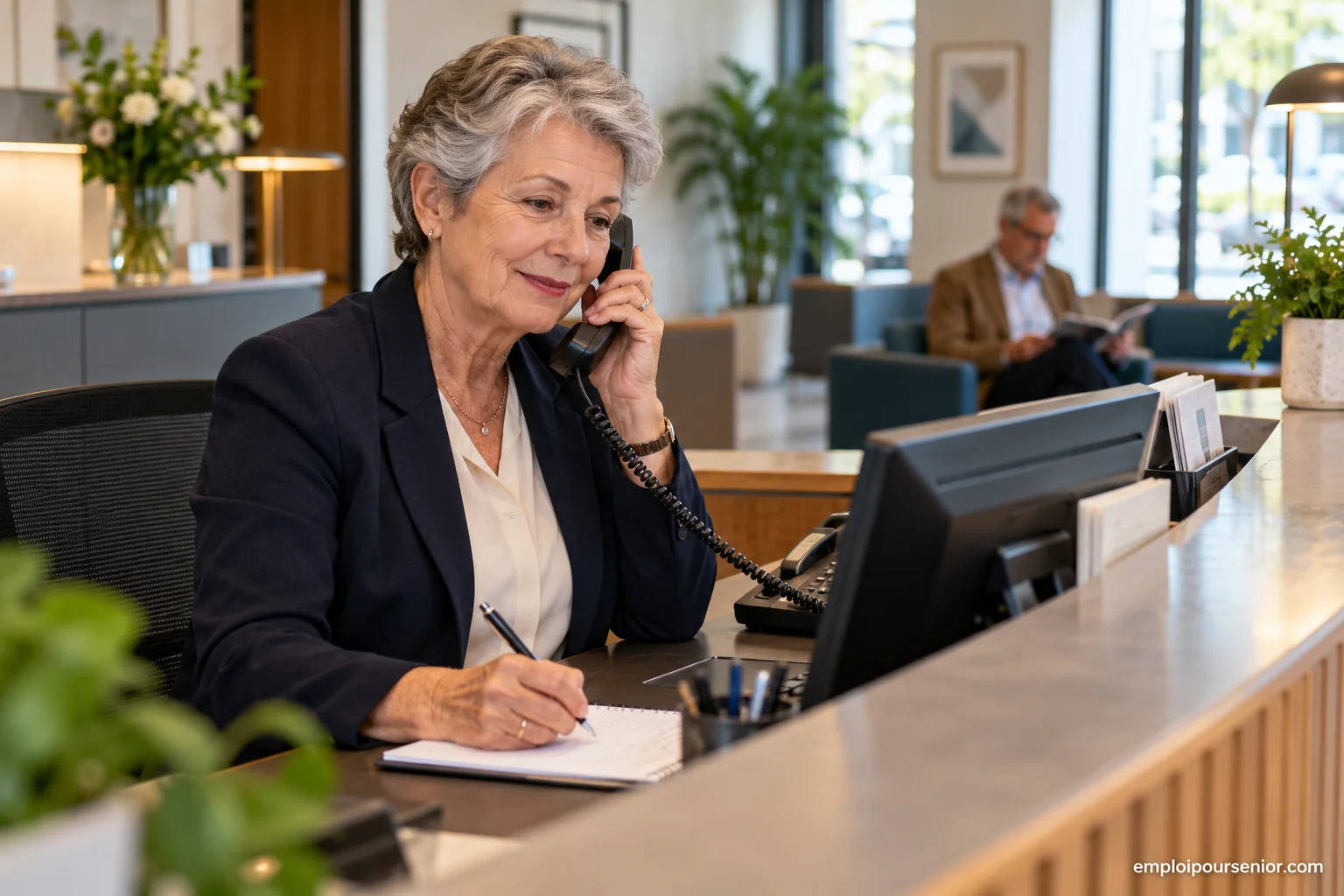
Switchboard and reception: two close but distinct roles
The switchboard operator handles incoming calls: identifying the caller, understanding the request, passing the call to the right person or taking a message that can actually be used. The receptionist adds the physical side of welcoming people: visitors, appointments, parcels, keys or badges depending on the site.
In many companies the two roles overlap, which is sometimes called a reception-and-switchboard host. In a hotel, reception adds arrivals, departures, bookings and billing. It is therefore worth reading each advert carefully to see what is really being asked.
What professional experience brings
Someone who has worked for a long time knows the vocabulary of different departments, can tell an emergency from an ordinary request and keeps calm with a caller in a hurry. These qualities do not replace technical skill, but they make relations easier with colleagues and clients alike.
The main limit is often the tools. Modern switchboards are built into a computer, with a directory, messaging and sometimes booking software. A senior who brings these skills up to date before applying narrows the gap with other candidates considerably, without having to justify it at length in an interview.
The tasks of a switchboard day
A typical day alternates calls, reception work and small administrative jobs. Instructions differ from one client to another: some require a precise greeting formula, others a strict screening of sales calls.
- Pick up within a short time using the greeting the company has chosen.
- Identify the name, the organisation and the purpose of the call.
- Transfer the call or take a complete message: name, number, reason, urgency.
- Handle physical reception, post and meeting-room bookings.
- Pass on instructions to the person covering the desk next.
The quality of a written message matters as much as your voice: one well-worded sentence saves several call-backs.
Simultaneous demands: setting priorities politely
The heart of the job is dealing with several requests without losing any information. A visitor is at the counter, a line is flashing and a colleague is waiting for an answer. The order of handling depends on the site’s instructions, but a few principles help: greet the person in front of you, warn the caller of a short wait, note the key details immediately.
A simple method
Look up, smile, give a time, then come back. This sequence shows everyone that they have been noticed, even when the matter cannot be dealt with straight away. In an interview, describing how you proceed with a concrete example is more convincing than simply declaring yourself well organised.
Confidentiality, languages and the demands of each site
The post gives access to sensitive information: visitors’ identities, absences, client names, internal organisation. Discretion is therefore an obligation in practice. Companies generally set rules on what may be said to an unknown caller, especially about whether a colleague is in the building.
The languages required depend on the place. In an international hotel, fluent English is common. In a medical practice or a town hall, careful use of the local language is often enough. Hours matter too: a hotel needs night or weekend cover, while an office business mostly works in the daytime.
Contracts, cover work and outsourced reception
Types of employment vary: a permanent post in a company, a fixed-term contract, agency work, holiday cover, or outsourced reception with a provider that places its staff with different clients. The last option offers variety but requires you to adapt quickly to each site.
Before a first cover assignment, it is reasonable to ask how you will be trained on the premises: introduction to the team, a demonstration of the switchboard, a list of useful numbers, the emergency procedure. Pay depends on the contract, the agreement and working time, and is not the same from one employer to the next. A retiree should also check the rules on combining work and a pension with their own pension fund; in France they differ by scheme.
Hotel reception: late arrivals and booking tools
Hotel reception stands out for its unusual rhythm and for tools specific to the sector. Late arrivals, early departures and last-minute requests call for patience and flexibility. The hotel management software records bookings, payments and guest preferences.
It is useful to ask whether the post includes nights, public holidays and handling complaints. For a senior, daytime posts or cover of a few hours may suit better than a night rota. A visit to the hotel beforehand often gives a good sense of the atmosphere.
Getting ready and comparing options
To prepare an application, gather two precise examples: one in which you dealt with several demands at once, and another in which you defused a tense exchange. Mention the software you master and the software you are learning. Practising quick note-taking and telephone listening is useful.
An example of a role-play
By way of illustration, a 58-year-old candidate imagines the following test: a delivery driver is waiting at the counter, two lines are ringing and a director asks for a number to be tracked down. She greets the driver, puts one caller on hold with a short sentence, takes the second message in writing, then comes back to each in turn. Telling this kind of story calmly says a lot about her way of working.
If the switchboard does not suit you, other reception jobs are nearby: office reception host, museum reception or ticket checking. Comparing two or three avenues stops you from limiting yourself to a single way of working.
Frequently asked questions
Do I need to be able to use a computer to be a switchboard operator?
Yes, in the great majority of cases. The switchboard is tied to a computer workstation with a directory, messaging and sometimes booking software. A basic level is often enough, but it must be solid. Digital workshops run by associations or libraries let you catch up before applying.
What is the difference between a switchboard operator and a receptionist?
The switchboard operator mainly handles calls and messages, while the receptionist also welcomes visitors, follows appointments or checks guests in at a hotel. In practice the two roles are often combined. The advert normally states how much is telephone work and how much is face-to-face reception.
Can I work part-time or on a cover basis?
Yes, these forms exist: holiday cover, agency assignments, part-time work or outsourced reception. They depend on each employer’s needs and are never guaranteed. Asking about the expected length, the hours and how you will be trained on site before accepting helps avoid surprises.
Is age a barrier for this job?
In France the law forbids any discrimination based on age, but recruitment practices remain uneven. Employers mostly look at command of the tools, clarity on the telephone, appearance and availability. Concrete examples of experience and a digital refresher strengthen an application.
Can I combine this work with a pension?
In principle yes, under the rules on combining work and a pension, which vary by scheme and personal situation. Conditions or limits may apply to earnings. Before signing, it is wise to ask your pension fund and to request a written estimate.
What questions should I ask at an interview?
Ask about the languages needed, the hours, the breaks, who covers during absences and which software is used. Ask too what training is planned on site and who to contact if you run into difficulty. These questions show you are serious and let you judge whether the post meets your expectations.