A country where working life can be extended
In Switzerland the reference age for retirement is 65, with a transition period for women linked to the reform of the AHV, the state old-age insurance. It does not necessarily mark the end of work: many people carry on in a reduced role, change jobs or start assignments on their own account. Employers, notably in crafts, precision industry, healthcare and services, value reliability and knowledge of the trade.
This openness creates no right to a job. The market remains selective, with big differences between cantons, so each application needs to be carefully prepared and tailored to the advert.
Flexible retirement and deferral: choosing your own pace
The AHV pension can be claimed from age 63 and no later than 70, at the moment you choose. You can also draw only part of it, for instance between 20 and 80 per cent, with the rest paid later. Full deferral, for a period of one to five years, earns a lifelong supplement whose rate rises with the length of deferral.
These choices affect both taxes and your standard of living, and they are hard to undo, because switching from a partial pension to full deferral is generally not allowed. Applying to the compensation fund several months before the planned date gets you an individual calculation.
AHV contributions after reference age
Anyone who still works after the reference age keeps paying AHV contributions but benefits from an allowance: a monthly amount of 1,400 francs per employer, or 16,800 francs a year, is exempt from AHV, disability insurance and income-loss compensation contributions. Above that, contributions are due according to the scale in force.
The allowance can be waived voluntarily, which sometimes makes it possible to fill gaps in your contribution record and improve the pension. The second pillar follows its own rules: depending on the pension fund regulations, voluntary contributions or continued coverage are sometimes possible. As the amounts change, confirm them with the official bodies.
Statuses and contracts to consider
Swiss law recognises the permanent contract, the fixed-term contract, temporary agency work and self-employment. The activity rate, expressed as a percentage, defines the workload; 40 or 50 per cent usually means fixed days or half-days.
The contract should state the job, the rate, the salary, the notice periods and, where relevant, irregular hours. Self-employed people must register properly and look into their pension provision. A retiree without a settlement permit, or a national of a non-EU country, must also check residence and work rights before taking any step.
Regions and languages: a market in three zones
French-speaking Switzerland offers adverts written in French, while German-speaking Switzerland often asks for German and Italian-speaking Switzerland for Italian. International firms in Geneva, Zurich or Basel also use English. A French speaker without German is therefore pointed towards Geneva, Vaud, Neuchâtel, Jura, Fribourg or Valais, depending on the sector.
Cross-border workers, especially around Geneva and in Jura, are numerous and work under a specific social insurance and tax regime. Their situation as retirees depends on the country of residence, so it is wise to ask the funds concerned for written information before committing.
Assignments that suit experience
Assignments that make the most of a long career are often limited in time: covering a leave, launching a project, mentoring a younger colleague, quality control, customer support, teaching or technical advice. In a workshop or a craft business, precise skill and knowledge of the standards count for more than a recent diploma.
- Cover and projects of limited duration
- Supervising young colleagues or apprentices
- Part-time administrative or accounting posts
- Reception, advice and customer service
Physical jobs call for an honest assessment of your fitness and of the burden of irregular hours.
Where to look: portals, associations and offices
The big Swiss job portals group adverts by region and by activity rate. Regional employment offices advise people who are registered as unemployed, and the official unemployment insurance platform also publishes vacancies. Some organisations that help older people pass on suitable offers and give free advice at their drop-in sessions.
Most positions are filled through recommendation. Letting your professional network know, former colleagues and clients included, therefore remains an effective channel. A typical Swiss application file consists of a short letter, a dated CV and work references, enclosed when the advert asks for them.
An example approach for a 66-year-old craftsman
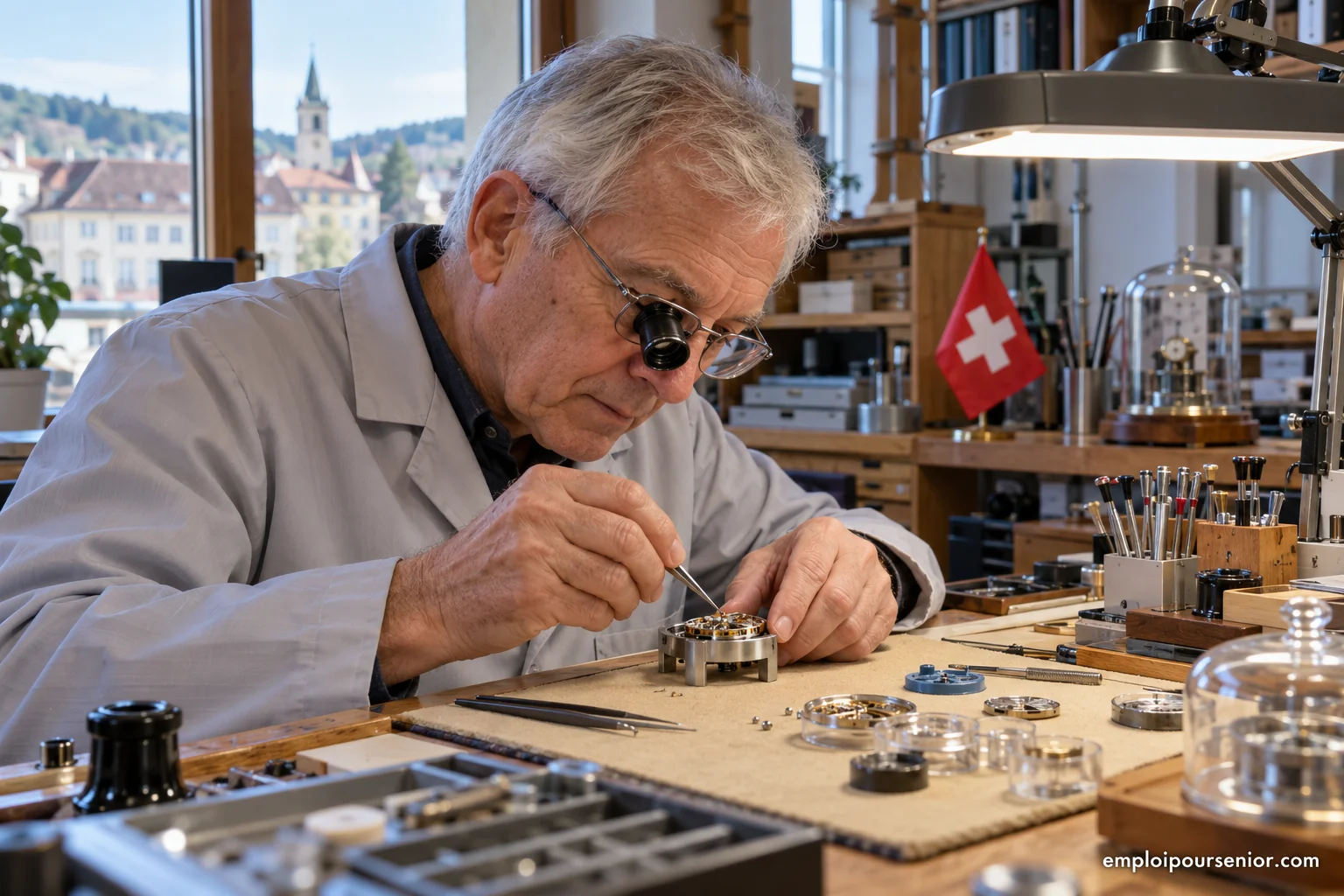
As an example, a former watchmaker aged 66 wants to carry on for two days a week. He first finds out about his pension and the AHV allowance, then prefers a contract with a fixed rate of 40 per cent to irregular assignments. He prepares a portfolio of his work, contacts former clients and browses the adverts in his canton.
This scenario is fictional and does not replace personalised information. It illustrates a method: check the social framework first, define a rhythm you can sustain, and only then negotiate with the employer.
Mistakes to avoid
It is common to confuse gross and net pay, to forget the tax effect of extra income or to claim the pension without comparing the options. A vague activity rate with no fixed days leaves you exposed to hours that creep upwards. Be wary, too, of offers that demand upfront payment for a file or a course.
Finally, housing and transport costs vary greatly by region, and a small income can be swallowed up quickly. A simple monthly budget, written down before you accept a job, avoids a nasty surprise.
Frequently asked questions
At what age can I claim my AHV pension in Switzerland?
The pension can be claimed from age 63, with a reduction, and no later than 70. Applying to the compensation fund several months before the date you want tells you the amount. The exact rules depend on year of birth and sex, so it is worth getting a personalised calculation.
Do I still pay AHV contributions if I work after 65?
Yes, but an allowance applies: a monthly amount of 1,400 francs per employer is exempt from AHV, disability and income-loss contributions. The excess is subject to contributions. The allowance can be waived to improve your pension. Check the current amounts with the fund.
Can I draw only part of my pension?
Yes, a partial pension equal to a share of the full pension, between 20 and 80 per cent, can be chosen, with the balance paid later. This choice has financial and tax consequences and cannot always be changed. Advice from the compensation fund is recommended.
Can a retired cross-border worker work in Switzerland?
This is often possible for a citizen of the European Union who holds the necessary permits, but insurance, tax and pension rules depend on the country of residence. Before accepting a post, it is wise to ask the bodies in both countries and to keep their replies in writing.
Is the activity rate negotiable?
Generally yes, especially for part-time posts. It is best to state the days of attendance, the percentage and the matching salary in the contract. Some employers prefer higher rates, while others accept 30 or 50 per cent to retain a scarce skill. Much depends on the job and the sector.