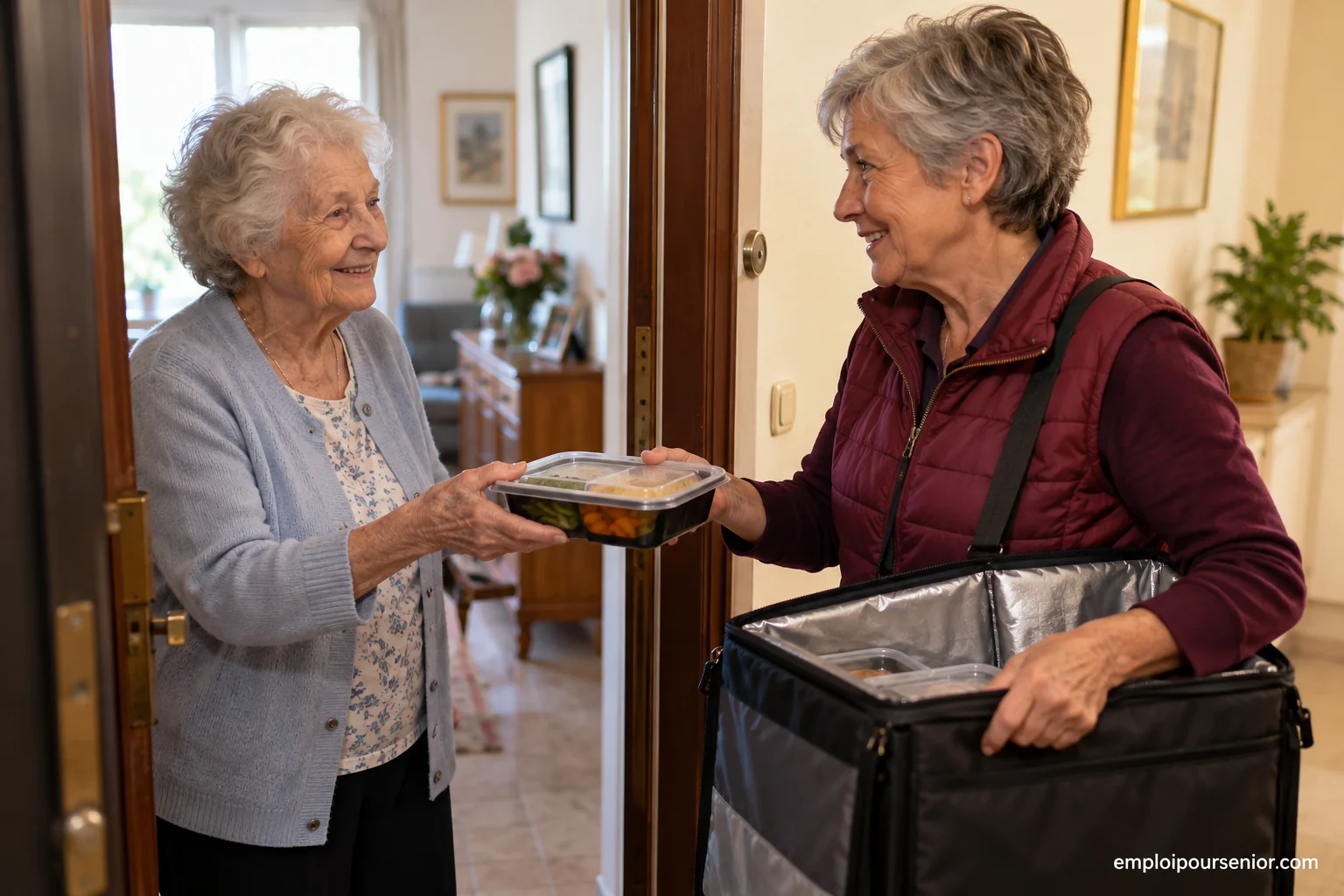
A round between the kitchen and the client's door
Home meal delivery means taking prepared meals from a kitchen to the homes of older, sick, disabled or less independent people. The driver prepares or checks the orders, loads the vehicle, follows a set route, rings at each client's door and hands over the right meal. Depending on the organisation, they also bring back uneaten trays and note down any useful remarks.
This daily visit, or several a week, is often the only contact of the day for some clients. That human side is what gives the job its value, but it does not turn it into care work: the driver does not change a diet on their own initiative and gives no medical advice.
Who can find their place in it after 50
The job attracts people who are punctual, calm, attentive and at ease with older people. Life experience, the habit of dealing with others and a sense of service are real strengths. Former home carers, shop workers, drivers, catering staff and activity organisers often find familiar ground.
It suits less well anyone who dislikes very early starts, days shaped by delivery time slots or repeated driving in town. It also means handling delicate situations tactfully, for example a client who does not answer the door or who wants to talk for longer than planned.
Licence, vehicle and everyday driving
A valid category B driving licence, the standard car licence, is generally required, sometimes held for a year or more depending on the employer. The vehicle is usually a small van fitted for refrigeration, or insulated crates, supplied by the organisation. You need to be able to manoeuvre in town centres, park close to buildings and follow road safety instructions.
Driving takes up a large part of the day. It is therefore worth checking whether the round is urban or rural, how far it covers, and whether the employer looks after the vehicle's servicing and insurance. Failing eyesight or hearing should be examined by a health professional before you choose this kind of work.
Hygiene, the cold chain and traceability
The meals being delivered are perishable. The driver applies the temperature rules, checks the condition of the packaging, checks the use-by dates of any products left over, and follows the hygiene rules set by the organisation: handwashing, a clean vehicle, keeping products separate.
The employer must explain these checks and provide training, often on the job and sometimes through a specific module. It is reasonable to ask how traceability is recorded, how an order mistake is reported and who to contact when the temperature of a load seems abnormal.
Hours and how the day is organised
Work starts early, sometimes at six o'clock, so that meals arrive before lunch. The round ends around the middle of the day, and the rest of the time may go on cleaning the vehicle, a debrief with the manager or preparing for the next day. Some organisations offer part-time hours, others full-time, and weekends may be involved depending on the service.
For a retired person, these early hours free up the afternoon but demand a disciplined routine for sleep and travel. It is wise to ask for a typical rota, the days worked and how often cover is needed.
Loads, stairs and physical demands
The job involves handling: meal trays, insulated crates, climbing stairs where there is no lift, and repeated trips between the vehicle and the building. The weight carried and the number of floors depend on the round.
Before accepting, it makes sense to ask to shadow an experienced driver on a round. That immersion tells you more about the reality of the job than a figure for kilometres. Any health limitation should be discussed with the occupational health doctor at the pre-employment check.
Contracts, status and going back to work in retirement
The contracts you meet include fixed-term and permanent ones, sometimes part-time or agency assignments, with specialist companies, home-care charities, council services or local social action centres. Pay depends on the organisation, the collective agreement, the number of hours and any bonuses. No serious advert guarantees an income level before signing.
For someone already retired, taking up paid work falls under the French rules on combining work and retirement (cumul emploi-retraite). The rules vary with the pension scheme and the individual situation, and they change over time. Checking with the pension fund is essential before signing. If you live outside France, ask your own country's pension authority.
Steps to get started
- Identify local players: meal delivery companies, charities, home-care services, town halls and social action centres.
- Prepare a service-minded CV: punctuality, driving, experience with older people, discretion.
- Ask for an immersion or a taster day on a round.
- Ask the right questions: span of hours, vehicle, loads, what to do if a client is absent, who to call if there is a problem.
- Check the contract: length, hours, trial period, reimbursement of any expenses.
Delicate situations and the limits of the role
The driver is neither a nurse nor a care assistant. If a client does not answer when expected, or seems to be in difficulty, the driver follows the organisation's protocol, which generally means alerting the manager. They avoid entering the home without permission, handling medication or replacing a meal on their own initiative. Anything confided to them stays confidential.
Setting out these limits at the interview stage protects the client, the employer and the employee alike.
An example of a morning, for illustration
For example, a typical morning might start at seven with a check of the meal crates, followed by loading and a round of around twenty homes. Conversations are brief, and attention stays on the order of calls and on special diets. Around noon the vehicle is cleaned and the driver has a debrief with the manager. This example does not reflect every organisation and is not a promise of a job.
Frequently asked questions
Do I need a qualification to deliver meals to people's homes?
In general, no particular qualification is required. Employers mainly expect a valid category B licence, sometimes held for a year or more, punctuality and a good rapport with older people. Training in hygiene and the cold chain is often provided in-house after you are hired.
Can I apply after 60?
No general rule prevents you from applying at that age, but hiring depends on the organisation's needs, your fitness to drive and your ability to carry loads. Vacancies are not guaranteed. A pre-employment medical check helps confirm that the job is compatible with your health.
What are the usual hours?
The round generally starts early, sometimes at six, so that meals arrive before lunch, and finishes around the middle of the day. Working time can be part-time or full-time depending on the employer, with weekends possible. Ask for a typical rota before committing, and check how you will get to work.
Can the driver help the client with their meals?
The role is limited to delivery, respecting dietary instructions and a kind manner. The driver provides no care, does not change meals on their own initiative and does not handle medication. If a client seems to be in difficulty, the driver alerts the manager following the organisation's procedure.
Can I combine this work with a retirement pension?
It is possible under the French rules on combining work and retirement, but the conditions depend on the pension scheme, the age at which you retired and each person's situation, and they have changed. Before signing, contact your pension fund to find out how the earned income will be taken into account in your pension.
What questions should I ask at the interview?
It makes sense to ask about the area and length of the round, the type of vehicle, the weight of the loads, the number of floors, the finishing time, the procedure if a client is absent, and whether any expenses are covered. The answers let you judge whether the job fits your own rhythm.