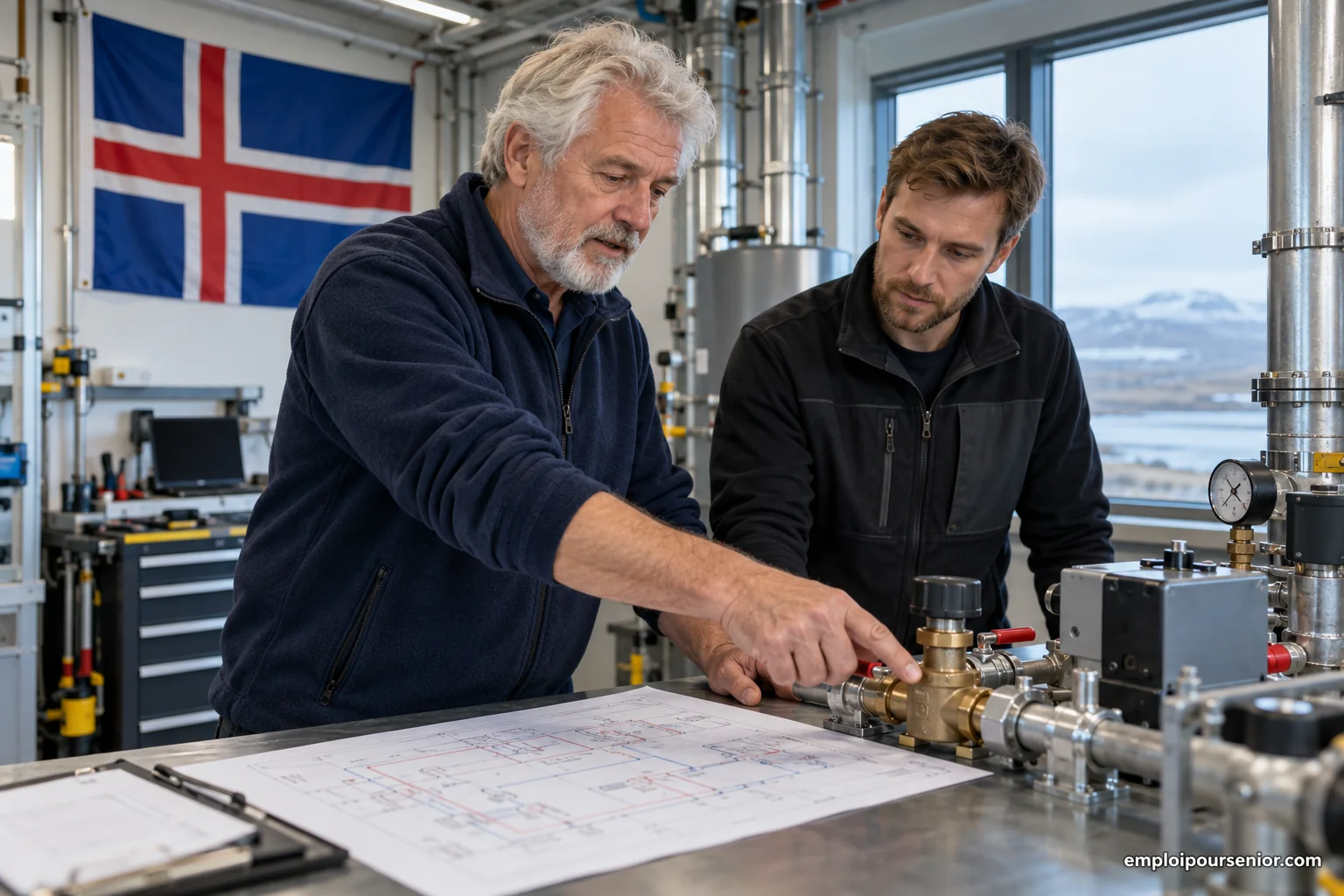
A small labour market with strong collective rules
Iceland has a small population and a very structured job market. Collective agreements set minimum pay and many working conditions sector by sector, and they apply to employees whether or not they belong to a union. Union membership is high, and staff representatives play a real part in workplaces.
In practice, a contract must respect the agreement for the sector in question, and a written document is required for jobs above a certain length and number of hours. Standard full-time work is about 40 hours a week, with minimum rest periods and supplements for night and weekend hours.
For an older worker this has one advantage: the rules are easy to read. It does mean reading the agreement that covers the post carefully before comparing two offers.
Language: the first obstacle to measure honestly
Icelandic is the main language of the labour market, and most adverts are written in it. A few vacancies, notably in tourism, catering, hotels or certain technical services, are published in English or accept fluent English. Adverts carried by the European EURES network must, according to the information available, include an English version.
A realistic approach for a French-speaking candidate is to:
- list the posts that accept English without Icelandic;
- separate hands-on tasks, where English is sometimes enough, from those involving customers, official documents or safety instructions in Icelandic;
- consider Icelandic lessons, often offered by adult education centres and sometimes supported by trade unions.
If the working language of a post is unclear, put a direct question to the employer before deciding to move.
Residence and permission to work, depending on nationality
Citizens of the European Union and the European Economic Area can generally work and live in Iceland without a specific residence permit, but they must register with the national registry for a stay of more than a few months. Citizens of other countries need to look into the residence and work permit conditions with the competent authority.
Whatever your situation, you should:
- check the up-to-date procedures on Iceland's official public services portal;
- avoid extending a stay without registering, since that can affect later rights;
- obtain a national identification number, needed for a contract, a bank or insurance;
- find out about health cover, which may start after a waiting period or straight away with the right certificates from your home country.
A job offer, even a firm one, does not guarantee that a permit will be granted: the two follow separate procedures.
Pension age and foreign pensions
In Iceland the usual age for the public pension is 67, with options to retire earlier or defer depending on the funded pension schemes, and a compulsory retirement age in the public sector. Every employee pays into an occupational pension fund, and the amount of the public pension depends partly on the number of years of residence between the ages of 16 and 67.
For someone who has already claimed pension rights in France, Belgium or Switzerland, several questions arise:
- does the foreign pension continue to be paid if you live in Iceland?
- do new years of work earn local rights?
- is tax on the combined income altered by agreements between countries?
These points should be put separately to each fund concerned, without presuming the answer. This site gives no individual advice on pensions or tax.
Where to find vacancies: public portal, private sites, agencies
Several sources complement each other. The Directorate of Labour publishes vacancies registered with the employment services, with filters by region and by percentage of working time. Private platforms such as Alfreð list hundreds of adverts with filters for contract type, location and language skills required. Local recruitment firms also post jobs and accept speculative applications.
Personal contacts still count for a lot in a country where people easily know one another: telling those around you, approaching employers directly and joining in local life are all common methods.
Have a CV and a cover letter ready, as is usual, along with a clear summary of your availability, especially if the post is seasonal or part-time.
What kinds of jobs suit an experienced profile
Tourism, accommodation, catering, construction, fishing and fish processing, technical services and education are among the sectors that recruit regularly. For an older worker, roles in coordination, reception, maintenance, training or group guidance can suit when the working language is workable.
A former technician, for instance, can explain how an installation works to a team; someone from the hotel trade can run a front desk in a tourist region. In both cases the hours can vary greatly: evening presence, weekends, busy periods.
It is important to ask how call-outs and cover are shared out, how long the journey is between home and workplace, and what winter weather conditions must be allowed for when travelling.
Housing, climate and daily life: very practical constraints
Beyond the contract, daily life weighs on the decision. The cost of housing, particularly in the capital region, can swallow much of your income. In some rural or coastal areas the supply of homes is limited and depends on the tourist seasons.
Several things are worth checking before you commit:
- whether housing is available near work, and what it really costs with bills;
- transport in winter, when roads can be difficult;
- daylight hours, which vary hugely by season and can affect energy and mood;
- access to healthcare and a pharmacy, which is further away in isolated areas.
A trial stay of a few weeks before moving often lets you gauge these constraints at modest cost.
A short assignment rather than a permanent move
For an older worker the choice is not necessarily between staying put and settling for good. A seasonal or one-off assignment can serve as a test: it gives a feel for the working atmosphere, the language and the cost of living without committing the rest of your life.
For this kind of assignment, it helps to get the following confirmed in writing:
- the start and end dates;
- the exact place and hours;
- the costs left to the employee, such as housing or transport;
- the social protection scheme that applies during the assignment.
By way of illustration, a former French technician aged 60 might consider a few months' work in a hotel on the south coast, checking in advance what accommodation is provided. The example is theoretical and implies no real vacancy.
Precautions and good habits before you leave
A few points come up often for people thinking of working in Iceland:
- read the sector's collective agreement and ask for a written contract;
- keep residence, pension, tax and health as separate questions, each to be settled with the competent body;
- avoid any offer that asks for money before you are hired;
- keep identity documents, career records and insurance papers in a file that is easy to produce;
- set aside an emergency budget for a return trip if the job does not work out.
These precautions do not remove the uncertainty, but they reduce the risk of being left without a solution in a country whose language and ways of working are far from what French speakers are used to.
Frequently asked questions
Can you work in Iceland without speaking Icelandic?
For some posts it is possible, notably in tourism, hotels or technical services, where English may be enough. Most adverts are still written in Icelandic, and tasks involving the public or official documents may require it. It is better to ask the employer before committing.
Does a European Union citizen need a work permit?
Generally not: citizens of the European Union and the European Economic Area can work and live in Iceland, but must register for a longer stay. Other nationalities need to check the permit conditions. The rules change, so confirm them with the official Icelandic services.
At what age can you retire in Iceland?
The usual age for the public pension is 67, with options to retire earlier or defer depending on pension funds, and a compulsory age in the public sector. The amount depends partly on years of residence in the country. For a personal situation, ask the competent bodies directly.
Where can I find job vacancies in Iceland?
You can check the Directorate of Labour vacancies, private platforms such as Alfreð, the European EURES network and local recruitment firms. Speculative applications and personal contacts remain important. It helps to filter adverts by the language required and the percentage of working time.
Do collective agreements apply to every employee?
In Iceland they set minimum pay and many working conditions for a given sector, whether or not the employee belongs to a union. A contract that contradicts the applicable agreement is not valid. It is therefore wise to find out about the sector's agreement before comparing offers.
Is it better to try a short assignment before moving?
It is a prudent approach. A seasonal or one-off assignment lets you assess the language, climate, housing and working rhythm without committing to a complete change of life. It is advisable to get the dates, place, hours and any costs you must cover confirmed in writing.