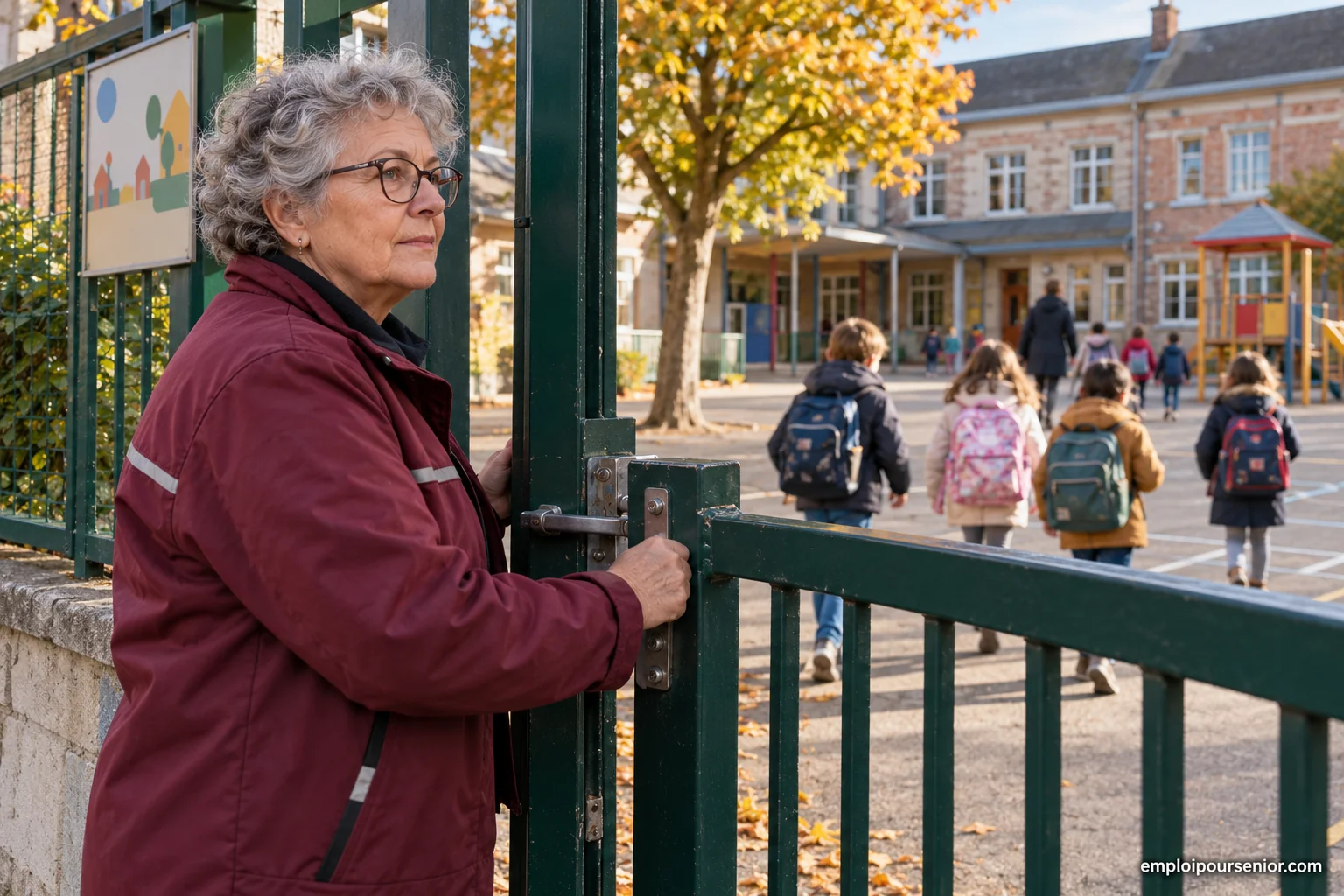
A presence post serving the school site
In a school, the caretaker looks after the premises rather than the pupils. They open the gates and doors, control access, receive deliveries and visiting workers, collect post and parcels, and report whatever stops working: a stuck lock, faulty lighting, a leak, damage.
Most often they work for a municipality, which in France is the employer responsible for the buildings of public nursery and primary schools. Depending on the town, the post may also be called reception officer, lodge attendant or caretaker-concierge. The job title varies and so do the real duties, so it pays to read each advert carefully.
The job is neither teaching nor activity leading. The caretaker has no educational role with the children, even though a calm manner and a daily presence contribute to the atmosphere of the school.
Everyday tasks, depending on the local authority
Adverts published by councils generally describe a mix of several strands.
- Guarding and monitoring: checking entrances and exits, looking over the surroundings, opening and locking the premises.
- Reception: answering questions from families and visitors, handling calls, post and parcels.
- Routine upkeep: cleaning some areas, managing bins and recycling, keeping track of cleaning supplies.
- Reporting technical problems: passing repair requests to the relevant departments and following them up.
- Safety: knowing the fire instructions and the procedures for an intrusion or incident.
In some cases neighbouring sports facilities are also covered. The share of cleaning, handling and minor DIY varies greatly from one site to another and should be clarified before applying.
Why this post can appeal to a senior
Qualities built up during a career come in directly useful: punctuality, observation, discretion, calm in the face of the unexpected, ease with families. Former receptionists, building caretakers, military personnel, technical staff or office workers can find familiar ground here.
The post often offers a stable framework, hours that follow the rhythm of the school and daily human contact without sales pressure. It suits people who prefer regular activity to very intellectual work.
It does, however, call for ordinary good physical condition: standing, moving along corridors and across the playground, climbing stairs, handling keys and small equipment. Anyone with back or joint problems should talk about them frankly before committing.
Status, contract and recruitment conditions
School staff are in principle employees of the French local public service, in category C, in administrative or technical job groups. Entry is by competitive exam or, for the first grade, by direct recruitment without an exam. Councils also use contract staff, for example to cover an absent employee, on fixed-term contracts.
A few markers, to be confirmed for each advert:
- the qualification level asked for is often modest (a vocational certificate or equivalent), but experience is valued;
- the length of the contract and the application deadline are stated in the advert;
- pay is not always specified and follows the local authority’s scale;
- the post may be full time or part time.
For a retired person, whether pension and pay can be combined depends on their pension scheme and circumstances: enquire before signing a contract.
Hours, split shifts and school holidays
The working day can be long: early opening, presence during arrival and departure times, closing in the evening. Breaks in the middle of the day are possible, which can make a second activity or long journeys difficult.
Before applying, ask precise questions:
- What time does the shift begin and end?
- Is there cover to provide during school holidays, or are leave dates imposed?
- Does the post include evenings or weekends for events, elections or hall hire?
- Which exceptional call-outs may be requested, such as opening up after an alarm?
This information is not always in the advert; the council’s human resources department or education department can supply it.
Tied accommodation: an option to examine closely
Some adverts mention a resident caretaker, others a non-resident one. Housing granted because the job requires it may seem practical, but it ties your home to the job: if the contract ends, the question of rehousing arises. It also means greater availability, since living on site can lead to requests outside working hours.
For a senior, these points deserve thought, especially when a partner, relatives or medical follow-up make a stable home important. It is advisable to ask in writing about the terms of occupation, the charges, the duration and what happens when the assignment ends.
Many current adverts concern non-resident posts. In that case the employee keeps their own home and a personal life separate from the site.
Building a credible application
A short CV centred on the skills useful for the post is better than a long history. Highlight experience in reception, key management, building supervision, security or dealing with the public, and illustrate each with a precise fact.
The covering letter, addressed to the local authority named in the advert, can be brief: why this post, what availability, which qualities. Mention a first-aid certificate or fire-safety training if you have one, without exaggerating.
Example of an argument
As an example, a former shop manager recalls that he opened and closed the site every day, checked deliveries, reported breakdowns to the technical department and welcomed customers of all ages. He links these tasks to the duties described by the municipality. A concrete comparison of this kind is more convincing than a list of general qualities.
Where to look for vacancies and how to prepare
Councils publish their recruitment on several portals dedicated to local-government jobs, on their own websites and sometimes on public employment service sites. Setting up alerts with the words school caretaker, reception officer or lodge attendant (in French, gardien d’école, agent d’accueil or agent de loge) helps you not to miss an advert. Cover posts are more frequent at certain times of year, especially around the start of the school year.
An unsolicited application to a council’s education department is also possible, with no guarantee of a reply. Some councils keep a pool of substitutes for unexpected absences.
Preparing for the interview means rereading basic safety instructions, thinking of situations you have lived through (an unwelcome visitor, a breakdown, a conflict to defuse) and asking about the training provided on arrival.
Pitfalls to avoid and related paths
The first pitfall is to confuse this post with pupil supervision or activity leading: it is a job tied to the premises. The second is to underestimate the tiredness of a long working day repeated over several months. The third is to commit without having read the conditions on accommodation, on combining work with a pension or on renewal of the contract.
If this post does not suit you, similar activities exist: reception officer in a public institution, caretaker of a sports or cultural facility, maintenance worker for municipal buildings, school-transport escort, exam invigilator on occasional assignments. Each has its own rhythm and conditions, and none should be considered a given.
Frequently asked questions
Does a school caretaker look after the children?
No, not in the educational sense of supervising them. The job concerns the buildings: access, welcoming visitors, reporting faults and routine upkeep depending on the council. The caretaker sees pupils every day and should be kind and vigilant, but looking after the children is the task of teachers and activity leaders.
Is there an age limit for being hired?
As a general rule, the French public service does not use age as a recruitment criterion for this kind of post, but each candidate’s situation can differ, particularly for a retired person. The precise conditions are in the advert or available from the human resources department of the authority that is recruiting.
Can you be a school caretaker and retired?
It is possible, for instance on a cover contract, but combining a pension with pay depends on the pension scheme and the rules applying to the public employer. Enquire with your pension fund before accepting, so that you know the exact effect on your entitlements.
Does the job always include cleaning?
Not always. Some adverts mention cleaning specific areas, handling waste and monitoring cleaning products; others concentrate on reception and monitoring entrances. The exact share is found in the description of each post and confirmed at the interview.
What qualification do you need?
For category C jobs, a vocational certificate level is often asked for, or even no specific qualification for direct recruitment at the first grade. Experience in reception, security or building maintenance often counts as much as the certificate. Each advert states its own conditions.
How do you know whether a vacancy is still open?
Each advert gives an application deadline and sometimes the start date. Cover vacancies are filled quickly. It is best to check on the authority’s website or contact its human resources department before sending an application, especially if the advert has been relayed on several sites.